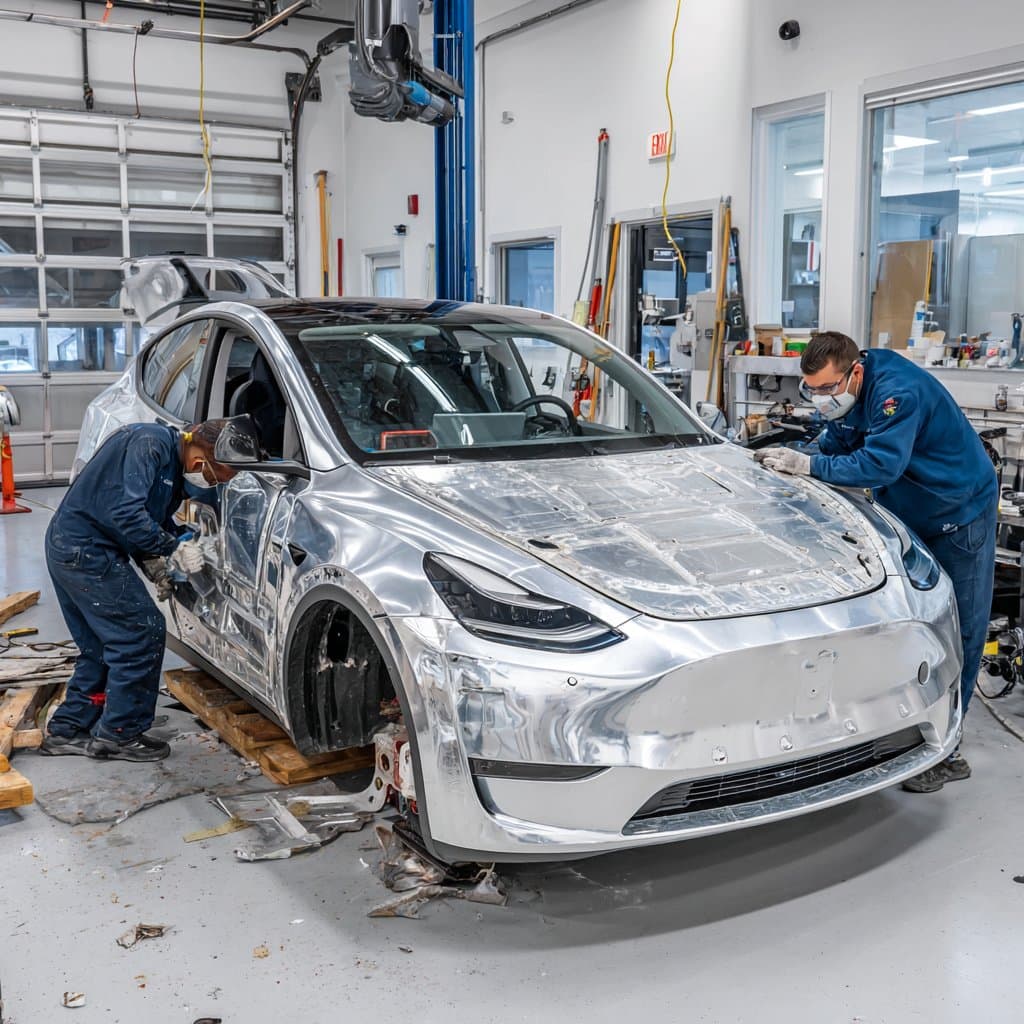
Finding the right EV collision repair near me after an accident is critical for your safety and your vehicle's integrity. Electric vehicles have unique requirements that traditional body shops simply aren't equipped to handle. From high-voltage battery systems to aluminum body construction, electric car accident repair cost considerations, and Tesla body shop certified requirements, this guide covers everything EV owners need to know.
Why EV Collision Repair Is Different
Electric vehicles present unique challenges that require specialized training, equipment, and safety protocols. Taking your Tesla, Rivian, or other EV to an uncertified shop can result in unsafe repairs, voided warranties, and potential safety hazards.
High-Voltage Battery Safety
The most critical difference is the high-voltage battery system. Modern EVs operate at 400-800+ volts—enough to cause serious injury or death if improperly handled. Before any collision repair begins, technicians must properly isolate and de-energize the battery system following manufacturer-specific procedures.
Certified shops have technicians trained in high-voltage safety, proper personal protective equipment (PPE), and the diagnostic tools needed to safely work around these systems. They understand the risks of thermal runaway and know how to identify battery damage that may not be immediately visible.
Aluminum and Mixed-Material Construction
Many EVs, particularly Teslas, use extensive aluminum construction to offset battery weight. Aluminum requires completely different repair techniques than traditional steel—different welding methods (MIG pulse welding), specialized rivet systems, and dedicated tools that can't be cross-contaminated with steel particles.
Using steel repair techniques on aluminum compromises structural integrity and can lead to galvanic corrosion. Certified EV repair shops maintain separate aluminum-only repair areas with dedicated tools and equipment.
EV-Specific Repair Requirements
- ⚡Battery isolation protocols – Must be performed before any repair work
- ⚡Aluminum-specific welding – MIG pulse or resistance spot welding required
- ⚡Structural scanning – 3D measuring to verify frame alignment
- ⚡ADAS calibration – Required after windshield or structural repairs
- ⚡OEM parts requirement – Often mandatory for safety-critical components
Finding a Tesla Certified Body Shop
Tesla maintains a network of Tesla body shop certified facilities that have invested significantly in training, tooling, and equipment. These shops must meet Tesla's rigorous standards and maintain ongoing certification through continued education and audits.
What Tesla Certification Requires
- ✓Technicians complete Tesla-specific training programs
- ✓Access to Tesla repair procedures and technical documentation
- ✓Investment in specialized aluminum repair equipment ($100,000+)
- ✓High-voltage safety equipment and dedicated EV repair bays
- ✓Direct ordering access to Tesla OEM parts
- ✓ADAS calibration equipment for Autopilot systems
You can find Tesla-approved body shops through the Tesla app or website. While you're legally allowed to use any shop, using a certified facility ensures repairs meet Tesla's standards and maintains your warranty coverage.
Other EV Manufacturer Certifications
Other EV manufacturers have similar certification programs:
Rivian
Rivian Certified Collision Network
Lucid
Lucid Certified Collision Center
Ford EV
Ford Certified Aluminum Repair
Porsche Taycan
Porsche Certified Collision
Electric Car Accident Repair Cost
Understanding electric car accident repair cost helps set realistic expectations. EV repairs typically cost 25-50% more than equivalent repairs on traditional vehicles due to specialized labor, equipment requirements, and parts costs.
Typical EV Repair Cost Ranges
Dent repair, paint blend
With sensors, paint match
Aluminum panel, structural
Frame work, multiple panels
Why EV Repairs Cost More
Several factors contribute to higher repair costs:
- •Specialized labor rates – Certified EV technicians command higher wages
- •OEM parts requirements – Aftermarket alternatives often not available or approved
- •Aluminum repair complexity – More time-intensive than steel repairs
- •ADAS calibration – Adds $500-$1,500 to many repairs
- •Battery inspection – Required after impacts, adds diagnostic time
The EV Collision Repair Process
Understanding what happens when your EV goes in for collision repair helps you know what to expect:
Step 1: Initial Assessment and Battery Safety
Before anything else, technicians assess the vehicle for high-voltage safety. They check for battery damage indicators, isolate the high-voltage system, and verify it's safe to proceed. If battery damage is suspected, additional diagnostic procedures are required.
Step 2: Damage Documentation
The vehicle is thoroughly documented with photos and 3D scanning to identify all damage, including hidden structural issues. This documentation is crucial for insurance claims and ensures nothing is missed during repair planning.
Step 3: Repair Planning and Parts Ordering
A detailed repair plan is created following manufacturer procedures. OEM parts are ordered—note that Tesla parts availability can sometimes cause delays, though this has improved significantly in recent years.
Step 4: Structural and Body Repairs
Repairs proceed following strict manufacturer guidelines. Aluminum panels require specialized techniques—they can't be heated and hammered like steel. Structural repairs must meet exact specifications verified by 3D measuring systems.
Step 5: Paint and Finishing
Tesla and other EV manufacturers use specific paint formulations that require proper color matching and application techniques. Quality shops use computerized color matching and spray techniques that ensure seamless blending.
Step 6: ADAS Calibration and Testing
After reassembly, all affected sensors and cameras must be calibrated. This includes Autopilot cameras, ultrasonic sensors, and radar systems. The vehicle is test-driven to verify all systems function correctly before delivery.
Insurance Considerations for EV Collision Repair
Working with insurance companies on EV repairs can be challenging. Here are tips for a smoother process:
- 1.Insist on certified shops – Don't let insurers steer you to uncertified facilities
- 2.Request OEM parts – Document why aftermarket parts aren't acceptable for safety
- 3.Get manufacturer repair procedures – These support the certified shop's repair plan
- 4.Document everything – Keep records of all communications and decisions
- 5.Know your policy – Review coverage for OEM parts and certified repairs
Questions to Ask a Collision Repair Shop
Before choosing a shop for your EV repair, ask these important questions:
- ?Are you certified by my vehicle's manufacturer?
- ?Do your technicians have high-voltage safety training?
- ?Do you have dedicated aluminum repair equipment?
- ?Can you perform ADAS calibration in-house?
- ?Do you use OEM parts or will you source aftermarket?
- ?What warranty do you offer on repairs?
Final Thoughts
Finding qualified EV collision repair near me requires more research than traditional vehicle repairs, but it's essential for your safety and your vehicle's integrity. The unique construction, high-voltage systems, and advanced technology in electric vehicles demand specialized expertise.
Always choose a manufacturer-certified shop when possible, insist on OEM parts for safety-critical repairs, and don't let cost pressure compromise the quality of your repair. Your EV represents a significant investment—protect it by ensuring repairs are done correctly the first time.