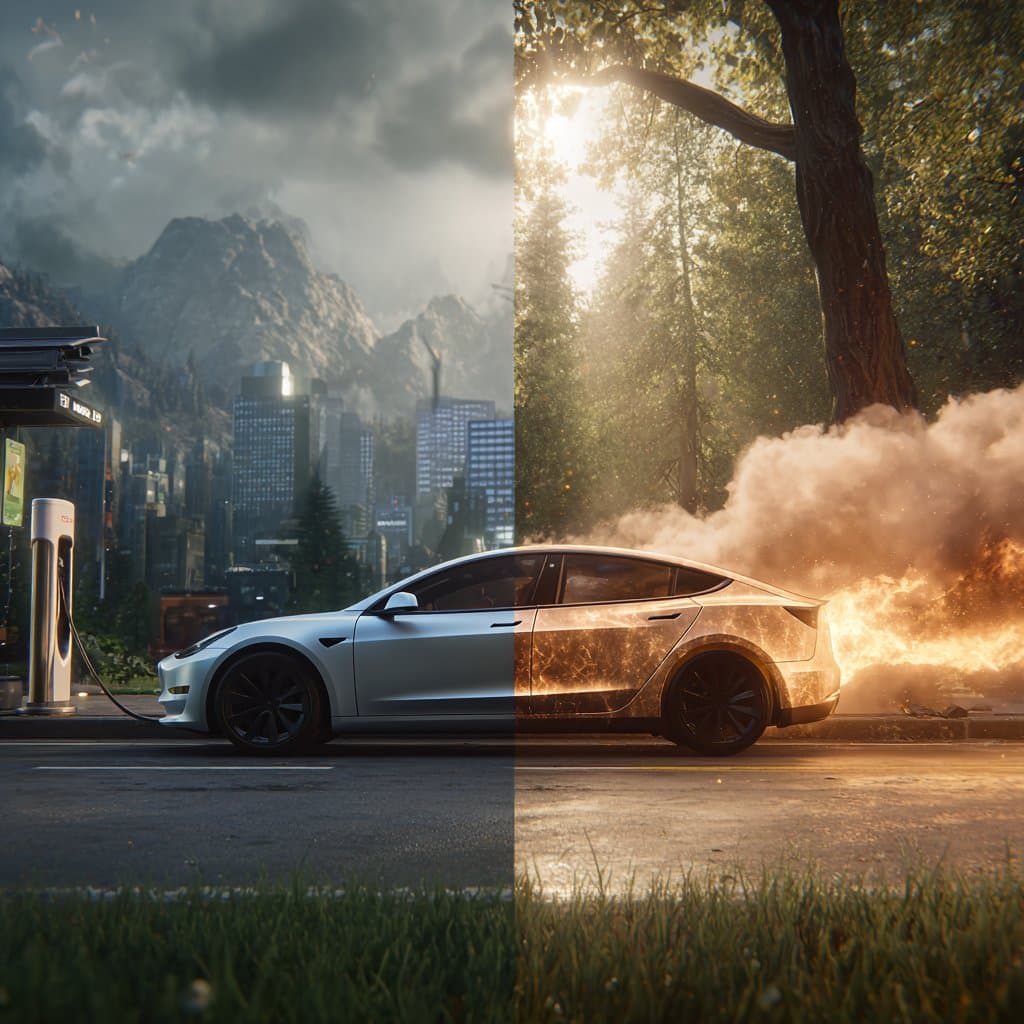
It's a question that sparks heated debates: Are electric cars actually better for the environment, or are we just shifting pollution from tailpipes to power plants and mining operations? The answer isn't as simple as "yes" or "no"—but when you look at the complete lifecycle data, a clear picture emerges. This comprehensive analysis examines the environmental impact of electric vehicles versus gas cars, from manufacturing to disposal.
The Lifecycle Approach: Why It Matters
To fairly compare EVs and gas cars, we need to look at the entire lifecycle: raw material extraction, manufacturing, fuel/electricity production, driving emissions, and end-of-life disposal. Critics often focus on one stage (usually battery manufacturing) while ignoring others. A complete analysis tells a different story.
Lifecycle Stages Compared
Manufacturing: The Carbon Debt
Let's address the elephant in the room: EV manufacturing does produce more CO2 than gas car manufacturing, primarily due to battery production. A typical EV battery creates 8-16 tons of CO2 during production, depending on battery size and manufacturing location.
This means an EV starts life with a "carbon debt" compared to a gas car. However, this debt is paid off relatively quickly through cleaner operation—typically within 1-3 years of average driving.
Manufacturing Emissions Comparison
Note: EV manufacturing emissions are decreasing as battery production becomes cleaner and more efficient.
The Good News: Manufacturing Is Getting Cleaner
Battery manufacturing emissions are dropping rapidly. Tesla's Gigafactory Nevada uses solar power. CATL and other Asian manufacturers are transitioning to renewable energy. New battery chemistries like LFP (lithium iron phosphate) have lower production emissions. By 2030, manufacturing emissions per kWh of battery are expected to drop by 50%.
Driving Emissions: Where EVs Excel
Gas cars emit CO2 continuously while driving—about 4.6 metric tons per year for an average vehicle. EVs produce zero direct emissions. But what about the electricity used to charge them?
Even when charged from the current US grid (which still relies partly on fossil fuels), EVs produce significantly fewer emissions than gas cars. And as the grid gets cleaner, EVs automatically become even more environmentally friendly.
Annual CO2 Emissions by Electricity Source
The Grid Is Getting Cleaner
This is crucial: the environmental advantage of EVs grows over time. In 2010, the US grid was 45% coal. By 2025, it's under 20% and falling. By 2035, most projections show renewables dominating. An EV purchased today will become cleaner every year as the grid improves—a gas car just keeps polluting at the same rate.
The "Long Tailpipe" Argument
Critics argue EVs just move pollution from tailpipes to power plants—the "long tailpipe" theory. While technically true, this misses several key points:
- 1.Efficiency matters: Power plants convert fuel to electricity more efficiently than car engines. Even with transmission losses, EVs use energy more efficiently.
- 2.Centralized pollution is easier to control: It's simpler to reduce emissions from one power plant than millions of tailpipes.
- 3.Grid improvements benefit all EVs: When the grid gets cleaner, every EV becomes cleaner automatically.
- 4.Location matters: Moving emissions away from urban centers improves air quality where people live.
Mining and Raw Materials
Lithium, cobalt, nickel, and rare earth elements used in EV batteries require mining, which has environmental and social impacts. This is a legitimate concern that the industry is actively addressing.
The Reality Check
However, it's important to maintain perspective. Oil extraction is also environmentally destructive—oil spills, tar sands mining, fracking, and refinery pollution cause massive ongoing damage. The difference is that battery materials are mined once to build a product lasting 15-20 years, while oil is extracted continuously throughout a gas car's life.
Material Usage: EV Battery vs Gas Car Fuel
EV (150,000 miles)
~30 lbs lithium, ~30 lbs cobalt, ~110 lbs nickel (mined once, recyclable)
Gas Car (150,000 miles)
~15,000 gallons of gasoline (continuously extracted, burned, gone forever)
Progress in Responsible Sourcing
The industry is making progress: LFP batteries eliminate cobalt entirely. Recycling technologies are improving—battery materials can be recovered and reused. Automakers are implementing ethical sourcing standards. New mining techniques are reducing environmental impact.
Battery Recycling and Second Life
What happens to EV batteries at end of life? This used to be a concern, but solutions are emerging rapidly.
Battery End-of-Life Options
Second Life Applications
Batteries degraded below EV standards (70-80% capacity) still work great for stationary energy storage—powering homes, buildings, or grid backup for another 10+ years.
Recycling
95%+ of battery materials can be recovered. Companies like Redwood Materials (founded by Tesla's former CTO) are building large-scale recycling facilities.
Closed Loop Manufacturing
Recovered materials go back into new batteries, reducing the need for new mining.
The Complete Picture: Lifecycle Analysis
Multiple independent studies have compared the total lifecycle emissions of EVs versus gas cars. The consensus is clear:
Lifetime CO2 Emissions (150,000 miles)
EVs produce 50-75% less lifetime CO2 than gas cars.
Beyond Carbon: Other Environmental Benefits
CO2 isn't the only environmental consideration. EVs offer additional benefits:
- •Zero local emissions: No NOx, particulates, or CO in urban areas where people live
- •Reduced noise pollution: Electric motors are nearly silent
- •No oil changes: Eliminates motor oil disposal issues
- •Regenerative braking: Reduces brake dust (a significant urban pollutant)
- •Grid stabilization: EV batteries can help integrate more renewable energy
Final Verdict: Yes, EVs Are Better
Are electric cars better for the environment? The evidence is clear: yes, significantly so. While EVs aren't perfect and do have environmental impacts, they produce substantially less pollution and CO2 over their lifetime than gas vehicles.
Key takeaways:
- ✓EVs produce 50-75% less lifetime CO2 than gas cars
- ✓The environmental advantage grows as the grid gets cleaner
- ✓Manufacturing emissions are decreasing rapidly
- ✓Battery recycling is solving end-of-life concerns
- ✓EVs eliminate local pollution where people live and breathe
The shift to electric vehicles is one of the most impactful changes individuals can make to reduce their environmental footprint. While we should continue pushing for cleaner manufacturing and responsible material sourcing, driving an EV today is definitively better for the environment than driving a gas car.