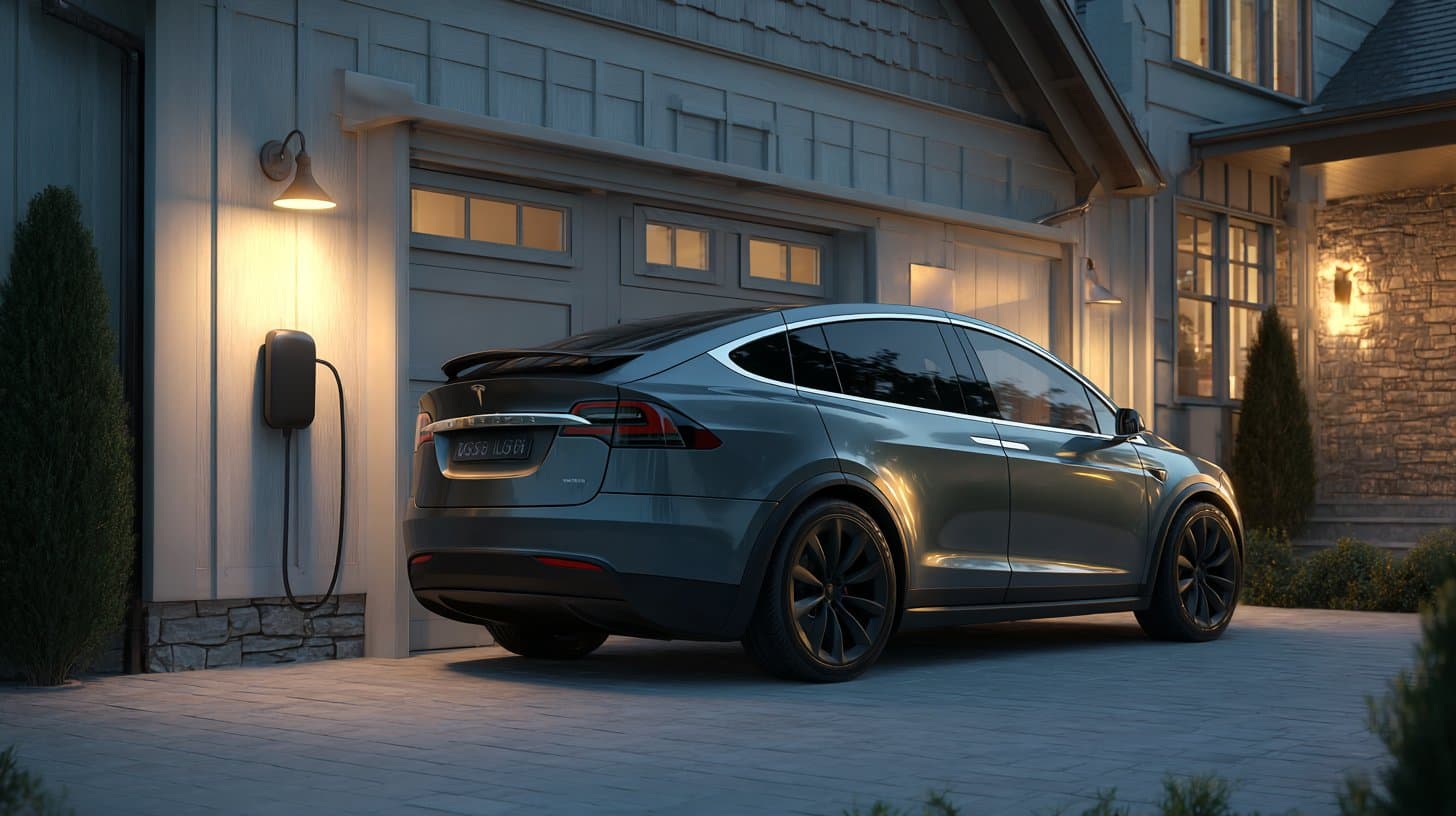
One of the biggest advantages of owning an electric vehicle is that you can “fill up” at home while you sleep. No gas stations. No detours. You leave every morning with a full battery.
But setting up home charging properly requires some understanding of the options. This guide covers everything you need to know about charging your EV at home — from the basic differences between charging levels to equipment recommendations, installation costs, and how to take advantage of available tax credits.
The Three Levels of EV Charging
Level 1: Standard Household Outlet (120V)
Level 1 charging uses a standard 120V household outlet — the same outlets your lamps and phone chargers use. Every EV comes with a Level 1 charging cable in the box.
How fast is it?
- Approximately 3–5 miles of range per hour of charging
- A full charge (for an EV with 250 miles of range) takes approximately 50–80 hours
Is it enough?
For most EV owners, Level 1 charging alone is not sufficient as a primary charging method. If you drive 40 miles per day, you need 8–12 hours of Level 1 charging overnight just to break even — which leaves no buffer and assumes perfectly timed overnight charging.
When Level 1 works:
- You drive fewer than 30–40 miles per day
- You have a second Level 2 charging option (at work, for example)
- You're using the EV as a secondary vehicle with infrequent use
Cost: $0 — you already have the outlet and the cable came with the car.
Level 2: The Home Charging Sweet Spot (240V)
Level 2 charging uses a 240V circuit — the same voltage as your dryer, electric oven, or central air conditioning unit. This is the standard home charging setup for EV owners and the clear recommendation for anyone using an EV as a primary vehicle.
How fast is it?
- Approximately 20–30 miles of range per hour of charging
- A full charge (250-mile EV) takes approximately 8–12 hours overnight
- Most owners plug in at bedtime and wake up fully charged
Equipment needed:
A Level 2 home charger (also called EVSE — Electric Vehicle Supply Equipment) is a wall-mounted or portable unit that connects to the 240V circuit and provides charging at a controlled rate. The charger communicates with the vehicle to manage charge rate, temperature, and safety cutoffs.
Best Level 2 Home Chargers for 2026:
| Charger | Max Output | Price | Best For |
|---|---|---|---|
| ChargePoint Home Flex | 50A / 12 kW | $549 | Best overall — adjustable amperage, works with all EVs |
| Wallbox Pulsar Plus | 48A / 11.5 kW | $649 | Best smart features — scheduling, energy monitoring |
| Grizzl-E Classic | 40A / 9.6 kW | $269 | Best budget option — simple, reliable, weatherproof |
| Tesla Wall Connector | 48A / 11.5 kW | $425 | Best for Tesla owners — native integration, no adapter needed |
| JuiceBox 48 | 48A / 11.5 kW | $549 | Best for energy management — time-of-use rate optimization |
Installation cost:
Installing a Level 2 home charger requires a 240V dedicated circuit, which must be installed by a licensed electrician. Typical installation cost ranges from $200–$1,000 depending on:
- Distance from your electrical panel to the charger location
- Whether your panel needs an upgrade to support the additional load
- Local labor rates and permit requirements
Total first-year cost including charger unit + installation: typically $500–$1,500.
Federal Tax Credit:
The federal government offers a 30% tax credit on home EV charger installation costs (equipment + installation), up to a maximum credit of $1,000, through 2032. This significantly reduces the net cost of installing a Level 2 charger.
Level 3 / DC Fast Charging (DCFC): For Road Trips Only
DC Fast Charging (DCFC) — also called Level 3 — is the type found at public fast charging stations: Tesla Superchargers, Electrify America, EVgo, ChargePoint DC, and similar networks.
How fast is it?
- 150–350+ kW of charging power
- 10–80% charge in 20–40 minutes for most EVs
- Adds 100–200 miles of range per 20–30 minutes
Is DCFC available for home installation?
Technically yes, but practically no for most homeowners. A proper commercial-grade DC fast charger costs $50,000–$100,000+ for equipment alone, requires a 480V three-phase electrical service (not available in residential areas in most of the US), and draws enough power to require utility-level infrastructure upgrades. Home DCFC is not a realistic option for the vast majority of EV owners.
When you'll use DCFC:
- Long road trips (to add range quickly between stops)
- Emergency top-ups when home charging wasn't sufficient
- If you live in an apartment without home charging access
The economics of public DCFC are less favorable than home charging — typically $0.30–$0.50/kWh vs $0.10–$0.17/kWh at home. Use it when you need speed; home Level 2 charging is the cost-efficient everyday solution.
How to Set Up Level 2 Home Charging: Step by Step
Step 1: Assess Your Electrical Panel
Open your main electrical panel and look for available breaker slots. You'll need a dedicated 40–50 amp double-pole breaker for a Level 2 charger. If your panel is full or has limited capacity, an electrician can assess whether an upgrade is needed (cost: $1,500–$4,000 for a panel upgrade, if required).
Most homes built after 1990 have 200-amp panels with enough capacity to add a 40–50 amp EV circuit without upgrading.
Step 2: Choose Your Charger
For most homeowners, the ChargePoint Home Flex (adjustable 16–50 amps) or Grizzl-E Classic (40 amps fixed) are excellent choices that work with every EV on the market. Tesla owners can use the Tesla Wall Connector for native integration, though any Level 2 charger works with Tesla via the included adapter.
Key specs to look for:
- At least 40 amps (provides 9.6 kW) — sufficient for overnight charging of any current EV
- NEMA 14-50 plug or hardwired — electrician will advise based on your setup
- Smart features (optional but useful) — scheduling to charge during off-peak electricity hours, energy monitoring, and app control
Step 3: Hire a Licensed Electrician
Always use a licensed electrician for EV charger installation. The work involves 240V circuits that must be permitted and inspected in most jurisdictions. An unlicensed installation may void your homeowner's insurance and could be flagged during home sale.
Get two or three quotes. Prices vary significantly by market and job complexity.
Ask the electrician specifically about:
- Total cost including permits and inspection
- Timeline (most jobs are completed in 2–4 hours)
- Whether a panel upgrade is needed
Step 4: Apply for Tax Credit and Utility Rebates
After installation, save all receipts. You'll claim the federal 30% charger tax credit (up to $1,000) on your annual tax return using IRS Form 8911.
Also check with your local utility company — many utilities offer additional rebates for EV charger installation ranging from $100–$500 or more. Some utilities also offer special EV time-of-use electricity rates that significantly reduce overnight charging costs.
Optimizing Home Charging Costs
Time-of-Use Rates
Many utilities offer Time-of-Use (TOU) electricity rate plans where electricity is cheaper during off-peak hours (typically 9 PM–6 AM) and more expensive during peak demand hours.
Setting your EV to charge during off-peak hours can reduce your charging cost by 30–50% in markets where TOU rates are available. All modern EVs and smart Level 2 chargers allow you to set a charging schedule.
Example: A utility offering $0.10/kWh off-peak vs $0.30/kWh peak rates means charging an EV with a 75 kWh battery overnight costs $7.50 at off-peak rates vs $22.50 at peak rates. Over a year, that's $585 vs $1,755 — a $1,170 annual difference.
Solar Charging
If you have or are considering rooftop solar, EV charging is one of the best uses for excess solar production. Pairing a solar system with a smart EV charger that can direct excess solar production to the car (rather than selling it back to the grid at low rates) can reduce your effective charging cost to near zero.
Several charger manufacturers (including Wallbox and ChargePoint) offer solar integration features that automatically maximize solar charging when production exceeds household demand.
Apartment and Condo Charging
If you don't own your parking space, home EV charging is more complicated but not impossible.
Options for apartment dwellers:
Talk to your building manager: Many states have “right to charge” laws that give tenants the right to request EV charging installation at their parking space at their own expense. Your building manager may be more open to this than you expect, especially if your state has a right-to-charge law.
Employer charging: If your workplace has EV charging (increasingly common), you may be able to charge fully at work and manage day-to-day needs without home charging.
Public charging: In major metropolitan areas, the density of Level 2 and DC fast chargers at parking garages, shopping centers, and dedicated charging stations has grown to the point where some urban EV owners manage entirely on public charging. This works better in some cities than others — evaluate the charging infrastructure in your specific neighborhood before committing.
Level 1 as a supplement: If you have a 120V outlet at your parking spot (some garages have these for block heaters in northern climates), Level 1 charging at 3–5 miles per hour can provide enough top-up for low-mileage urban drivers.
Home Charging FAQ
Can I use any Level 2 charger with my EV?
Yes. All EVs sold in the US (including Tesla, as of 2024) use the J1772 connector standard for Level 2 charging. Tesla vehicles come with a J1772 adapter. So any Level 2 charger will work with any EV.
How much does it cost to run Level 2 overnight?
At the US average electricity rate of $0.17/kWh, charging a 75 kWh battery from 20% to 90% costs approximately $8.50. At off-peak rates ($0.10/kWh), approximately $5.00.
Should I always charge to 100%?
No — most manufacturers recommend keeping daily charging at 80–90% to preserve battery health. Save 100% charges for long trip days. All EVs allow you to set a default charge limit.
Do I need a smart charger?
Not strictly necessary, but the scheduling feature (to charge during off-peak hours) pays for the premium over a basic charger in electricity savings within 6–12 months in most markets.
What gauge wire does the installation require?
A 50-amp circuit requires 6-gauge wire. A 40-amp circuit requires 8-gauge wire. Your electrician will handle this — just know the specs if you're reviewing a quote.
The Bottom Line
For most EV owners, the ideal home charging setup is simple: a Level 2 charger (40–50 amps) installed on a dedicated 240V circuit by a licensed electrician. Budget $500–$1,500 all-in, claim the federal tax credit, and you'll have a setup that reliably charges any current EV overnight for the life of the vehicle.
The time-of-use rate optimization — if your utility offers it — can pay for the charger in fuel savings within 12–18 months.
Home charging transforms EV ownership from a logistics exercise into a seamless daily habit. Plug in at night. Wake up charged. That's it.
Browse EV models with home charging specifications on our EV Deals page, or use our EV Match Tool to find the right EV for your home charging situation.