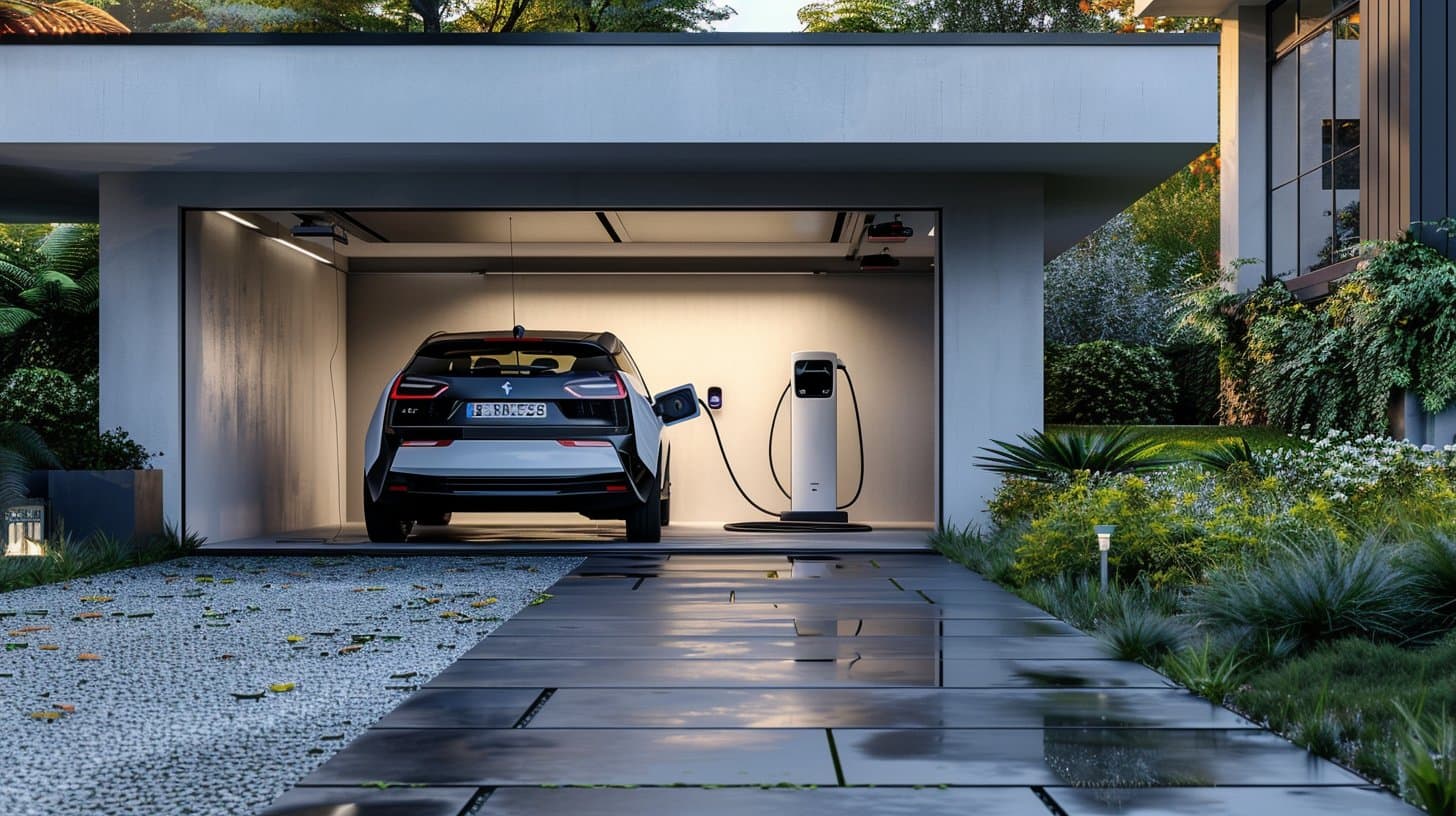
You bought an EV — now you need to charge it at home. The good news: installing a home EV charger in 2026 is simpler, cheaper, and faster than most people expect. The bad news: there's a lot of confusing information out there about levels, amps, volts, and installation requirements that makes the process seem more complicated than it actually is. This home EV charger installation guide cuts through the noise and gives you everything you need to know — from whether you even need a dedicated charger to exact installation costs, the best chargers to buy, permits, electrician selection, and the federal tax credit that covers 30% of your costs.
Do You Even Need a Home Charger?
Before spending money on installation, understand your options:
Level 1 Charging: The Free Option
Every EV comes with a Level 1 charger (also called a “trickle charger” or “mobile connector”) that plugs into any standard 120V household outlet. No installation needed — just plug it into your garage or outdoor outlet.
- Charging speed: 3–5 miles of range per hour (about 40–60 miles overnight)
- Best for: Drivers with short commutes (under 40 miles/day), plugin hybrids, or second cars
- Cost: $0 (included with your EV)
- Electricity cost: Same as your existing household rate
If you drive less than 40 miles per day, Level 1 charging may be all you ever need. Plug in when you get home, unplug when you leave — 12 hours of charging adds 36–60 miles, enough for most daily driving. Many EV owners start with Level 1 and upgrade to Level 2 only if they find it insufficient.
Level 2 Charging: The Sweet Spot
Level 2 chargers use a 240V outlet (like a dryer or oven) and charge 5–10 times faster than Level 1. This is what most EV owners install at home, and it's the focus of this guide.
- Charging speed: 25–40 miles of range per hour (full charge in 6–10 hours)
- Best for: Daily commuters, long-range EVs, families with multiple EVs
- Charger cost: $300–$700 for the unit
- Installation cost: $300–$1,500 depending on electrical panel and distance
- Total cost: $600–$2,200 before the tax credit
Step-by-Step Installation Process
Step 1: Assess Your Electrical Panel
This is the most important step and determines your installation cost. A Level 2 EV charger needs a dedicated 240V circuit with 40–50 amps. Your electrical panel needs available capacity for this circuit.
If your panel has available breaker spaces and capacity (most homes built after 2000): The electrician runs a new 240V circuit from the panel to the garage. This is the simplest and cheapest scenario: $300–$800 for installation.
If your panel is full or undersized (common in homes built before 1990): You may need a panel upgrade (from 100A to 200A service). This adds $1,500–$3,000 to the project but modernizes your entire home's electrical system. An alternative is installing a “smart splitter” or load-sharing device that shares a circuit with your dryer or water heater — avoiding a panel upgrade entirely for $200–$400.
If your garage is detached or far from the panel: Longer wire runs increase cost. Expect an additional $3–$6 per foot of wire run beyond the first 25 feet. A 75-foot run from the panel to a detached garage might add $200–$400.
Step 2: Choose Your Charger
There are two types of Level 2 chargers: hardwired and plug-in.
Hardwired chargers are permanently connected to the electrical circuit. They look cleaner and are slightly more reliable, but they can't be moved if you sell the house (without an electrician disconnecting them). Most professional installations use hardwired chargers.
Plug-in chargers connect to a NEMA 14-50 outlet (the same type as a dryer). They can be unplugged and moved — useful if you're renting, may move, or want to take the charger with you. The electrician installs the outlet, and you plug in the charger yourself.
Our recommendation: go with a plug-in charger and NEMA 14-50 outlet. It gives you flexibility and portability, and the outlet is useful even without the charger (for a welder, RV, or future EV).
Top Recommended Home EV Chargers
| Charger | Price | Amps | mi/hr | Best For |
|---|---|---|---|---|
| ChargePoint Home Flex | $399 | 16–50 | 37 | Best all-around |
| Grizzl-E Classic | $399 | 40 | 30 | Best durability |
| Lectron V-Box | $329 | 48 | 36 | Best value |
| Emporia Smart Charger | $449 | 48 | 36 | Best smart features |
| Tesla Wall Connector | $475 | 48 | 44 | Best for Tesla owners |
Step 3: Hire a Licensed Electrician
Do not DIY your EV charger installation unless you are a licensed electrician. This involves 240V wiring, dedicated circuits, and potentially working inside your electrical panel. Improper installation risks fire, electrocution, and voided homeowner's insurance.
How to find a good electrician:
- Get 3 quotes from licensed electricians in your area
- Ask specifically about EV charger installation experience — it's a specialty
- Check that they pull permits (required in most Florida counties)
- Verify their license at myfloridalicense.com
- Ask for references from other EV charger installations they've done
- Some EV charger manufacturers (ChargePoint, Emporia) have preferred installer networks
Step 4: Permits and Inspections
Most Florida counties require an electrical permit for EV charger installation. Your electrician typically handles the permit application. The process is usually:
- Electrician applies for permit ($50–$150 permit fee, usually included in their quote)
- Installation is completed
- County inspector visits to verify the work (usually within 1–2 weeks)
- Inspector approves — you're good to charge
The entire process from scheduling the electrician to charging your EV typically takes 1–3 weeks. The actual installation takes 2–4 hours for a standard installation.
Complete Cost Breakdown
| Scenario | Charger | Installation | Total | After 30% Credit |
|---|---|---|---|---|
| Simple (panel has capacity, short run) | $400 | $300 | $700 | $490 |
| Average (panel has capacity, moderate run) | $400 | $600 | $1,000 | $700 |
| Complex (panel upgrade needed) | $400 | $2,500 | $2,900 | $2,030 |
| Detached garage (long run) | $400 | $1,200 | $1,600 | $1,120 |
The Federal EV Charger Tax Credit
The federal Alternative Fuel Vehicle Refueling Equipment tax credit covers 30% of the total cost (charger + installation), up to $1,000 for residential installations. This credit applies to both new and retrofit installations.
- What qualifies: The charger itself, all installation labor, electrical materials, and permit fees
- How to claim: File IRS Form 8911 with your tax return
- Maximum credit: $1,000 for residential; $100,000 for commercial
- Eligibility: The charger must be installed at your primary or secondary residence in an eligible census tract
Some Florida utilities also offer charger installation rebates. FPL offers up to $250, Duke Energy offers $500, and Tampa Electric offers $200 for residential Level 2 charger installations. These stack with the federal credit.
Florida-Specific Installation Tips
- Outdoor installations: Florida's weather demands NEMA 4 rated (weatherproof) chargers for outdoor installations. Most quality chargers meet this standard, but verify before buying.
- Hurricane considerations: Mount outdoor chargers securely to walls, not freestanding posts that can topple in high winds. Consider a location sheltered from direct wind exposure.
- Surge protection: Florida has more lightning strikes than any other state. Install a whole-house surge protector ($200–$400) or a dedicated surge protector on the EV charger circuit to prevent lightning damage.
- Flooding: If your garage is in a flood-prone area, mount the charger and outlet at least 4 feet above floor level.
- HOA rules: Florida law (SB 50) prohibits HOAs from unreasonably restricting EV charger installations. However, HOAs can require reasonable architectural review. Notify your HOA before installation to avoid conflicts.
Smart Charging: Saving Money on Electricity
Once your charger is installed, smart charging features can reduce your electricity costs significantly:
Scheduled charging: Set your car or charger to start charging at midnight when off-peak rates kick in. FPL's off-peak rate is $0.06–$0.08/kWh compared to $0.12–$0.15/kWh during peak hours. This alone can cut your charging costs in half.
Solar pairing: If you have solar panels, charge during the day when your panels are producing excess electricity. This effectively makes your fuel free. A 7 kW solar system produces enough daily energy to charge an EV for 30–40 miles of driving — matching most commutes.
The Bottom Line
Installing a home EV charger is the single best investment you can make as an EV owner. The total cost — typically $700–$1,600 after the 30% tax credit — pays for itself within 6–12 months through electricity savings compared to gas. You'll wake up every morning with a full “tank,” never visit a gas station again, and enjoy the convenience that makes EV ownership genuinely effortless.
Start by checking your electrical panel's capacity, get three quotes from licensed electricians, choose a plug-in charger for flexibility, and don't forget to claim the 30% federal tax credit.
Shopping for an EV to charge at home? Browse our EV deals page for current pricing with all credits applied, or use our EV Match & Savings Hub to find the perfect EV for your driving needs.