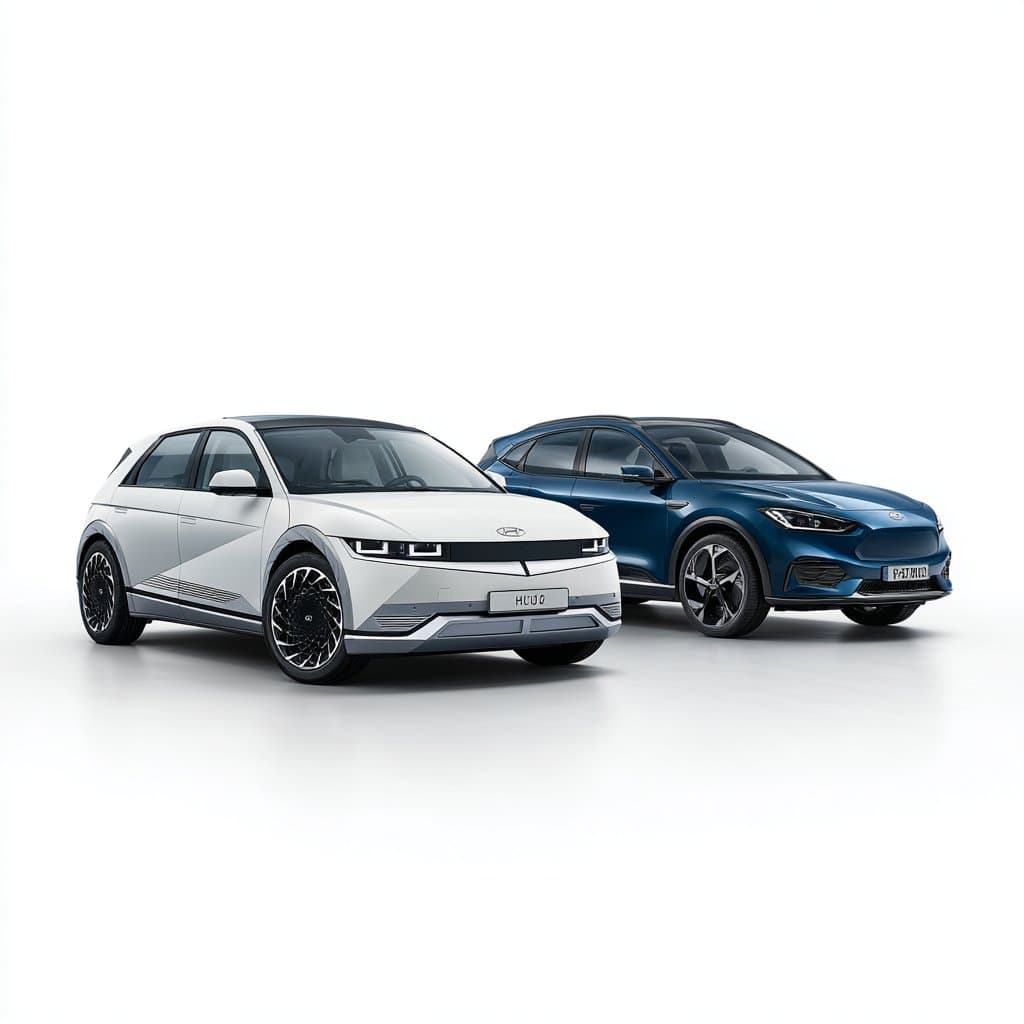
Same platform. Same battery. Same ultra-fast 800V charging. Very different cars.
The Hyundai Ioniq 5 and Kia EV6 share Hyundai Motor Group's E-GMP electric vehicle platform — the most technically capable EV architecture outside of Tesla in terms of charging speed. Under the skin, they're closely related. But above it, they're designed for entirely different buyers.
This is the complete 2026 comparison to help you decide which one is right for you.
Quick Specs Comparison
| Spec | Hyundai Ioniq 5 | Kia EV6 |
|---|---|---|
| Starting Price | $41,450 (SE Standard RWD) | $42,600 (Light Standard RWD) |
| Max Range | 303 miles (Long Range RWD) | 310 miles (Long Range RWD) |
| 0–60 mph (LR RWD) | 7.4 seconds | 7.4 seconds |
| 0–60 mph (top AWD) | 5.1 seconds (AWD) | 3.4 seconds (GT) |
| Max Charging Speed | 233 kW (800V) | 239 kW (800V) |
| 10–80% Fast Charge Time | ~18 minutes | ~18 minutes |
| Cargo Space | 27.2 cu ft (rear seats up) | 24.4 cu ft (rear seats up) |
| Interior Style | Retro-futuristic, lounge-like | Sporty, driver-focused |
| Warranty | 10 yr/100,000 mi battery | 10 yr/100,000 mi battery |
| NHTSA Rating | 5 stars overall | 5 stars overall |
The Shared Foundation: 800V E-GMP Platform
Both vehicles share the E-GMP (Electric-Global Modular Platform) architecture, which means both get:
800V charging: The most important shared feature. 800V charging at compatible stations (Electrify America 350 kW, EVgo 350 kW, and others) enables charging speeds up to 239 kW. At that speed, 10–80% charge takes approximately 18 minutes — faster than any non-Tesla EV at this price point and comparable to Tesla V3 Supercharging.
Vehicle-to-Load (V2L): Both vehicles can export power from their battery through the charging port — up to 3.6 kW. This lets you power appliances, charge other devices, or run equipment directly from the car's battery. Useful for camping, outdoor work, or emergency backup power.
Flat floor architecture: The E-GMP's skateboard battery layout means a completely flat floor in both vehicles — no transmission tunnel — allowing flexible interior configurations.
Long-range battery: Both use a 77.4 kWh usable battery pack in Long Range configuration, delivering 300+ miles of EPA-rated range.
Design: The Biggest Difference
If you've seen both cars in person, you immediately understand why these are different vehicles despite the shared platform.
Hyundai Ioniq 5: Retro-Futuristic Boldness
The Ioniq 5's design is one of the most distinctive in the automotive world — a pixelated, angular, deliberately retro-futuristic aesthetic inspired by Hyundai's 1974 Pony concept. It's boxy, geometric, and looks like nothing else on the road.
The interior continues this philosophy. The Ioniq 5's cabin is spacious and lounge-like — Universal Island center console that slides back to create a pass-through between front seats, a flat floor that lets the front passenger stretch out fully, and a rear bench that slides fore-and-aft to adjust legroom vs cargo space.
It's designed to feel like a room, not a cockpit.
Kia EV6: Sporty and Dynamic
The EV6 is sleek, low, and aerodynamic — a dramatic departure from any previous Kia styling. The fastback roofline, wide rear stance, and sharp LED lighting give it a presence that many buyers find more conventional-premium than the Ioniq 5's avant-garde look.
The interior is driver-focused: a dual curved screen setup, a sporty steering wheel, and a more traditional cockpit orientation. It's designed to feel like a performance car, not a living room.
Interior Space: Ioniq 5 Wins
The Ioniq 5 is larger in almost every interior dimension:
- Rear legroom: Ioniq 5 has best-in-class rear legroom for a compact EV — nearly identical to larger midsize SUVs. The sliding rear bench lets passengers configure legroom to their preference.
- Cargo space: Ioniq 5 offers 27.2 cubic feet behind the rear seats vs 24.4 for the EV6. Both have a small front trunk (frunk).
- Front passenger space: The sliding center console on the Ioniq 5 creates a genuinely open, airy feeling that the EV6 doesn't match.
If interior space is a priority — especially rear passenger comfort — the Ioniq 5 wins clearly.
Performance: EV6 GT is the Standout
For standard Long Range RWD, both vehicles perform identically — 7.4 seconds 0–60 mph, which is respectable but not sports car quick.
The difference emerges at the top end. The Kia EV6 GT ($61,600) is a genuinely fast car — 576 horsepower, 3.4 seconds 0–60 mph, 161 mph top speed. It's available with a track-specific GT mode that unlocks maximum power and adjusts the stability control for performance driving. The GT is one of the most thrilling EVs at any price point.
Hyundai offers the Ioniq 5 N ($67,450) as its performance counterpart — 641 horsepower, 3.4 seconds 0–60, and a unique “N Race” mode with simulated gear shifts and exhaust sounds designed for track driving. The Ioniq 5 N is more focused on track performance than the EV6 GT.
For most buyers who aren't interested in track performance: the LR AWD versions of both (approximately 5 seconds 0–60) are excellent daily performance levels.
Charging Experience: Effectively Identical
At 800V with nearly identical battery packs and charging systems, the real-world charging experience is the same:
- 18 minutes from 10–80% at a 350 kW station
- ~27 minutes from 10–80% at a 150 kW station
- Level 2 home charging: approximately 7–8 hours for a full charge from empty on a 48-amp charger
Both vehicles support Plug & Charge on compatible networks (the vehicle authenticates automatically — no app or card required). Both support scheduled charging for off-peak electricity rate optimization.
Both also support V2L — plug a standard extension cord into the charging port adapter and power a device up to 3.6 kW. This feature has developed a devoted following among camping and outdoor-focused owners.
Advantage: Tie — charging performance is identical in practice.
Technology and Infotainment
Both vehicles use similar 12-inch dual-screen setups (instrument cluster + infotainment), though the visual design and UI differ by brand.
Hyundai's infotainment: Clean, well-organized, with an intuitive layout. Standard wireless Apple CarPlay and Android Auto on most trims. The augmented reality navigation (shows turn directions overlaid on a real-time camera view of the road ahead) is genuinely useful in unfamiliar areas.
Kia's infotainment: Similar underlying software, with a more driver-sport-oriented UI design. Also includes wireless CarPlay and Android Auto. Kia's connect app is slightly more feature-rich for remote functions (start/stop, climate pre-conditioning, charging scheduling).
Both include driver assistance packages with highway driving assist, lane following, and forward collision avoidance. The Kia GT adds track-specific modes.
Advantage: Slight edge to Kia for remote app features; slight edge to Hyundai for AR navigation.
Ride Quality
The Ioniq 5 and EV6 have notably different suspension tuning despite the shared platform:
Ioniq 5: Softer, more comfort-oriented suspension. Absorbs road imperfections well. Feels more like a luxury vehicle at highway speeds. Ideal for buyers who prioritize comfort on long drives.
EV6: Firmer, more sports-oriented suspension. More direct steering response. Feels more connected and engaging to drive. The GT model has adaptive magnetic dampers for track-ready handling.
This is a genuine philosophical difference, not just a minor variation. Test drive both before deciding.
Pricing: Where They Stand in 2026
Hyundai Ioniq 5:
- SE Standard Range: $41,450
- SE Long Range RWD: $46,450
- SEL Long Range AWD: $50,950
- XRT (off-road package) AWD: $52,450
- Ioniq 5 N: $67,450
Kia EV6:
- Light Standard Range: $42,600
- Wind Long Range RWD: $46,900
- Wind Long Range AWD: $50,900
- GT-Line Long Range AWD: $54,900
- EV6 GT: $61,600
Both are eligible for up to $7,500 federal EV tax credit on qualifying trims and for qualifying buyers (MSRP must be under $55,000 for crossovers; income limits apply).
Which Should You Buy?
Buy the Hyundai Ioniq 5 if:
- Interior space and passenger comfort are priorities — especially rear legroom
- You want the most distinctive, head-turning design
- You frequently carry four adults and appreciate the sliding rear bench
- You prefer a softer, more comfortable ride
- You want the Ioniq 5 N's unique track-performance character
Buy the Kia EV6 if:
- You prefer a sleeker, more conventional-premium exterior design
- You want a sportier, more driver-focused driving experience
- The EV6 GT's 576 hp and 3.4-second 0–60 is appealing
- You prioritize the slightly more mature Kia app and connected services
- You want a fastback silhouette over the Ioniq 5's boxy profile
The Bottom Line
Both the Ioniq 5 and EV6 are exceptional EVs that any buyer can purchase with complete confidence. The shared E-GMP platform means both deliver the same outstanding charging speed, the same long-range battery, and the same 10-year warranty — the best coverage in the industry.
The choice between them comes down to lifestyle and preference: lounge or cockpit, comfort or sport, retro-futurism or sleek modernity.
There's no wrong answer. Drive both.
Compare full specs, trims, and current pricing for both the Ioniq 5 and EV6 on our EV Deals page. Use our EV Match Tool for a personalized recommendation based on your priorities.