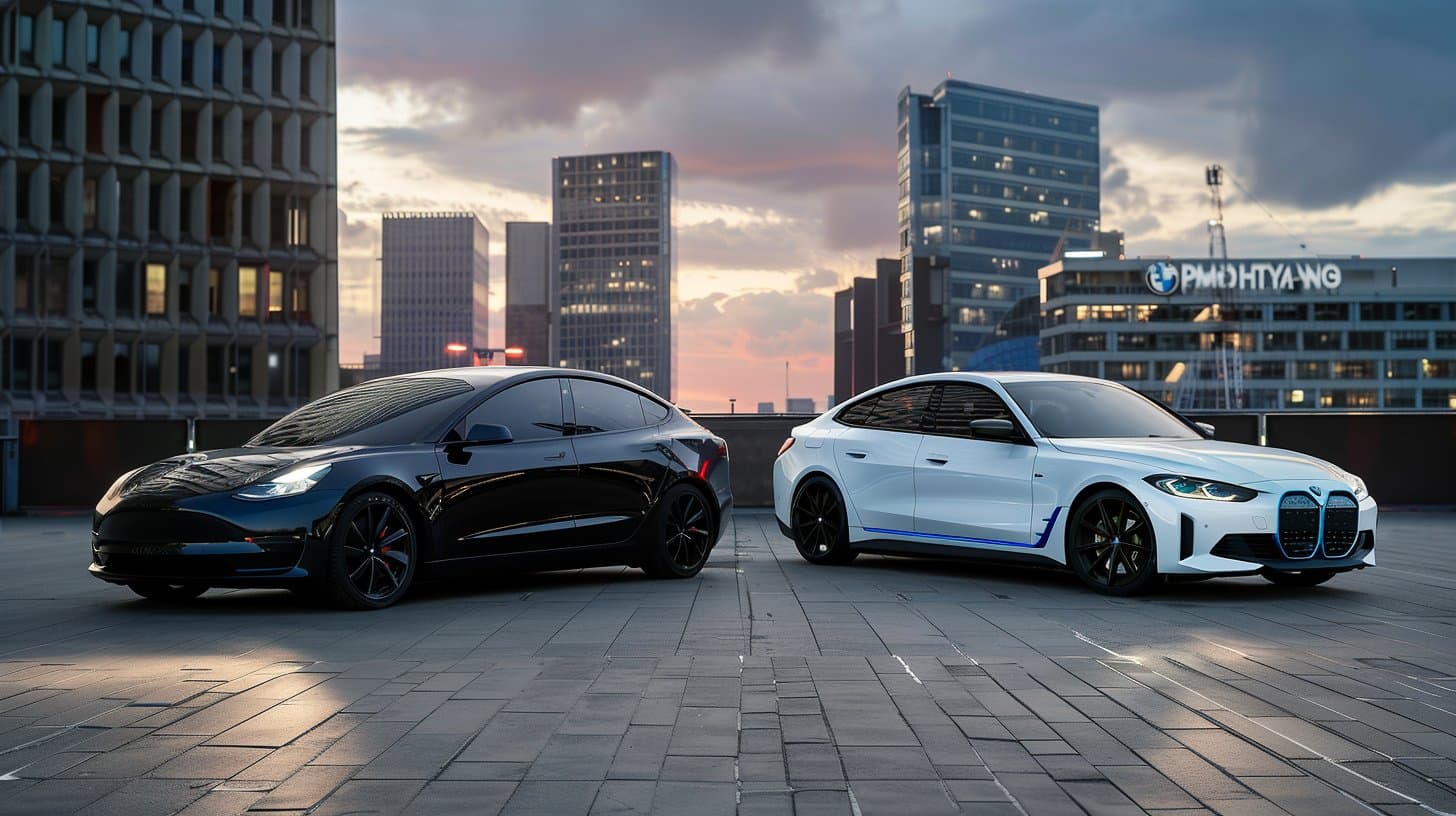
The Tesla Model 3 and BMW i4 are the two most compelling electric sedans you can buy in 2026 — and they represent fundamentally different philosophies. Tesla built the Model 3 as a tech company builds a car: minimalist, software-first, constantly evolving through updates. BMW built the i4 as a car company perfects a sedan: driver-focused, luxuriously appointed, mechanically refined. Both are excellent. Neither is perfect. This comparison tells you exactly which one deserves your money based on what actually matters to you.
At a Glance: Tesla Model 3 vs BMW i4
| Spec | Model 3 Long Range | BMW i4 eDrive40 |
|---|---|---|
| Starting Price | $42,490 | $52,200 |
| After Tax Credit | $34,990 | $44,700 |
| Range (EPA) | 358 miles | 318 miles |
| 0–60 mph | 4.0 seconds | 5.5 seconds |
| Horsepower | 366 hp (dual motor) | 335 hp (single motor) |
| Efficiency | 132 MPGe | 109 MPGe |
| DC Fast Charge (10–80%) | ~27 minutes | ~31 minutes |
| Cargo Space | 23 cu ft + frunk | 17 cu ft |
| Driver Assistance | Autopilot (included) | Driving Assistant Pro ($1,700) |
| Interior Style | Minimalist tech | Traditional luxury |
Range and Efficiency: Tesla Wins
The Tesla Model 3 Long Range delivers 358 miles versus the i4's 318 miles — a 40-mile advantage that grows larger in real-world driving. Tesla's superior efficiency (132 MPGe vs 109 MPGe) means each kilowatt-hour takes you further, which translates to lower charging costs over time. At 15,000 miles per year, the Model 3 costs about $500 in electricity annually versus $600 for the i4 — a small but real ongoing savings.
Where the gap matters most is highway driving. At 75 mph, the Model 3's aerodynamic design maintains about 290–310 miles of real-world range, while the i4 drops to 260–280 miles. For daily commuting, both are more than adequate. For road trips, the Model 3's extra range means fewer charging stops.
Driving Experience: BMW Wins
This is where the BMW i4 earns every dollar of its premium. The steering feel is communicative and weighted perfectly — you feel the road through the wheel in a way the Model 3 simply doesn't offer. The suspension strikes an ideal balance between comfort and sport, absorbing bumps without wallowing through corners. The brake feel is natural and progressive, unlike the sometimes-inconsistent regenerative braking blending in the Tesla.
BMW's decades of refining chassis dynamics show in every corner. The i4 rotates eagerly, maintains composure at speed, and inspires confidence. The Model 3 is quick and competent, but it feels like a fast appliance compared to the i4's engagement. If you enjoy driving — if the act of driving is a source of pleasure, not just transportation — the i4 is the clear winner.
The Model 3 wins on straight-line acceleration (4.0 vs 5.5 seconds to 60), but most drivers rarely use full acceleration. The i4's superior chassis dynamics are noticeable on every drive, making it the more rewarding car on a daily basis.
Interior and Comfort
Tesla Model 3: The interior is defined by the 15.4-inch center touchscreen that controls everything. Climate, mirrors, glovebox, lights — it's all in the screen. This is either brilliantly simple or frustratingly minimalist depending on your personality. The seats are comfortable for long drives, the glass roof creates an airy cabin, and the build quality has improved significantly in recent years. But there are no physical buttons for climate or volume — a dealbreaker for some drivers.
BMW i4: The i4's interior is unmistakably BMW. The curved dual-screen display (12.3-inch driver + 14.9-inch center) runs iDrive 8, which blends touchscreen, voice control, and a physical iDrive rotary controller. You can adjust temperature, volume, and driving modes without ever touching the screen. The materials are premium — real leather (or Sensatec vegan leather), aluminum trim, and soft-touch surfaces throughout. The seats offer more lateral support and adjustability than the Tesla's. The Harman Kardon audio system is significantly better than the Model 3's built-in speakers.
Winner: BMW, clearly. The i4's interior feels like a $50,000+ car should. The Model 3's interior is clean and functional but lacks the richness and tactile quality of the BMW.
Technology and Software
Tesla wins on software. Tesla's operating system is faster, more responsive, and more frequently updated than BMW's iDrive 8. Over-the-air updates add new features regularly — your car literally gets better over time. The navigation system factors in elevation, weather, and real-time charging station availability for optimal route planning. The Supercharger network integration is seamless — the car pre-conditions the battery before arriving at a charger for maximum charging speed.
BMW wins on interface design. iDrive 8 is the more intuitive system for traditional car buyers. The physical controls mean you never fumble with a touchscreen while driving. Voice control understands natural language commands well. Apple CarPlay and Android Auto are supported (Tesla does not offer CarPlay). For drivers who want their phone to seamlessly integrate with their car, BMW wins decisively.
Charging Infrastructure
Tesla maintains a significant advantage with the Supercharger network — the most reliable, widespread, and well-maintained fast-charging network in North America. With 20,000+ Supercharger stalls and a reliability rate above 95%, finding a working charger is never a concern. The BMW i4 now has access to Tesla Superchargers via a CCS-to-NACS adapter, but the experience isn't as seamless as it is for native Tesla drivers. BMW also accesses the CCS networks (Electrify America, EVgo, ChargePoint), providing wide coverage but with less consistent reliability.
Value and Cost of Ownership
The Model 3 Long Range at $34,990 after the federal credit is $9,710 cheaper than the i4 at $44,700. That's a substantial gap. The Model 3 also costs less to run (better efficiency), less to insure in most states, and holds its value better (Tesla's resale values are consistently the highest among EVs).
The i4's $9,710 premium buys you a significantly better interior, superior driving dynamics, physical controls, and the BMW badge. Whether that's worth nearly $10,000 is entirely personal. For buyers who prioritize value and technology, the Model 3 is the rational choice. For buyers who prioritize driving pleasure and interior quality, the i4 justifies its premium.
Performance Variants: Model 3 Performance vs i4 M50
For enthusiasts, both offer high-performance variants. The Tesla Model 3 Performance ($50,990 / ~$43,490 after credit) delivers 3.1 seconds to 60 mph with track-ready acceleration. The BMW i4 M50 ($67,300 / ~$59,800 after credit) offers 3.7 seconds to 60 with BMW M-tuned suspension, brakes, and steering that create a more engaging driving experience despite being technically slower. The M50 is the better track car; the Model 3 Performance is the faster drag racer.
The Verdict
Buy the Tesla Model 3 if: You prioritize value, maximum range, the best charging network, cutting-edge software, and you're comfortable with a screen-centric interface. The Model 3 is the more rational choice — it costs less, goes further, and offers the most reliable charging experience. It's the EV for people who think with their heads.
Buy the BMW i4 if: You love driving, want a premium interior with physical controls, value traditional luxury, and you're willing to pay more for a car that feels special every time you sit in it. The i4 is the EV for people who think with their hearts — and there's nothing wrong with that. Life's too short to drive a boring car.
Compare current pricing on both models on our EV deals page, or use the EV Match & Savings Hub to see which one fits your budget and driving style.