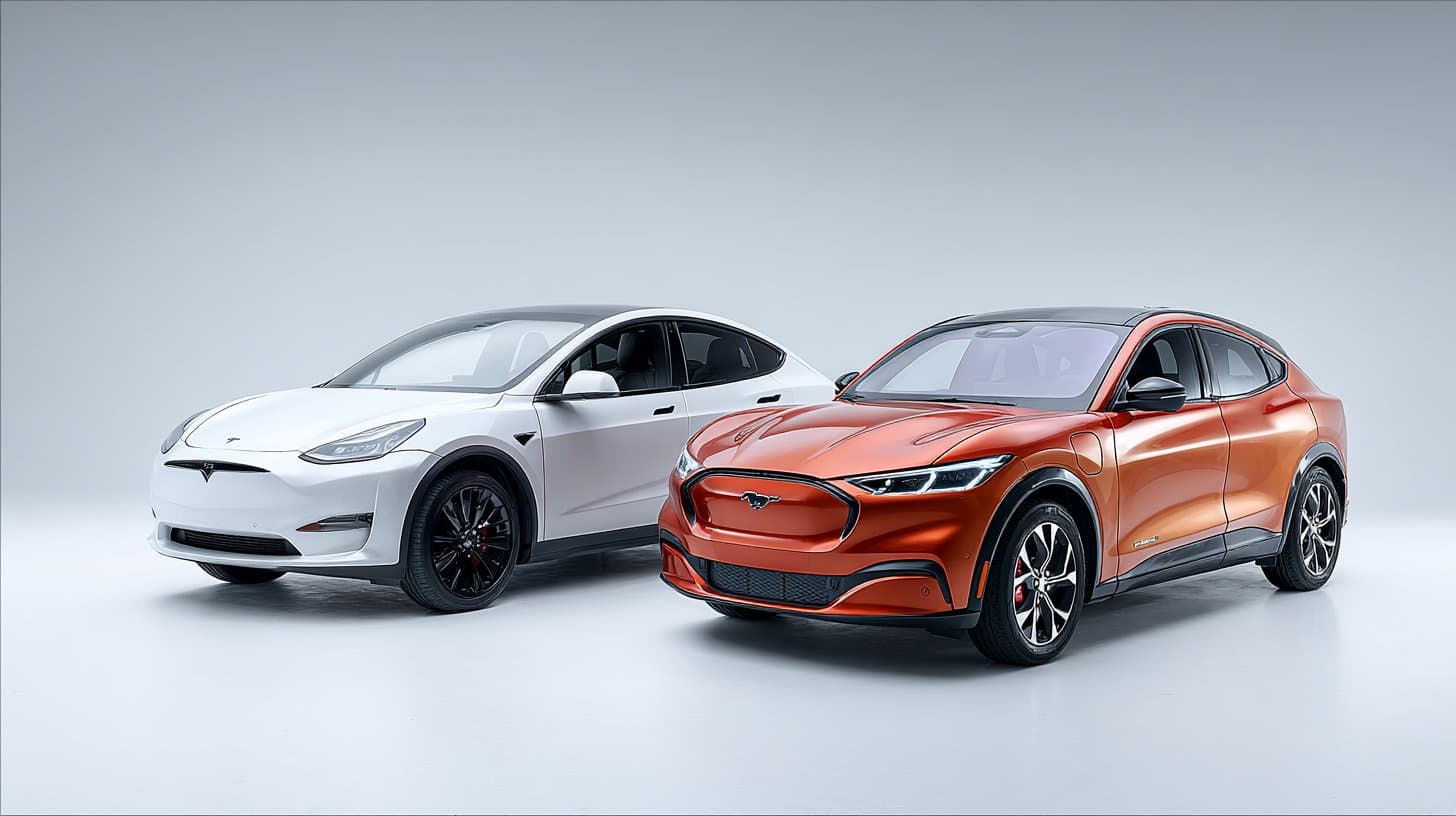
Two of the most popular electric SUVs on the market. Two very different philosophies. One decision.
The Tesla Model Y and Ford Mustang Mach-E are frequently cross-shopped by buyers looking for a practical, mid-size electric crossover with good range and a reasonable price. On paper, they look similar. In practice, they're quite different — and the right choice depends heavily on what you value most.
This is the complete head-to-head comparison for 2026.
At a Glance
| Spec | Tesla Model Y LR RWD | Ford Mustang Mach-E Premium ER RWD |
|---|---|---|
| Starting Price | $44,990 | $48,995 |
| EPA Range | 320 miles | 312 miles |
| 0–60 mph | 5.0 seconds | 5.2 seconds |
| Cargo Space (rear seats up) | 68 cu ft | 59.6 cu ft |
| Cargo Space (rear seats down) | 76 cu ft | 59.6 cu ft |
| DC Fast Charging Speed | 250 kW (V3 Supercharger) | 150 kW |
| Charging Network | Tesla Supercharger (50,000+ stalls) | Ford Charge Network / Electrify America |
| Towing Capacity | 3,500 lbs | 2,000 lbs |
| NHTSA Safety Rating | 5 stars overall | 5 stars overall |
| Warranty | 4 yr/50,000 mi basic; 8 yr/100k–150k mi battery | 3 yr/36,000 mi basic; 8 yr/100,000 mi battery |
Price: Mach-E vs Model Y
At comparable range and feature levels, the Tesla Model Y Long Range RWD ($44,990) comes in slightly cheaper than the Mach-E Premium Extended Range RWD ($48,995).
Both are eligible for the $7,500 federal EV tax credit for qualifying buyers, which brings the effective prices to approximately $37,490 (Model Y) and $41,495 (Mach-E).
Advantage: Model Y — meaningfully cheaper at comparable specs.
One nuance: Ford has been more aggressive with dealer-level discounts and incentives than Tesla, which doesn't negotiate on price. Buyers who work the system at Ford dealerships can sometimes close the gap to $2,000–$3,000, or even reach near-parity.
Range: Effectively a Tie
Model Y Long Range: 320 miles EPA
Mach-E Premium ER: 312 miles EPA
In real-world highway driving, both typically deliver 260–290 miles at 70–75 mph, with AC running. The 8-mile EPA difference evaporates completely in practice.
Advantage: Tie — both provide more than enough range for most buyers.
Charging: Tesla Wins Decisively
This is the most significant performance difference between the two vehicles — and it matters most on road trips.
Tesla Model Y:
- Charges at up to 250 kW on V3 Superchargers
- 15–80% charge in approximately 25 minutes
- Access to 50,000+ Supercharger stalls across North America
- Navigation automatically routes through Superchargers and pre-conditions battery for charging
Ford Mustang Mach-E:
- Charges at up to 150 kW on compatible DC fast chargers
- 10–80% charge in approximately 38 minutes
- Primary fast charging on Electrify America network (4,500+ stalls) and other CCS networks
- Ford Charge Station Pro for home Level 2 charging (up to 48 amps / 11.5 kW)
The difference in DC fast charging speed is significant: the Model Y can add roughly 40% more range in the same time as the Mach-E at a fast charger. On a long road trip with multiple charging stops, this adds up to noticeably less time waiting.
More importantly, the Supercharger network is larger, more reliable, and better located than Electrify America. In 2026, Electrify America has improved significantly — but Supercharger station uptime and availability still leads the industry.
Advantage: Tesla Model Y — clearly.
Interior and Technology: Different Philosophies
Tesla Model Y Interior
The Model Y's interior is minimalist to a fault — intentionally so. The entire vehicle is controlled through a 15.4-inch portrait touchscreen. There are no physical buttons for climate control, fan speed, or audio. Even the glove box opens via the touchscreen.
This either feels elegant and futuristic or frustrating and impractical depending on the driver. Many people adapt quickly and appreciate the clean, uncluttered space. Others find it genuinely annoying to navigate menus to change the temperature while driving.
The cabin quality has improved with the 2024–2026 Highland refresh, with better materials, a quieter interior, and a rear-facing entertainment screen for back seat passengers. But it still lacks the tactile familiarity of a traditional dashboard layout.
Storage and space are outstanding. The Model Y has the largest cargo volume in the segment (68 cu ft behind the rear seats, 76 cu ft with them folded), plus a small front trunk (frunk) for additional secured storage.
Ford Mustang Mach-E Interior
The Mach-E takes a more conventional approach that many buyers find more immediately comfortable. It has a large 15.5-inch portrait touchscreen (similar in size to Tesla's), but it retains physical controls for climate and volume — a practical choice that many drivers strongly prefer.
The interior quality is a step above what Ford offered five years ago, with soft-touch materials and a premium feel on the Premium and GT trims. The Bang & Olufsen audio system (available as an upgrade) is excellent — one of the best factory audio options in the segment.
Cargo space is smaller than the Model Y — 59.6 cu ft behind rear seats — and there's no frunk. But the load floor is flat and low, making it practical for bulky items.
Advantage: Depends on preference. Tech-forward drivers who adapt to touchscreen-first controls prefer the Model Y. Drivers who want physical controls and immediate familiarity prefer the Mach-E.
Driving Experience
Tesla Model Y
The Model Y drives with the characteristic Tesla sensation: instant, linear acceleration and a low center of gravity from the floor-mounted battery. The standard Model Y has a fairly soft, comfort-oriented suspension tune that prioritizes ride quality over handling engagement. It doesn't feel sporty — it feels planted and confident.
Autopilot (standard) handles lane keeping and adaptive cruise control well. Full Self-Driving (FSD, subscription or purchase required) adds more sophisticated driver assist features and continues to improve through over-the-air updates.
Ford Mustang Mach-E
The Mach-E has a more engaging, athletic driving feel than the Model Y — particularly in GT and GT Performance Edition trims, which deliver genuinely quick 0–60 times (3.5 seconds for the GT PE). Even in the standard Premium trim, the Mach-E has a more driver-focused character than the Model Y.
BlueCruise (Ford's hands-free highway driving system, available on higher trims) has been rated among the best driver assist systems in independent testing, consistently outperforming competitors in real-world highway conditions.
Advantage: Mach-E for driving engagement and hands-free driving quality. Model Y for autonomous capability development trajectory.
Reliability and Ownership Experience
Tesla
Tesla's quality and service experience have been polarizing. Initial quality scores (J.D. Power) have historically ranked Tesla below average, with panel gaps, paint inconsistencies, and feature software bugs reported by some owners. Tesla's service network has expanded but remains concentrated in urban areas. Service appointments can be backed up weeks in some markets.
On the positive side: Tesla's over-the-air updates mean the car genuinely improves over time, and the Supercharger network's reliability is industry-leading.
Ford
Ford's dealer network is one of its strongest assets — with dealers in essentially every market, including rural areas. Service availability and turnaround times are generally better than Tesla in most markets. Ford's initial quality has been typical for major manufacturers — better than Tesla historically, though the Mach-E had some early software and charging reliability issues in its first year that have since been largely resolved.
Advantage: Ford Mach-E for dealer network coverage and traditional service experience.
Resale Value
Tesla Model Y consistently holds value better than the Mustang Mach-E. Used Model Y values reflect strong demand and the appeal of the Supercharger network. The Mach-E depreciates faster, which actually creates an opportunity for used car buyers — but matters if you're buying new and plan to sell in 3–5 years.
Advantage: Tesla Model Y.
Who Should Buy Each
Buy the Tesla Model Y if:
- You travel long distances and road trip charging convenience is a priority
- You want the largest cargo space in the segment
- Resale value matters to you
- You're comfortable with an all-touchscreen interface
- You want the vehicle with the most active software development and feature improvement
Buy the Ford Mustang Mach-E if:
- You prefer physical climate controls and a more traditional interior layout
- You value a fun, sporty driving experience
- Ford dealer network access for service is important to you
- You're a fan of the Mustang brand and styling
- You want BlueCruise hands-free driving (among the best in the industry)
The Verdict
The Tesla Model Y wins on range efficiency, charging speed, charging network, cargo space, and resale value. The Ford Mustang Mach-E wins on interior intuitiveness, driving engagement, dealer service access, and hands-free driving quality.
For most buyers — especially those who road trip frequently or prioritize the total cost of ownership — the Model Y is the rational choice. For buyers who prioritize the in-car experience, physical controls, and dealer familiarity, the Mach-E is a genuinely excellent alternative that doesn't force any compromises on daily driving.
Neither is the wrong choice. They're just different.
Compare full specs and current pricing for both models on our EV Deals page. Or use the EV Match Tool to find which one fits your specific driving profile.