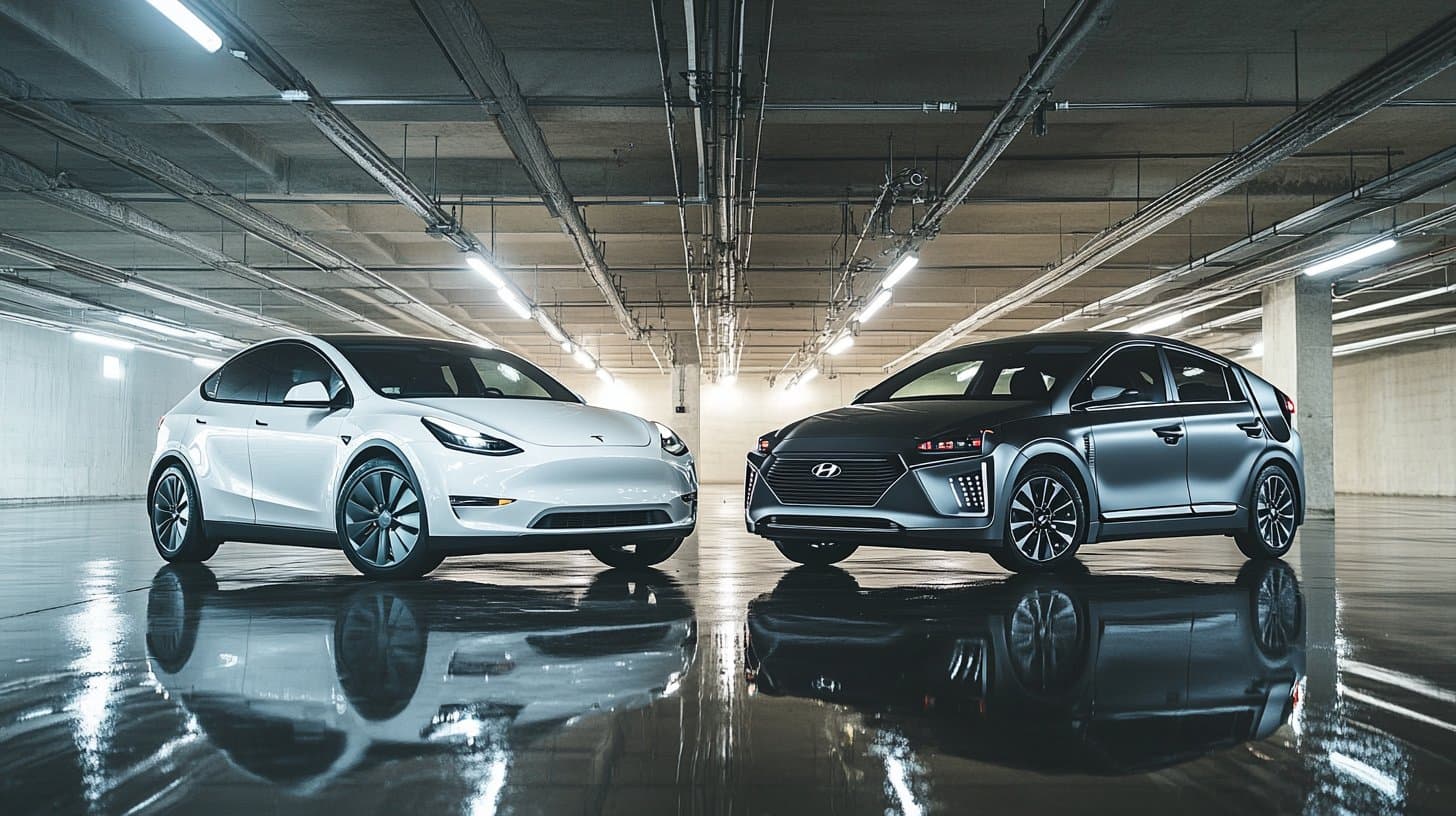
The Tesla Model Y vs Hyundai Ioniq 5 debate is one of the most common crossover comparisons in the electric vehicle world right now. Both sit in the $44,000–$55,000 price band, both deliver over 300 miles of range in their long-range configurations, and both have earned devoted followings. But these two vehicles couldn't be more different in philosophy. Tesla bets on software, efficiency, and a vertically integrated ecosystem. Hyundai counters with 800-volt architecture, a more traditional ownership experience, and an interior that feels genuinely premium at every trim level. If you're cross-shopping these two EVs in 2026, this comprehensive comparison guide breaks down everything you need to know before signing on the dotted line.
At a Glance
Before diving into the details, here is a side-by-side snapshot of the key specifications that separate these two popular electric crossovers. The numbers tell an interesting story: neither vehicle dominates every category, which is exactly what makes this comparison so compelling.
| Spec | Tesla Model Y (2026) | Hyundai Ioniq 5 (2026) |
|---|---|---|
| Starting Price | ~$44,990 | ~$43,800 |
| Range (EPA est.) | Up to 320 mi (LR AWD) | Up to 303 mi (LR RWD) |
| 0–60 mph | 4.8 s (LR) / 3.5 s (Perf) | 5.1 s (AWD) |
| Cargo Space | 76 cu ft (seats folded) | 59.3 cu ft (seats folded) |
| Charging Speed | 250 kW (Supercharger V3) | 350 kW (800V architecture) |
| Warranty (basic) | 4 yr / 50,000 mi | 5 yr / 60,000 mi |
Design and Interior
The Tesla Model Y takes the minimalist route. The 2026 "Juniper" refresh brought revised headlights, a sleeker front fascia, and new interior ambient lighting, but the design philosophy remains the same: clean lines, aerodynamic efficiency, and a cockpit that revolves almost entirely around a central 15.4-inch touchscreen. There are no physical buttons for climate or media. Love it or hate it, it is unmistakably Tesla — functional, forward-looking, and intentionally sparse.
The Hyundai Ioniq 5 goes in the opposite direction with a retro-futuristic aesthetic inspired by Hyundai's 1974 Pony concept. Pixel-style LED headlights and taillights, sharp body cladding, and a wide stance give it a look that genuinely turns heads. Inside, the difference is even more pronounced. Hyundai offers a completely flat floor, a sliding center console, dual 12.3-inch displays, physical climate controls, and sustainable materials including recycled PET yarn and eco-processed leather. At comparable price points, the Ioniq 5's interior materials simply feel richer and more considered than the Model Y's.
If you prioritize a cabin that feels high-end and offers tactile controls, the Ioniq 5 wins this round. If you prefer simplicity and a screen-first interface, the Model Y's approach will feel refreshingly uncluttered.
Range and Charging
Range is one of the Model Y's strongest suits. The Long Range AWD variant delivers an estimated 320 miles on a full charge, and Tesla's real-world efficiency tends to track close to the EPA estimate thanks to years of drivetrain optimization, an advanced heat pump system, and excellent aerodynamics. Even the base rear-wheel-drive model manages around 283 miles, making the Model Y one of the most efficient crossovers you can buy regardless of powertrain.
The Ioniq 5 posts a respectable 303 miles on the Long Range RWD trim, though the AWD version dips to roughly 260 miles. Real-world highway range at sustained speeds above 70 mph tends to fall a bit shorter than the EPA number, which is common among 800-volt platforms that prioritize charging speed over peak efficiency.
Charging is where the Ioniq 5 strikes back — hard. Its 800-volt architecture supports peak rates up to 350 kW, translating to a 10–80% charge in approximately 18 minutes at a compatible station. That is fast enough to add over 200 miles during a quick coffee stop. The Model Y uses a 400-volt system and tops out at 250 kW on Tesla's Supercharger V3 network, with 10–80% taking roughly 27 minutes — still quick, but noticeably slower than the Hyundai.
Tesla's counterargument is network quality. The Supercharger network remains the largest and most reliable public charging infrastructure in North America, with over 50,000 stalls and a reputation for uptime that third-party networks are still chasing. That said, the Ioniq 5 now ships with a NACS port, granting it full Supercharger access alongside CCS stations. The network gap is narrowing fast.
Technology and Software
Tesla's software advantage is real and significant. The Model Y receives over-the-air (OTA) updates that add features, improve performance, and refine the driving experience long after purchase. Autopilot comes standard, and the optional Full Self-Driving package offers advanced capabilities like Navigate on Autopilot, auto lane changes, and Smart Summon. Tesla's in-house software team iterates rapidly, meaning the car you own today will gain functionality over time — something few competitors can match.
The Ioniq 5's infotainment system runs on Hyundai's latest Connected Car Navigation Cockpit platform with wireless Apple CarPlay and Android Auto, a feature Tesla still does not support. The dual-screen layout is intuitive, and physical buttons for HVAC and volume mean you can adjust settings without taking your eyes off the road. Hyundai also offers OTA updates, though they arrive less frequently and tend to focus on bug fixes rather than new features.
One unique Ioniq 5 feature: Vehicle-to-Load (V2L) capability lets you power 120-volt appliances, tools, or even another EV from a standard outlet built into the car. Camping, tailgating, and job-site scenarios where the Ioniq 5 doubles as a mobile power bank give it genuine lifestyle versatility that the Model Y simply cannot replicate.
Practicality and Space
The Model Y holds the cargo crown with 76 cubic feet of total volume when the rear seats are folded, compared to the Ioniq 5's 59.3 cubic feet. Tesla also offers a small front trunk ("frunk") for additional secure storage. If you regularly haul bikes, strollers, or flat-pack furniture, the Model Y's sheer volume and wide liftgate opening are tough to beat.
The Ioniq 5 counters with a remarkably open and airy cabin made possible by its dedicated EV platform and completely flat floor. Rear passengers enjoy limousine-like legroom, and the sliding center console can be repositioned to create a walk-through cabin. For families with young children who need easy car-seat access, or for anyone who values passenger comfort over raw cargo capacity, the Ioniq 5's interior layout is hard to beat. It feels bigger inside than its exterior dimensions suggest.
Ownership Costs
Total cost of ownership goes beyond the sticker price, and this is where the two vehicles diverge in notable ways.
- •Insurance — Tesla insurance premiums tend to run higher due to expensive proprietary parts and specialized repair procedures. The Ioniq 5 is generally $200–$400 per year cheaper to insure, depending on your state and driving record.
- •Maintenance — Both are low-maintenance EVs with no oil changes, transmission services, or exhaust work. Tesla publishes no recommended service intervals, while Hyundai suggests periodic cabin air filter replacements and brake fluid checks. In practice, annual maintenance costs hover around $500–$800 for either vehicle.
- •Depreciation — Tesla has historically held its resale value better than almost any other EV brand, buoyed by Supercharger network lock-in and strong brand demand. The Ioniq 5's residual values have been climbing, however, particularly as 800-volt charging and Hyundai's reputation for reliability earn broader recognition.
- •Warranty — Hyundai offers a 5-year/60,000-mile basic warranty and a 10-year/100,000-mile powertrain warranty, comfortably outpacing Tesla's 4-year/50,000-mile basic coverage. Both include 8-year/100,000-mile-plus battery warranties.
- •Tax Credits — Both vehicles may qualify for federal EV tax credits up to $7,500, depending on trim, battery sourcing, and final assembly location. Always verify current eligibility before purchase, as requirements change frequently.
The Verdict
There is no single "better" vehicle here — only the better vehicle for your specific needs. The Tesla Model Y is the choice for drivers who prioritize range, cargo space, and a software-defined ownership experience. Its Supercharger network and OTA updates create an ecosystem that feels cohesive and future-proof. If you drive long distances regularly or want the sportiest electric crossover in this price range, the Model Y delivers.
The Hyundai Ioniq 5 is the choice for buyers who value interior quality, ultra-fast charging, and a more conventional ownership experience backed by a stronger warranty. Its V2L capability, flat-floor cabin, and retro-futuristic styling give it a personality that the Model Y intentionally avoids. If charging speed and passenger comfort rank high on your list, the Ioniq 5 is the smarter pick.
Our honest recommendation: test drive both. These are two of the best electric crossovers money can buy in 2026, and the deciding factor will almost certainly come down to which one feels right when you sit behind the wheel.