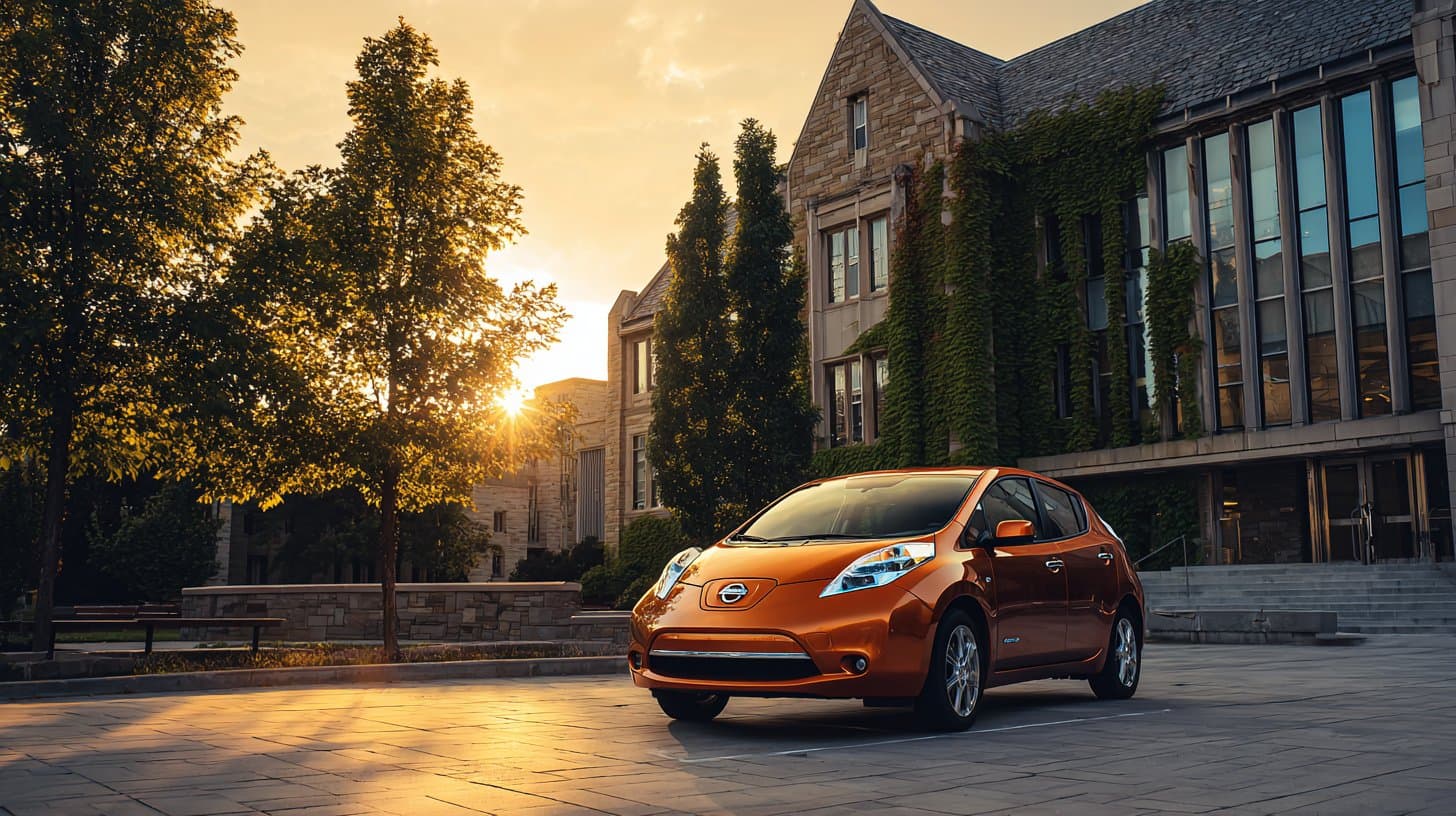
College students have enough to worry about — tuition, rent, textbooks, and meal plans don't leave much room in the budget for expensive gas fill-ups and surprise car repair bills. That's exactly why an electric vehicle might be the smartest transportation move a student can make in 2026. With used EVs available for under $15,000, campus charging stations expanding rapidly, and operating costs that are a fraction of gas vehicles, an EV can actually save you money compared to running an older gas car.
Why an EV Makes Sense for Students
Lower Monthly Costs Than You Think
The biggest misconception about EVs is that they're expensive. While new luxury EVs can cost $50,000+, the used EV market has exploded with affordable options. A used Nissan Leaf can be found for $10,000–$15,000, and a used Chevy Bolt EV for $15,000–$20,000. But the real savings come from operating costs. The average college student drives about 10,000 miles per year. In a gas car getting 28 MPG, that's roughly 357 gallons of gas at $3.50 per gallon — about $1,250 per year in fuel. In an EV, the same 10,000 miles costs approximately $400 per year in electricity at average home charging rates. That's $850 saved annually on fuel alone — money that goes a long way on a student budget.
No Surprise Repair Bills
One of the worst financial nightmares for a student is an unexpected $800 repair bill on an aging gas car. EVs have dramatically fewer parts that can fail — no engine oil, no transmission fluid, no spark plugs, no timing belt, no exhaust system. Brake pads last 2–3 times longer thanks to regenerative braking. The biggest maintenance expense is tire rotation, which costs the same regardless of powertrain. For students who can't afford to be stranded with a broken car during midterms, EV reliability is a major advantage.
Campus Charging Is Growing Fast
Hundreds of universities across the country have installed Level 2 charging stations in campus parking lots and garages. Many offer free or discounted charging to students. Even if your school doesn't have campus chargers yet, most college towns have public charging stations at shopping centers, libraries, and grocery stores where you can top up while running errands. Check your university's parking services website or apps like PlugShare to see what's available near you.
Top EV Picks for College Students
1. Nissan Leaf (Used) — The Budget King
The Nissan Leaf is the most affordable entry point into EV ownership, and for a college student, it checks every box. Used models from 2020–2024 can be found for $10,000–$18,000, putting them in the same price range as used Honda Civics and Toyota Corollas. The Leaf Plus models offer 226 miles of range — more than enough for campus commuting, weekend trips home, and everything in between. Insurance costs on the Leaf are among the lowest of any EV, which matters when you're paying your own premiums. The compact size makes parking on crowded campuses easier, and the hatchback design gives you plenty of room for moving dorm essentials. The only trade-off is that the Leaf uses CHAdeMO fast charging, which is less common than CCS. For daily driving with home or campus Level 2 charging, this rarely matters.
2. Chevrolet Bolt EV (Used) — Best Value and Reliability
The Chevy Bolt EV is arguably the best overall value in the used EV market. With 259 miles of range, it can handle road trips home that are 100+ miles each way without needing a charge stop. The 2022–2023 models received new batteries under GM's recall program, meaning you're getting essentially a brand-new battery pack in a used car — a remarkable deal. The hatchback body style offers 56.6 cubic feet of cargo space with the rear seats folded, which is enough to move in and out of dorms and apartments. GM's one-pedal driving mode is perfect for stop-and-go campus traffic, and the compact footprint fits into tight campus parking spots. Insurance rates are reasonable, and the Bolt's proven reliability means you won't be dealing with unexpected breakdowns during finals week.
3. Chevrolet Equinox EV — Best New EV for Students
If your parents are helping with the purchase or you're in a position to buy new, the Chevrolet Equinox EV is the best new EV value available. After the federal tax credit, you're looking at a brand-new crossover SUV for around $26,400 — competitive with mid-trim gas SUVs. With 319 miles of range, there's zero range anxiety for any college driving scenario. The crossover body style sits higher than a sedan, which students tend to prefer, and the interior feels far more premium than the price suggests. GM's Ultium platform provides reliable fast charging via CCS, and the 11.2-inch infotainment screen integrates seamlessly with Apple CarPlay and Android Auto. For students who plan to keep their car through college and into their early career, the Equinox EV is a vehicle you won't outgrow.
View Chevrolet Equinox EV Deals →4. Tesla Model 3 Standard Range (Used) — The Aspirational Choice
For students who want the best tech experience and access to the Tesla Supercharger network, a used Model 3 Standard Range is increasingly attainable. Used 2021–2023 models can be found in the $22,000–$30,000 range, and they come with all the features that make Teslas famous: over-the-air software updates, the massive 15.4-inch touchscreen, autopilot for highway driving, and the most extensive fast-charging network in the country. The Supercharger advantage is especially valuable for students who need to make road trips home — you can drive 200+ miles on the highway, stop for 15–20 minutes to charge, and keep going. No other brand makes long-distance EV travel this seamless. Insurance is slightly higher than the Leaf or Bolt, but for students prioritizing technology and charging convenience, the Model 3 is worth the premium.
View Tesla Model 3 Deals →Charging at Apartments and Dorms: What Students Need to Know
One of the biggest concerns for college students considering an EV is charging access. Not every student has a garage with a dedicated outlet. Here are practical solutions:
- Campus charging stations: Check your university's parking website. Many schools offer free Level 2 charging in student parking lots and garages. Even a few hours plugged in during classes can add 25–40 miles of range.
- Standard 120V outlet (Level 1): If your apartment has an outdoor outlet or a garage with a standard plug, you can use the included charging cable. Level 1 charging adds about 3–5 miles of range per hour — overnight, that's 30–50 miles, which covers most daily driving needs.
- Apartment complex chargers: Many newer apartment complexes are installing Level 2 chargers as amenities. Ask your leasing office or look for EV-friendly apartments when choosing housing.
- Public charging while running errands: Charge while grocery shopping, studying at a coffee shop, or hitting the gym. Apps like PlugShare and ChargePoint help you find stations near you.
- DC fast charging for occasional use: When you need a quick charge, DC fast chargers can add 100+ miles in 20–30 minutes. Use these sparingly since they cost more than Level 2 charging.
Cost Comparison: Gas Car vs. EV for a College Student
Monthly Cost Breakdown (10,000 miles/year)
That's a savings of roughly $146 per month — enough to cover a significant portion of a student's food budget or textbook expenses.
Used EV Buying Tips for Students
- Check battery health: Ask for the battery health report or State of Health (SOH) percentage. Most EVs retain 85–95% of their original capacity after 5 years of normal use. Avoid any EV below 80% SOH.
- Look for recall-repaired Chevy Bolts: 2020–2023 Bolts that received new batteries under GM's recall are exceptional used values — essentially new batteries in a used car.
- Consider CPO (Certified Pre-Owned): Many manufacturers offer CPO programs for used EVs with extended warranties, giving you peace of mind.
- Factor in the federal tax credit: Used EVs priced under $25,000 may qualify for a used EV tax credit of up to $4,000. This can make a $20,000 used EV effectively cost $16,000.
- Test the charging door and port: During your test drive, stop at a public charger and confirm the car charges properly. This is the EV equivalent of checking for engine problems.
Insurance Tips for Student EV Owners
EV insurance costs vary widely by model. The Nissan Leaf and Chevy Bolt tend to have the lowest insurance premiums among EVs, comparable to economy gas cars. Teslas cost more to insure due to higher repair costs. As a student, you can reduce premiums by staying on a parent's policy, maintaining good grades (many insurers offer good student discounts of 5–25%), and choosing a higher deductible if you have savings to cover it. Some insurers also offer EV-specific discounts — ask about them when shopping for quotes.
The Bottom Line
An EV isn't just for tech executives and environmentalists — it's a genuinely practical choice for college students who want to minimize transportation costs and avoid the unpredictable repair bills that come with aging gas cars. Whether you go with a $12,000 used Nissan Leaf, a $17,000 used Chevy Bolt with a brand-new battery, a new Chevrolet Equinox EV for under $27,000 after tax credits, or a used Tesla Model 3 for the ultimate tech experience, you'll spend less every month on transportation than your classmates driving gas cars. That extra $100–$150 per month can go toward tuition, rent, or actually enjoying your college experience.
Browse the latest EV deals → and find the perfect affordable EV for your college years.