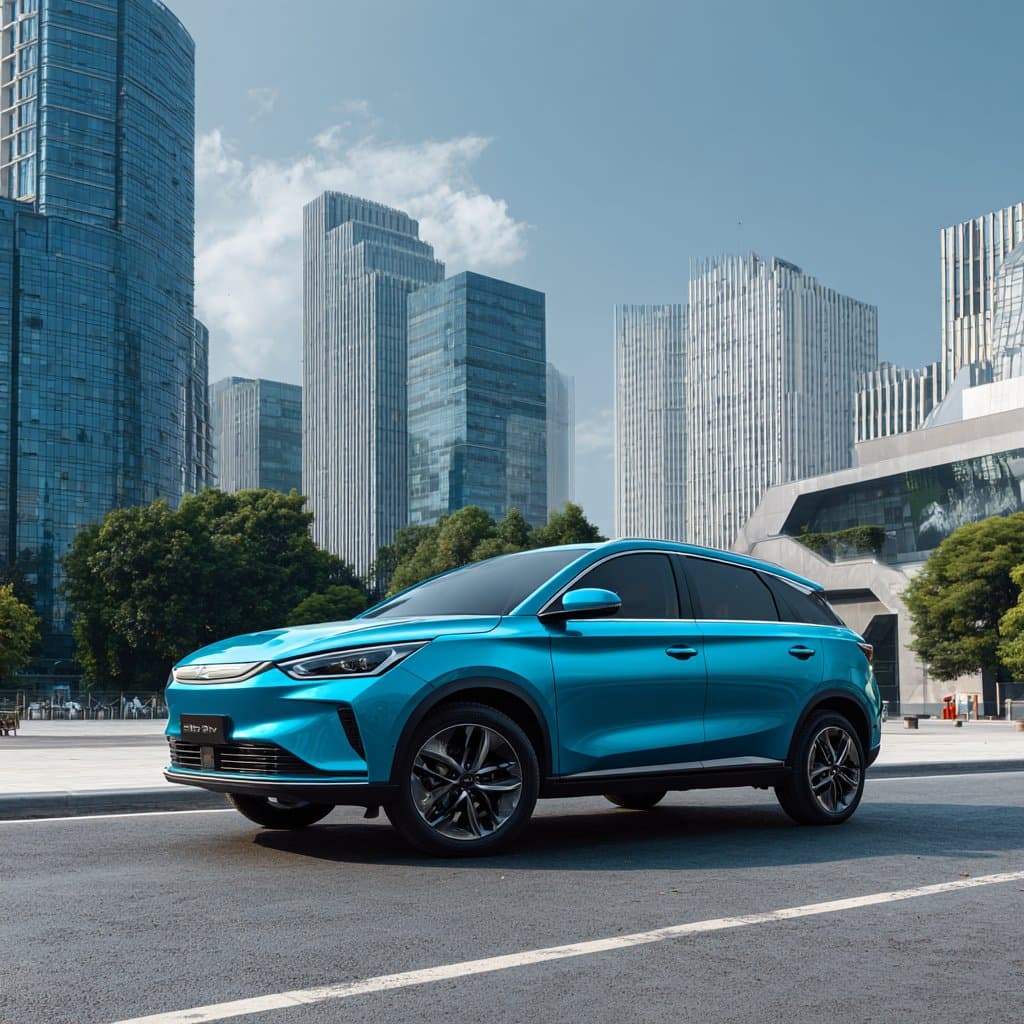
BYD unveiled the Sealion 05 in China a few days ago, with an official debut scheduled for April 20, 2026. The starting price is approximately $16,200 USD (117,800 yuan). That is less than half the price of a Tesla Model Y. It has a built-in refrigerator. And Americans cannot buy one. Welcome to the strangest corner of the 2026 global EV market — the part where the most compelling affordable electric car in the world is one most of us will only ever see in photos.
Let that sentence sink in for a moment. A new-from-the-factory compact electric SUV, with more than 250 miles of range on the top trim, a full ADAS suite, a panoramic roof, and a refrigerator — for roughly what a lightly used Toyota Corolla costs in Florida. The Sealion 05 is not a concept. It is not a show car. It is a real vehicle rolling off BYD's production lines as you read this. It just happens to exist in a market that American policy has decided to fence off.
If you have been wondering why US EV prices keep slowly creeping down but never seem to crack the $20,000 floor, the Sealion 05 is the answer. And the frustration — because there is frustration, let us not pretend otherwise — is that none of this is about what is technically possible. It is entirely about what is politically allowed.
The Price That Shouldn't Be Possible
The Sealion 05 starts at around $16,200 USD (117,800 yuan converted at current rates). For a brand-new, factory-warrantied, fully equipped compact electric SUV, that number does not make sense against any American pricing reference. The cheapest new EV on sale in the United States is the Nissan Leaf at roughly $24,500, and the Leaf is a small hatchback with a stubbornly outdated CHAdeMO charge port. A used 2022–2023 Chevy Bolt in decent condition runs $17,000–$19,000 — and that is used.
BYD can price the Sealion 05 this way for two reasons, and neither of them is magic. The first is vertical integration. BYD makes its own batteries (the Blade LFP pack is manufactured in-house), its own electric motors, its own power electronics, and even its own automotive-grade semiconductors. When you own every step of the supply chain, you do not pay margins to anyone else along the way. The second is scale. BYD built more than 4 million vehicles in 2025. At that volume, per-unit fixed costs dissolve into a rounding error.
There is also a PHEV version of the Sealion 05 that starts even lower — around $14,000 USD. Fourteen thousand dollars. For a new plug-in hybrid SUV. The math simply does not exist in the American market, and that is not because American engineers cannot do it. It is because American suppliers, American labor, American regulatory overhead, and American dealer networks all add costs that Chinese manufacturers do not carry in their home market.
Specs and Features
The Sealion 05 is not a stripped-out econobox. On paper, it reads like a midrange European or Korean EV offered at a bargain-basement price.
Powertrain: Buyers get two motor options depending on trim. The base configuration delivers 200 kW (roughly 268 horsepower), while the uplevel variant offers 240 kW (about 321 horsepower). Both are front-wheel-drive single-motor setups at launch, with AWD variants expected later in the model run. For context, 268 hp in a compact SUV is quicker than a base Tesla Model Y Standard Range Plus was a few years ago.
Battery and range: The base trim uses a 50 kWh LFP (lithium iron phosphate) pack rated at up to 267 miles on China's CLTC cycle. The higher trim steps up to a 60.9 kWh pack good for up to 323 miles CLTC. CLTC is an optimistic test cycle — roughly 20–25% more generous than EPA — so the realistic EPA-equivalent range lands somewhere between 200 and 260 miles depending on trim. That is not Tesla Long Range territory, but it is more than enough for daily driving and most weekend trips.
Chemistry matters: The LFP choice is the right call for an affordable EV. LFP cells are less energy-dense than NMC, but they are cheaper, safer (they are far more thermally stable and dramatically less prone to thermal runaway), and they handle full-charge cycles better — meaning you can charge to 100% every day without noticeable long-term degradation. For a vehicle that is going to be owned for a decade by a budget-conscious buyer, LFP is the better chemistry.
Dimensions: The Sealion 05 is a genuine compact SUV — smaller than a Tesla Model Y but larger than the Dolphin hatchback. Think closer to a Hyundai Kona Electric or Chevy Equinox in footprint, with seating for five and a proper cargo area.
The Features That Would Be Luxury in a $40K Car
Here is where the Sealion 05 stops being just a cheap car and starts being something genuinely annoying to think about as an American consumer. The feature list reads like an options sheet for a luxury vehicle.
A built-in refrigerator. Not a cupholder with a cooling function. An actual refrigerated compartment in the center console or rear area. This is a feature that is rare at any price point in the American market — you will find it in some Mercedes Maybach trims and a handful of full-size luxury SUVs, and that is about it. BYD is putting it in a $16,200 compact SUV.
“God's Eye” smart driving system. This is BYD's branded ADAS platform, and depending on trim it includes highway autonomous driving, automatic lane changes, navigate-on-autopilot-style functionality, and advanced parking assist. It is not FSD, but it is roughly competitive with current Hyundai Highway Driving Assist 2 or Ford BlueCruise — features that, in the US market, typically show up on vehicles costing three to four times as much.
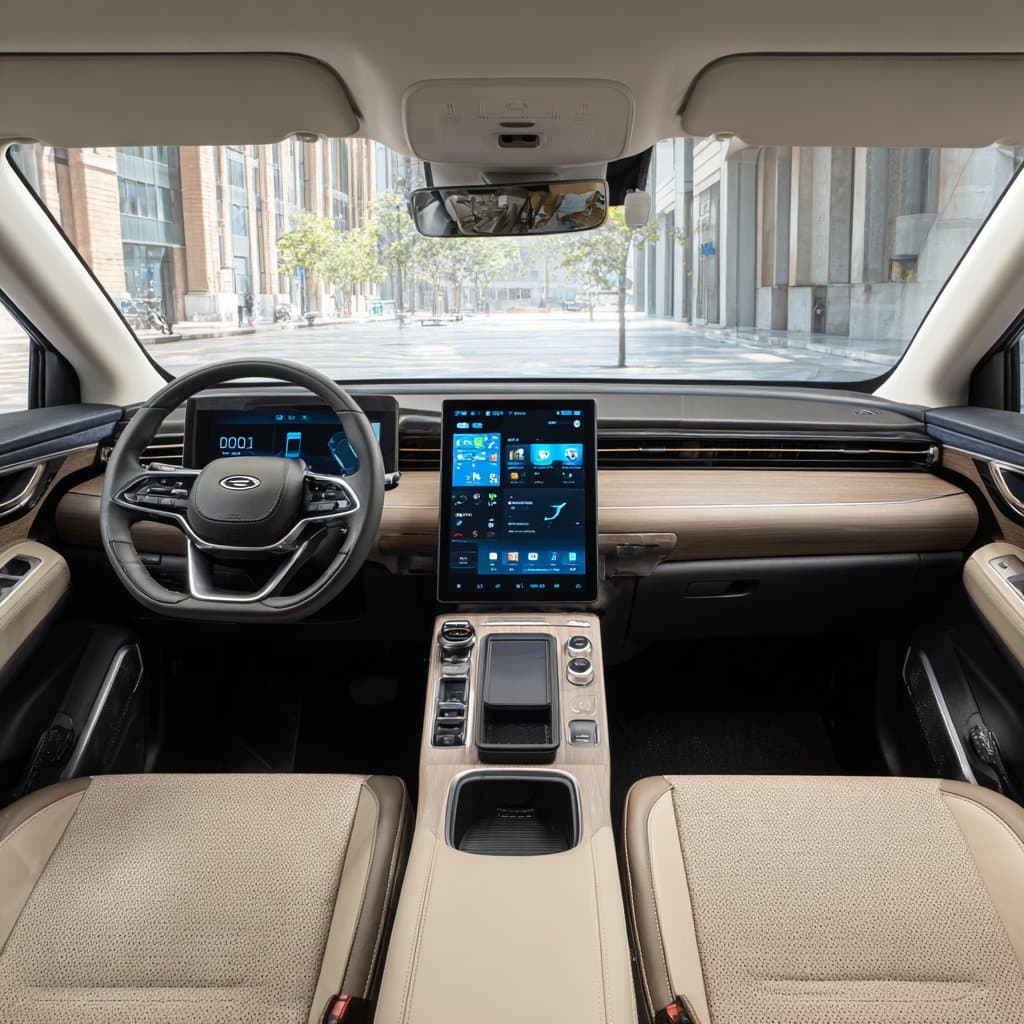
A premium interior. Soft-touch materials across the dashboard, a massive central touchscreen (rotating on higher trims, which is a BYD signature), natural-language voice control, ambient lighting, a panoramic glass roof on upper trims, and a minimalist but not cold design language. Interior photos out of the Chinese press look closer to a $35,000 Hyundai Ioniq 5 than a $16,000 anything.
The point is not that the Sealion 05 is a flagship — it is not, and BYD has flagships (the Han, the Yangwang U8) for that. The point is that features which define premium segments in America show up as standard or near-standard equipment on a Chinese EV that costs less than many Americans spend on a motorcycle.
Why Americans Cannot Buy This Car
This is the part where we talk about tariffs, and yes, there is going to be an edge in the writing here. There is no honest way to discuss the American EV market in 2026 without acknowledging that US policy has put a 100% import tariff on Chinese-made EVs. That is not a typo. A $16,200 Sealion 05 would land on American shores with a sticker price of $32,400 minimum, before destination charges, dealer markup, or any of the normal friction that gets between a window sticker and a driveway.
And the tariff is only the first wall. Even if BYD wanted to pay the tariff and sell the Sealion 05 in the US anyway, the car would need FMVSS crash certification, EPA emissions and efficiency certification, and federal safety compliance for everything from bumper heights to child seat anchors. None of that is currently done for the Sealion 05. It would take years of engineering and regulatory work to make the car street-legal in America, and BYD has given no indication they intend to try.
No Chinese automaker currently sells passenger EVs in the United States. Not BYD, not Geely, not NIO, not Xpeng, not Li Auto, not Leapmotor, not Zeekr, not Chery. BYD is the largest EV manufacturer in the world by volume and it has zero US retail presence. Polestar, which shares a parent with Geely, is in the US — but the vehicles Americans buy are assembled in South Carolina specifically to dodge the tariff regime.
The tariff policy is bipartisan. It is not going away with an election. It was raised under the previous administration and sustained under the current one, and there is no serious political constituency in Washington pushing to lower it. Whether that is the right call is a legitimate policy debate — there are arguments about data security, manufacturing jobs, supply chain independence, and strategic competition that are not trivial. But the consumer-side consequence is straightforward: Americans pay more for EVs than almost anyone else in the developed world, and a vehicle like the Sealion 05 is simply not an option.
What This Means for the Global Market
Step outside the American context and the Sealion 05 looks like part of a much larger story. BYD sold more than 4 million vehicles globally in 2025, and the company has been aggressive about pushing into every market that will have it — Europe, Southeast Asia, Latin America, Australia, the Middle East. In several of those markets, BYD is now genuinely taking share from European legacy brands. It is no longer surprising to see a German consumer in Munich buy a BYD Seal over a BMW i4. It happens constantly.
The price pressure is global. Tesla, Hyundai, Kia, Volkswagen, Stellantis, and Renault are all being forced to sharpen their offerings because BYD and its Chinese peers are undercutting them everywhere they are allowed to compete. That pressure is part of the reason EV prices have been slowly reaching parity with gas vehicles in certain segments — battery costs have dropped, yes, but the competitive dynamic set by Chinese manufacturing is just as important.
If the US ever does lower or eliminate the tariff — through a trade deal, a policy change, or a carve-out for plants built on US soil — the pricing landscape changes overnight. The floor for a new EV drops by thousands of dollars. Legacy automakers that have been quietly protected by the tariff regime suddenly have to compete with a manufacturer that can build a compact SUV for the cost of their base trim. That is not a scenario Detroit or Wolfsburg is eager to entertain.
What You Can Buy in America Instead
Frustration aside, pragmatism wins. If you need an affordable EV in the United States in 2026, you have options — just not $16,200 options. Here is the realistic menu.
Used Chevy Bolt 2022–2023: The 2022–2023 Bolt EV and Bolt EUV are genuinely the best cheap-EV-in-America play right now. Expect to pay $17,000–$19,000 for a clean example with reasonable miles. The battery warranty transfers, and post-recall the battery situation is resolved. Range is 247–259 miles depending on trim.
Slate Truck (late 2026): The Slate Truck is the closest thing America has to a true low-cost EV project, launching later this year with a starting price projected around $25,000–$28,000. It is stripped-down by design — no touchscreen, no power windows in base form — but it is a real new EV at a real low price from a US-based startup.
Nissan Leaf 2026: Starting at about $24,500, the refreshed 2026 Leaf is the cheapest new EV on sale in America. The CHAdeMO charging situation remains a drawback, but for around-town driving it is perfectly functional.
Chevy Equinox EV: After typical dealer discounts, the Equinox EV can land around $27,000 — and for that money you get 319 miles of range and a genuinely competitive compact SUV. It is not $16K, but it is the closest in spirit that America currently offers.
None of these match the Sealion 05 on raw dollars, but any of them will get you into an electric vehicle without requiring a second mortgage.
The Broader Implications
Chinese EV makers have solved a problem that American and European manufacturers still visibly struggle with — how to build a good EV at a price that normal people can afford without financing gymnastics. BYD reaching a $16,000 sticker on a compact SUV is not a fluke or a loss leader. It is the logical output of a decade of battery cost declines, manufacturing scale, and ruthless vertical integration.
The American EV industry will not reach mainstream mass adoption without $15,000–$25,000 offerings, and right now the near-term pipeline for that price band is thin. The Slate Truck is one attempt. GM keeps hinting at a next-gen affordable Bolt successor. Ford has not committed to anything at that price point. Tesla pulled the Model 2 back into development purgatory. Rivian is targeting $45,000, not $25,000. A long list of US EV startups that tried to crack the low end of the market — Lordstown, Canoo, Fisker, Faraday — failed spectacularly.
Meanwhile, the political situation shows no sign of shifting. Tariffs on Chinese EVs are one of the few things both parties agree on. The result is a protected market where domestic manufacturers have room to move slowly, charge more, and prioritize profit margin over volume. Whether that protects long-term American competitiveness or merely postpones an inevitable reckoning is a question economists will argue about for the rest of the decade.
The Bottom Line
The BYD Sealion 05 represents the EV future that Americans can read about but cannot buy. A compact SUV with up to 267 miles of range, a genuinely capable smart driving system, a premium-feeling interior, and a built-in refrigerator — all for $16,200. It is a preview of what globally competitive EV manufacturing actually looks like in 2026, and it is a reminder that the American market operates behind a tariff wall that protects domestic manufacturers at the direct cost of consumer choice. Whether that tradeoff is worth it is the political debate, and reasonable people will land in different places on it. The consumer outcome, however, is not up for debate: Americans pay significantly more for EVs than most of the world, and a car like the Sealion 05 is the reason we know exactly how much more.