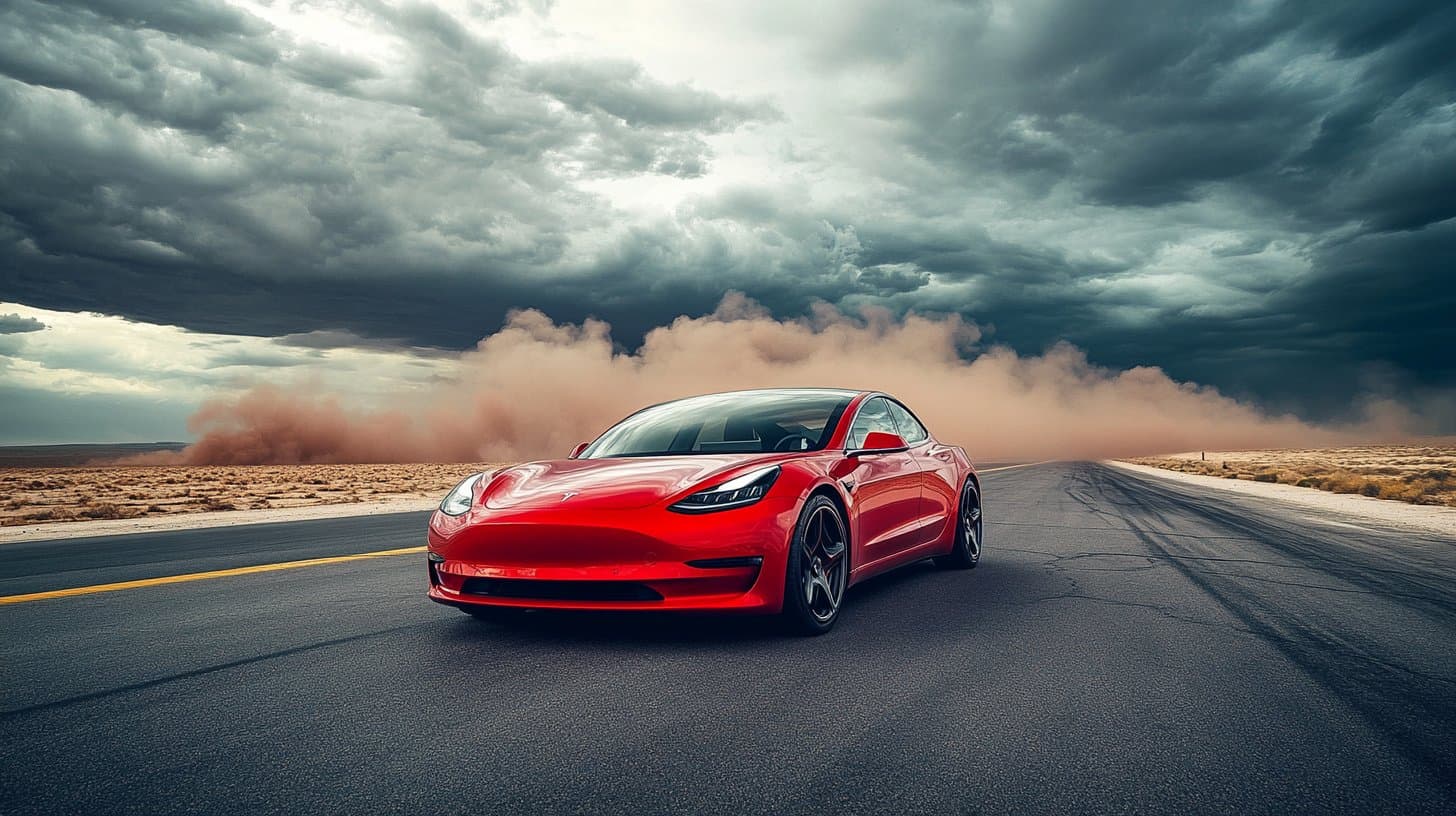
Dodge bet everything on making an electric muscle car. The Dodge Charger Daytona is the result — a 670-horsepower, tire-shredding sedan that swaps the legendary HEMI V8 for a dual-motor electric powertrain. The question isn't whether it's fast. It's whether it can still feel like a real Charger without the rumble of eight cylinders. After spending a week behind the wheel, we have our answer.
The Numbers: 670 Horsepower and a Simulated Exhaust
The Dodge Charger Daytona in its range-topping R/T Scat Pack trim produces 670 horsepower from its dual-motor all-wheel-drive setup. That translates to a blistering 3.3-second 0-60 mph sprint — faster than the Hellcat ever was. The 100.5 kWh battery delivers an EPA-estimated 317 miles of range, and DC fast charging at up to 350 kW can add roughly 100 miles in under 10 minutes.
Then there's the elephant in the room: the Fratzonic Chambered Exhaust system. Dodge engineered an actual tuned chamber in the car's body that amplifies sound from an internal speaker, producing up to 126 decibels of simulated exhaust noise. It's not a recording played through the stereo — it's a physical resonance chamber that vibrates the air around you. Whether that's brilliant or absurd depends entirely on who you ask.
Charger Daytona Key Specs
670
Horsepower
3.3s
0-60 mph
317
Miles Range
126
dB Exhaust
What It's Like to Drive
Plant your right foot and the Charger Daytona launches with the kind of ferocity that pins you into the seat and makes passengers grab the door handle. The instant torque is staggering — there's no turbo lag, no waiting for the powerband, just a wall of acceleration that doesn't let up until you ease off or run out of nerve. It is, without question, the fastest production Charger ever built.
At nearly 5,400 pounds, the Daytona is heavy. You feel that weight in transitions and tight corners, where the car leans more than a Porsche Taycan or Tesla Model S would. But Dodge has done impressive work with the suspension tuning. The adaptive dampers keep the body remarkably composed during hard driving, and the low center of gravity from the floor-mounted battery pack means it feels planted and predictable even when you're pushing hard. It drives like a muscle car that went to engineering school — raw power wrapped in genuine competence.
The Fratzonic exhaust is where opinions split sharply. In quiet mode, the car is whisper-silent like any EV. Turn it up and the cabin fills with a deep, rumbling growl that rises in pitch with the accelerator. It doesn't sound like a V8 — it sounds like something new, something deliberately synthetic but unapologetically aggressive. Muscle car purists will either love it as a bridge to the electric future or dismiss it as gimmickry. There's no middle ground.
The Design: Classic Proportions, Modern Execution
Dodge didn't try to make the Charger Daytona look like a spaceship. The silhouette is unmistakably Charger — a long hood, short rear deck, wide haunches, and that signature full-width rear taillight bar. The R-Wing front end features a blacked-out grille with an illuminated Fratzog badge, and the muscular fender flares house staggered 20-inch wheels that fill the arches perfectly.
Up close, the EV details emerge: flush door handles, a sealed front fascia with active aero elements, and a subtle rear diffuser. The paint options include several heritage-inspired colors like B5 Blue and TorRed alongside modern metallics. It looks aggressive without trying too hard, and it turns heads at every gas station you'll never need to visit again.
Compared to the Gas Charger
The last-generation Charger R/T Scat Pack made 485 horsepower from its 6.4-liter HEMI V8 and hit 60 in about 4.3 seconds. The electric Daytona is a full second faster. The gas Charger got around 18 mpg combined; the Daytona's equivalent is roughly 95 MPGe. In every measurable metric — acceleration, efficiency, technology — the electric version wins.
Where the gas Charger still holds sentimental advantage is sound. The HEMI's idle lope and full-throttle scream are irreplaceable. The Fratzonic system is clever, but it's an approximation, not a replication. If the sound of a naturally aspirated V8 is the entire reason you buy a muscle car, the Daytona will feel like a compromise. If you care more about going fast and staying modern, it's an upgrade in every way.
Compared to the Tesla Model 3 Performance
The Tesla Model 3 Performance is a natural cross-shop, and the two cars could not be more philosophically different. The Tesla is a minimalist tech appliance — sparse interior, silent operation, over-the-air updates, and a focus on efficiency above all else. The Charger Daytona is an emotional machine that screams (literally) at you while delivering muscle car theater at every stoplight.
On paper, the Model 3 Performance is lighter, more efficient, and less expensive at around $47,000. The Daytona starts at roughly $55,000 for the base model and climbs to $68,000 for the Scat Pack. But the Charger offers something no Tesla can: a sense of occasion. Every drive feels like an event, not an errand. That intangible quality is either worth the premium or it isn't — and only you can make that call.
Ownership Costs: Is $55K Justified for a Dodge?
Let's address the elephant in the room: $55,000 is a lot of money for a Dodge. The brand has historically competed on value, offering big power at accessible prices. The gas Charger Scat Pack started around $45,000. Asking ten grand more for the electric version — even with more power — pushes the Charger into territory occupied by BMW, Genesis, and Tesla.
The ownership cost math does tilt in the Daytona's favor over time. Electricity costs roughly $500–$700 per year for average driving compared to $2,500+ for premium gas in the old HEMI. Maintenance drops significantly without oil changes, transmission servicing, or exhaust repairs. Dodge offers an 8-year/100,000-mile battery warranty, and the EV powertrain has far fewer moving parts to wear out. Over a five-year ownership period, the total cost of ownership may actually be lower than the gas Charger despite the higher purchase price.
Who Should Buy the Charger Daytona?
The Dodge Charger Daytona is built for muscle car enthusiasts who are ready to make the leap to electric. If you grew up loving Chargers, Challengers, and Mustangs but recognize that the future is electric, this car was designed specifically for you. It respects the heritage while embracing the technology, and it does so with a swagger that no other EV on the market can match.
This is not the car for EV purists who value efficiency, minimalism, and silent running above all else. Those buyers are better served by a Tesla, a Hyundai Ioniq 6, or a Lucid Air. The Daytona is loud, brash, and deliberately excessive — and that's exactly the point. It's an EV that doesn't apologize for being fun.
The Verdict
The Dodge Charger Daytona is bold, fast, and genuinely fun to drive. It proves that an electric muscle car isn't a contradiction in terms — it's an evolution. The 670 horsepower, 3.3-second 0-60 time, and 317 miles of range make it competitive with the best performance EVs on the market, while the Fratzonic exhaust and aggressive styling give it a personality that nothing else in the EV space can replicate.
It's expensive for a Dodge, and the simulated exhaust won't convert everyone. But as the best electric muscle car you can buy — and really, the only one — it holds a unique position in the market. Dodge didn't just electrify the Charger. They made an electric car that actually has a soul. Whether that soul speaks to you is the only question that matters.
Rating: 8.2 / 10 — A thrilling electric muscle car that trades some refinement for raw personality. Not for everyone, but unforgettable for the right buyer.