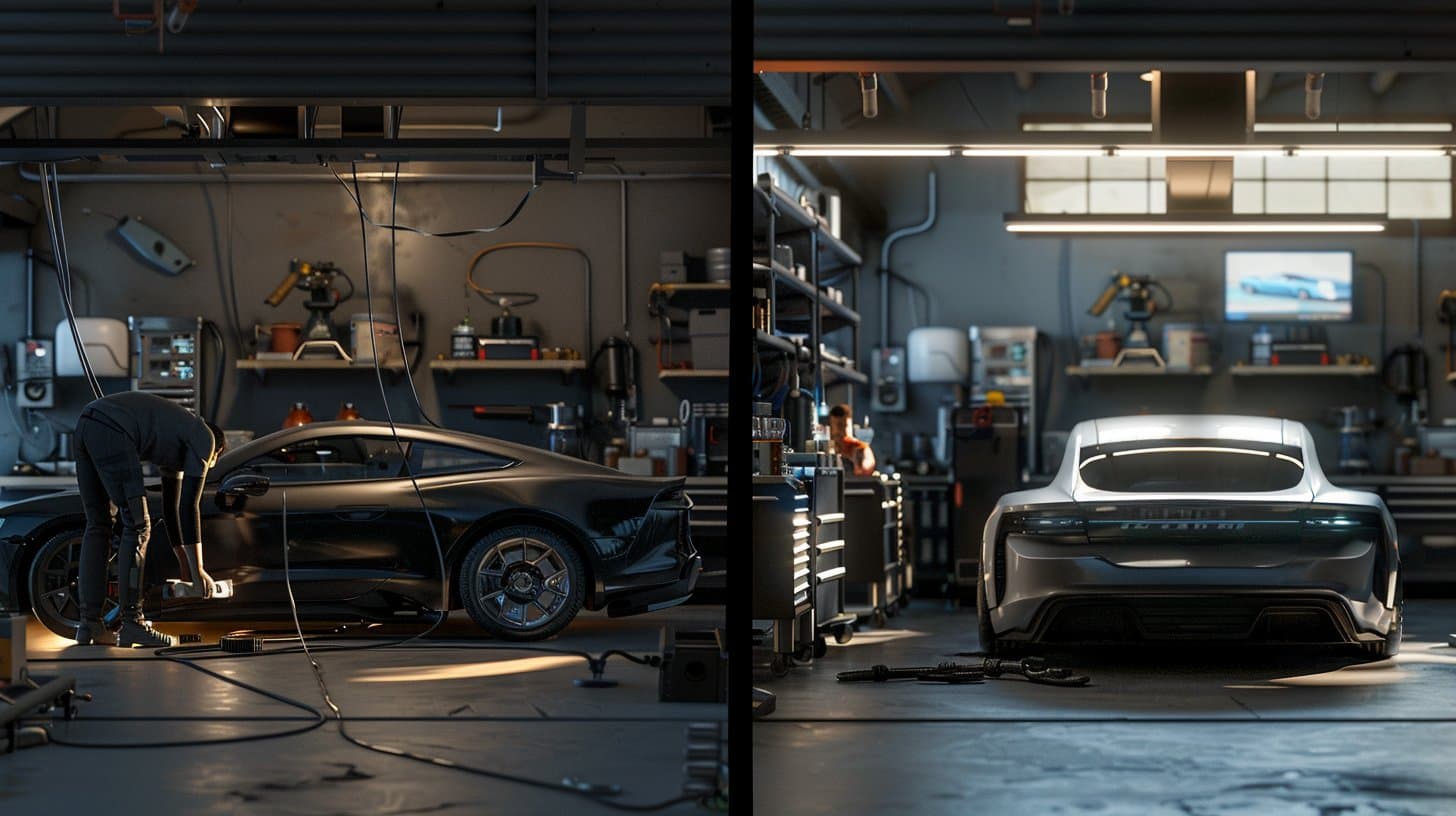
One of the biggest selling points of electric vehicles is lower maintenance costs. But how much lower, exactly? We dug into real-world data from EV owners, manufacturer service schedules, and independent repair shops to build a side-by-side 5-year cost comparison. The results are clear — and they're even better than most people expect.
What EVs Don't Need — The Parts That Don't Exist
The biggest maintenance savings come from parts that simply aren't in an electric vehicle. An EV has no internal combustion engine, which means no oil changes, no transmission fluid, no exhaust system, no spark plugs, no timing belt, no fuel filter, and no radiator. These are some of the most common and expensive maintenance items on gas cars, and they're completely eliminated.
A gas car's engine has hundreds of moving parts that wear against each other, generate heat, and require constant lubrication. An EV's electric motor has as few as one moving part — the rotor. There's nothing to combust, nothing to lubricate with oil, and nothing to exhaust. The drivetrain is fundamentally simpler, and simpler means cheaper to maintain.
Eliminated Maintenance Items
$50–$100 × 2–4/yr
$150–$400 every 60K mi
$200–$600 replacement
$100–$300 every 30–100K mi
$500–$1,000 every 60–100K mi
$50–$150 every 20–40K mi
What EVs Still Need — The Real Maintenance List
EVs aren't maintenance-free. They still have tires, brakes, suspension, a 12V battery, cabin air filters, wipers, and a thermal management system. Here's what each item actually costs.
Tires — $600–$1,200 Every 25,000–40,000 Miles
$600–$1,200 (set of 4)
25,000–40,000 miles
$30–$60 every 5K–7.5K mi
Heavier cars = faster wear
Tires are the single biggest recurring cost for EV owners. Electric vehicles are heavier than equivalent gas cars (battery weight) and deliver instant torque, both of which accelerate tire wear. Using EV-specific low-rolling-resistance tires helps extend life and maximize range. Budget about $200–$300 per year for tires and rotations.
Brakes — $0–$300 Over 100,000 Miles
Often never needed
$80–$150 every 2–3 years
Regenerative braking
$300–$800 every 30–50K mi
Thanks to regenerative braking, most EV owners never replace brake pads during normal ownership. The electric motor does most of the slowing, with friction brakes only needed for hard stops. Many Tesla and Hyundai owners report original brake pads lasting well past 100,000 miles. Brake fluid still needs replacement every 2–3 years as it absorbs moisture over time.
Cabin Air Filter — $20–$50 Every 15,000–20,000 Miles
$20–$50
Every 15,000–20,000 miles
Easy — 5 minutes
Yes, identical
One of the few items that's identical between EVs and gas cars. Easy to do yourself in minutes.
Wipers, 12V Battery, Coolant
$20–$50/year
$100–$300 every 4–5 years
$100–$250 every 50–100K mi
~$80/year combined
These smaller items add up to modest annual costs. The 12V battery powers accessories and computers, and lasts 4–5 years like in any car. Battery coolant maintains optimal temperature for the high-voltage pack and typically needs service once during a 5-year ownership period.
The 5-Year Maintenance Cost Comparison
Here's the full picture. We calculated 5-year maintenance costs for both vehicle types assuming 12,000 miles per year (60,000 miles total), using average 2026 service pricing.
5-Year Maintenance Breakdown (60,000 Miles)
| Item | Gas Car | EV |
|---|---|---|
| Oil Changes | $600 | $0 |
| Brake Pads/Rotors | $400 | $0 |
| Brake Fluid | $200 | $200 |
| Transmission Service | $250 | $0 |
| Spark Plugs | $200 | $0 |
| Tires (2 sets + rotations) | $700 | $900 |
| Cabin Air Filter | $120 | $120 |
| Wiper Blades | $150 | $150 |
| 12V Battery | $150 | $150 |
| Battery Coolant | $0 | $120 |
| Engine Coolant | $150 | $0 |
| Belts/Hoses | $100 | $0 |
| 5-Year Total | $3,020 | $1,640 |
EVs cost 46% less to maintain over 5 years — saving $1,380
The only category where EVs cost more is tires, due to heavier vehicle weight causing faster wear. Every other category is either equal or dramatically cheaper. And this comparison doesn't even include fuel savings — add another $4,000–$5,000 in electricity vs gas savings over 5 years, and the total cost-of-ownership advantage becomes enormous.
The Battery Question — What About Replacement?
The elephant in the room is always battery replacement. A new EV battery pack costs $5,000–$15,000 depending on the vehicle. But here's the reality: you almost certainly won't need one.
Every EV sold in the US carries a federal-mandated 8-year/100,000-mile battery warranty (10 years in California and CARB states). Real-world data from millions of EVs now shows that most batteries retain 85–95% of their original capacity after 8 years of normal use. Tesla's fleet data shows an average of 88% capacity remaining after 200,000 miles. Hyundai and Kia's 800V batteries are showing even lower degradation rates.
For comparison, a gas car's engine and transmission can fail catastrophically at any time — and a replacement engine costs $3,000–$7,000, while a transmission runs $2,000–$5,000. The risk profile isn't as different as people assume.
The Bottom Line
EVs cost roughly half as much to maintain as gas cars. Over a typical 10-year ownership period, you'll save $2,500–$3,000 on maintenance alone. Combined with fuel savings of $8,000–$10,000 over the same period, the total operating cost advantage of an EV is $10,000–$13,000. That's real money — and it closes the purchase price gap faster than most buyers realize.
Ready to Cut Your Maintenance Costs in Half?
Compare real-time pricing on the lowest-maintenance vehicles on the road. Our EV Best Price Finder tracks deals across Carvana, CarMax, AutoTrader, and dealer inventory.
Browse EV DealsRelated Reading
EV Best Price Finder
Compare real-time pricing across 50 EV models from top sources.
BrowseExplore All EV Brands
Detailed specs, reviews, and deals organized by manufacturer.
GuideCheapest EVs to Own in 2026
Total cost of ownership rankings including purchase price, fuel, and maintenance.
GuideEV Home Charging Complete Guide 2026
Everything you need to know about Level 1, Level 2, and home charging setup.