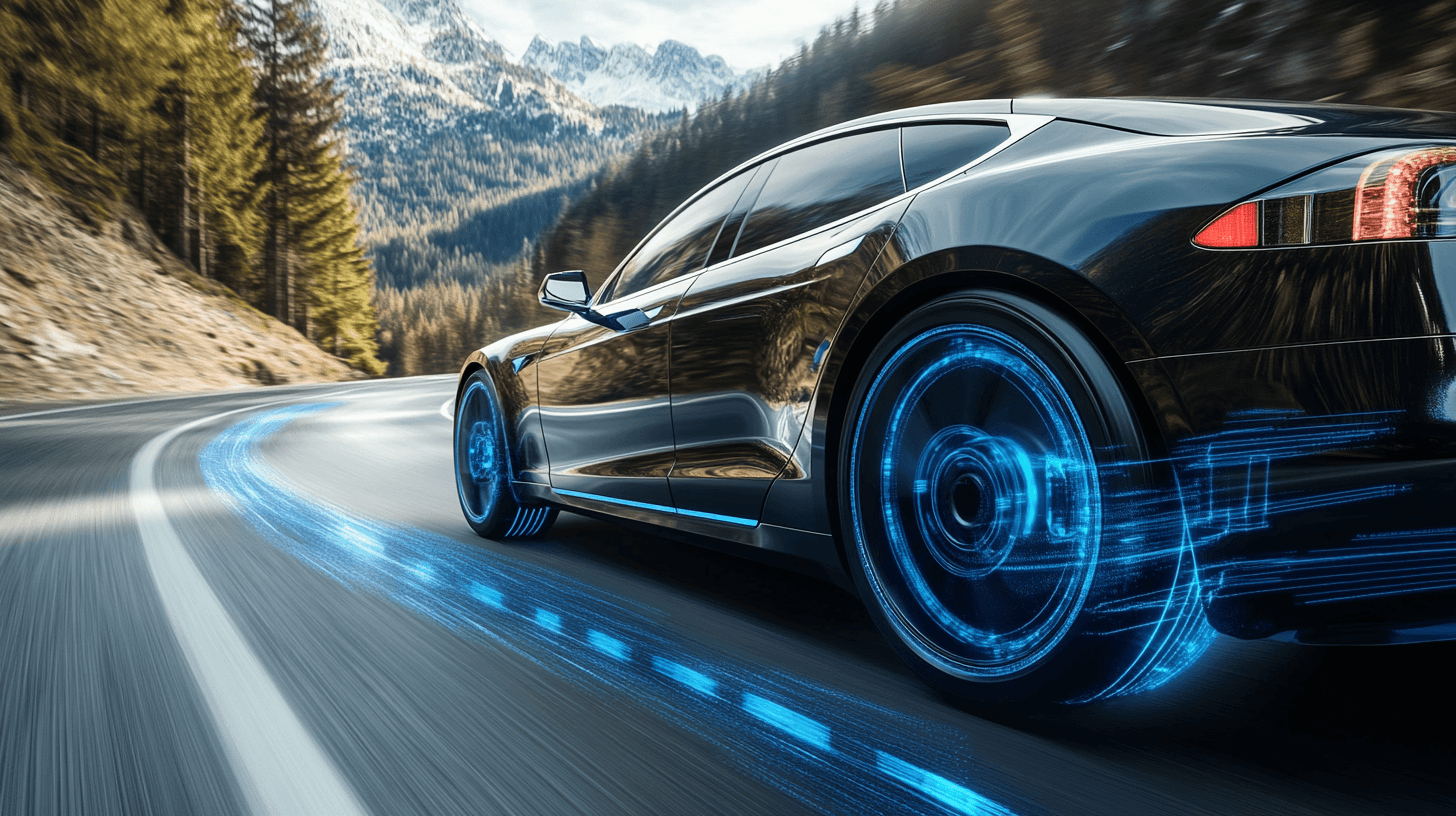
Every time you lift off the accelerator in an EV, something remarkable happens — the electric motor reverses its role and becomes a generator, converting your car's kinetic energy back into electricity and feeding it to the battery. This is regenerative braking, and it's one of the key reasons EVs are so efficient.
How Regenerative Braking Works
In a gas car, braking converts kinetic energy into heat through friction pads pressing against rotors. That energy is wasted — it dissipates into the air. In an EV, regenerative braking captures a portion of that energy before friction brakes are needed:
- You lift off the accelerator — The motor controller detects reduced throttle input.
- The motor becomes a generator — Instead of consuming electricity to spin the wheels, the motor uses the wheels' rotation to generate electricity.
- Resistance creates deceleration — The generator effect creates electromagnetic resistance, which slows the car. This feels like engine braking in a manual transmission car, but much stronger.
- Energy flows back to the battery — The generated electricity is routed through the inverter and stored in the battery pack, extending your range.
- Friction brakes engage if needed — At very low speeds or during hard braking, traditional friction brakes supplement the regenerative system.
How Much Energy Does It Recover?
The amount of energy recovered depends on driving conditions, speed, and the vehicle's regen system:
| Driving Scenario | Energy Recovery | Range Impact |
|---|---|---|
| City driving (stop-and-go) | 15-25% | +30-60 miles on 300mi battery |
| Suburban (mixed) | 10-15% | +20-40 miles |
| Highway (steady speed) | 3-8% | +5-15 miles |
| Mountain descent | 20-40% | Significant recovery |
City driving benefits most from regen because you're constantly decelerating. Highway driving benefits least because you're maintaining steady speed with minimal braking events. This is why EVs often get better "MPGe" in city driving than highway — the opposite of gas cars.
One-Pedal Driving
Most modern EVs offer a "one-pedal driving" mode that maximizes regenerative braking. In this mode, lifting off the accelerator produces strong enough deceleration that you rarely need the brake pedal.
- ✓How it works — The regen is set to maximum. Lifting your foot fully off the accelerator can produce 0.2-0.3g of deceleration — enough to bring the car to a complete stop in most situations.
- ✓Benefits — Less brake wear (some EV owners go 150,000+ miles on original brake pads), more energy recovery, and once you adapt, it feels more intuitive and relaxing than two-pedal driving.
- ✓Adaptation period — Most drivers adjust within 1-2 weeks. The key is learning to modulate the accelerator pedal for smooth deceleration rather than binary on/off inputs.
Regen Levels by Manufacturer
| Manufacturer | Regen Options | One-Pedal? |
|---|---|---|
| Tesla | Standard (strong by default) | Yes (default on newer models) |
| Hyundai/Kia (E-GMP) | 4 levels + i-Pedal via paddle shifters | Yes (i-Pedal mode) |
| BMW | Adaptive, low, medium, high | Yes (B mode) |
| Rivian | Standard and high | Yes |
| Ford (Mach-E) | Normal and one-pedal | Yes (L mode) |
| Mercedes (EQ) | 4 levels + adaptive via paddles | Yes (D-- mode) |
Hyundai/Kia's paddle shifter regen control is particularly well-regarded — you can adjust regen strength on the fly without taking your hands off the wheel.
When Regen Braking Is Limited
- ✕Battery is fully charged — A 100% full battery can't accept more energy. Regen is reduced or disabled until the battery has room. This is one reason to avoid charging to 100% before driving downhill.
- ✕Very cold battery temperatures — Cold lithium-ion cells can't absorb energy efficiently. Regen is reduced until the battery warms up. Preconditioning the car while plugged in helps.
- ✕Very low speeds — Below roughly 5-10 mph, regen produces minimal deceleration. The car blends in friction brakes to bring you to a complete stop.
- ✕Emergency braking — Hard emergency stops always engage friction brakes. Regen alone can't produce the stopping force needed in a panic situation.
The Brake Wear Benefit
Because regen handles most deceleration, EV brake pads and rotors last dramatically longer than gas car brakes:
- •Gas car brake pads: 30,000-50,000 miles typical replacement interval
- •EV brake pads (with regen): 100,000-200,000+ miles — many EVs reach end of life without ever replacing brake pads
The downside: since the brakes are used so infrequently, the rotors can develop surface rust. Occasional moderate braking on a dry road helps keep the rotors clean.
Tips for Maximizing Regen Efficiency
- ✓Anticipate stops — Lift off the accelerator early and let regen slow you gradually. Sudden braking wastes energy as heat in the friction brakes.
- ✓Use one-pedal mode in city driving — Maximum regen in stop-and-go traffic recovers the most energy.
- ✓Don't charge to 100% before a downhill commute — Leave room in the battery for regen to work. Charging to 80% gives you a buffer.
- ✓Precondition in cold weather — A warm battery accepts regen energy more efficiently. Start preconditioning while plugged in.
- ✓Use lower regen on highways — On constant-speed highway driving, lower regen settings reduce the jerkiness from small throttle adjustments and improve ride smoothness.
Final Verdict
Regenerative braking is one of the most tangible advantages of electric driving. It extends range by 10-25%, virtually eliminates brake maintenance, and once you adjust to one-pedal driving, it makes the experience smoother and more intuitive.
If you're new to EVs, give one-pedal mode at least two weeks before deciding. Almost everyone who commits to the learning curve prefers it permanently. It transforms driving from a two-foot activity into something more like controlling a video game — precise, responsive, and oddly satisfying.