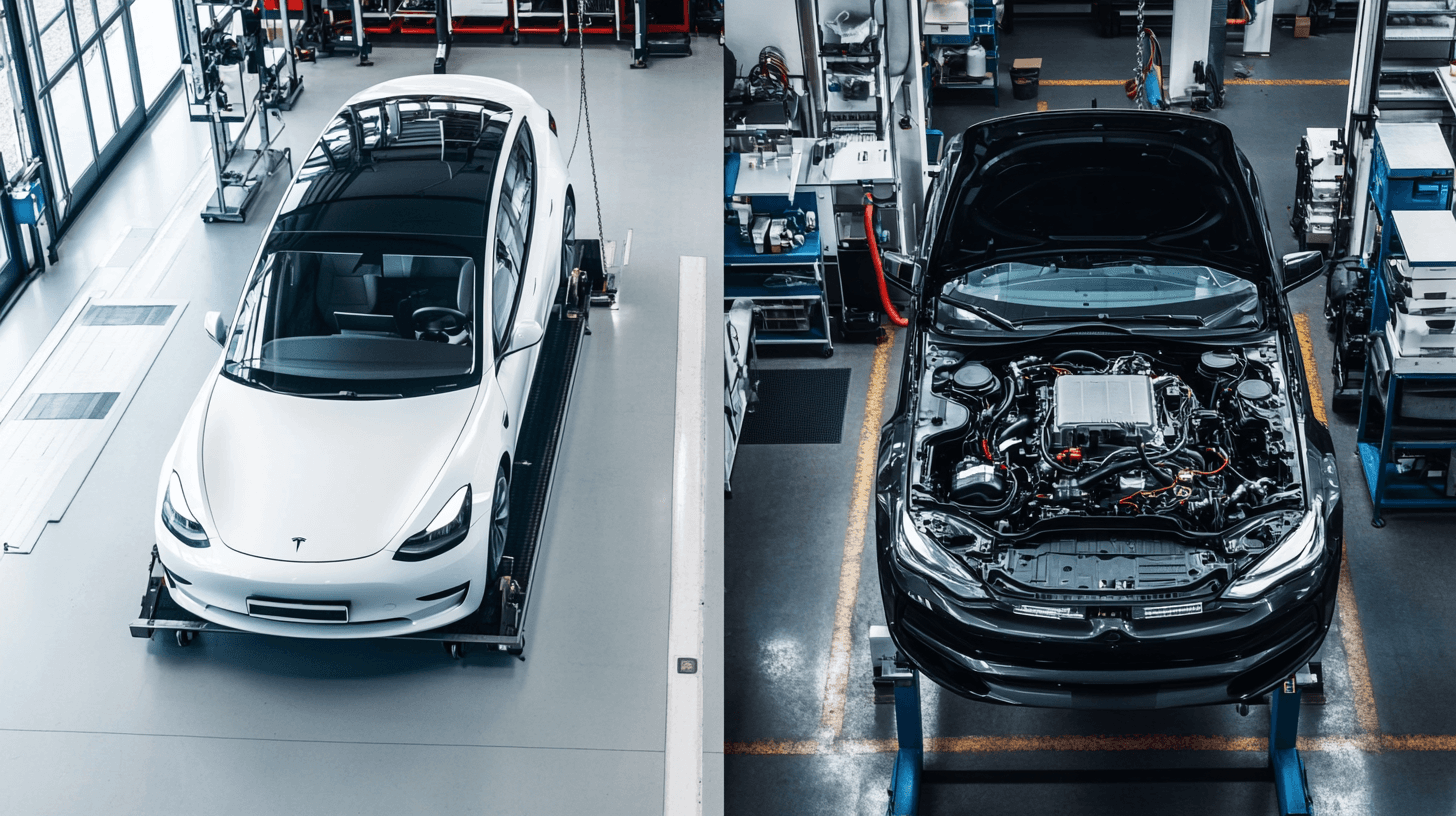
One of the biggest selling points of electric vehicles is lower maintenance costs. But how much do you actually save? The answer depends on what you drive, how long you keep it, and which costs you're comparing. Here's a detailed breakdown of every major maintenance category — EV vs gas.
The Big Picture
According to data from AAA and Consumer Reports, EV owners spend roughly 40-50% less on maintenance over the life of the vehicle compared to gas car owners. The primary reason: EVs have far fewer moving parts — no engine, transmission, exhaust system, or oil to maintain.
~$0.06/mile
Average EV maintenance cost
~$0.10/mile
Average gas car maintenance cost
Category-by-Category Breakdown
Oil Changes — EV: $0 | Gas: $600 - $1,200/year
Electric vehicles have no engine oil. This is the most obvious and immediate savings. A gas car needs oil changes every 5,000 - 7,500 miles, costing $40 - $100 each (or $150+ for synthetic in luxury vehicles). Over 5 years of typical driving, that's $2,000 - $5,000 in oil changes alone.
EV advantage: $2,000 - $5,000 saved over 5 years
Brakes — EV: 50-70% less | Gas: Standard wear
EVs use regenerative braking, which recaptures energy and dramatically reduces wear on the physical brake pads and rotors. Many EV owners go 100,000+ miles before needing brake pad replacement. Gas cars typically need new pads every 30,000 - 50,000 miles ($150 - $400 per axle).
EV advantage: $1,000 - $2,000 saved over 100k miles
Transmission — EV: $0 | Gas: $500 - $3,500
EVs use a simple single-speed reduction gear with no traditional transmission. No transmission fluid changes, no clutch wear, no torque converter issues. Gas cars need transmission fluid changes ($150 - $300) and can face costly transmission repairs or replacement ($1,500 - $3,500) as they age.
EV advantage: $500 - $3,500 saved over vehicle lifetime
Tires — EV: Slightly more | Gas: Standard
This is one area where EVs cost more. EVs are heavier (due to the battery pack) and produce instant torque, which wears tires faster. EV-specific tires designed for the extra weight and low rolling resistance cost 10-20% more than standard tires. Expect to replace EV tires every 25,000 - 35,000 miles vs 40,000 - 50,000 for gas cars.
Gas advantage: $500 - $1,000 saved over 5 years
Coolant System — EV: Minimal | Gas: Moderate
Both EVs and gas cars have cooling systems, but they work differently. EVs use a thermal management system for the battery and motor that's largely sealed and low-maintenance. Gas cars need coolant flushes every 30,000 - 50,000 miles ($100 - $200) plus potential radiator, thermostat, and water pump repairs.
EV advantage: $300 - $800 saved over 5 years
Exhaust System — EV: $0 | Gas: $200 - $2,000
EVs have no exhaust system. Gas cars have catalytic converters, mufflers, exhaust pipes, and O2 sensors — all of which degrade over time and can be expensive to replace, especially catalytic converters ($1,000 - $2,500).
EV advantage: $200 - $2,000 saved over vehicle lifetime
Battery — EV: Warranty-covered | Gas: N/A
The EV battery is the elephant in the room. Replacement costs $10,000 - $25,000+, but most EV batteries are warranted for 8 years / 100,000 miles and are designed to retain 70-80% capacity over that period. Out-of-warranty battery replacement is rare but expensive. Gas cars have their own costly long-term component: engine rebuild or replacement ($3,000 - $7,000+).
Depends on vehicle age and warranty coverage
5-Year Cost Comparison
| Category | EV (5 years) | Gas Car (5 years) |
|---|---|---|
| Oil changes | $0 | $2,000 - $4,000 |
| Brake pads/rotors | $0 - $300 | $600 - $1,200 |
| Transmission service | $0 | $300 - $600 |
| Tires | $1,600 - $2,400 | $1,200 - $1,800 |
| Coolant/fluids | $0 - $100 | $200 - $400 |
| Cabin air filter | $50 - $100 | $50 - $100 |
| Wiper blades | $60 - $120 | $60 - $120 |
| Total (5 years) | $1,710 - $3,020 | $4,410 - $8,220 |
*Based on 12,000 miles/year average driving. Excludes insurance, fuel/electricity, and depreciation.
The Hidden EV Costs
EVs aren't maintenance-free. Here are the costs that catch some owners off guard:
- •12V battery replacement — EVs still have a 12V battery for accessories. It fails every 3-5 years and costs $100 - $300 to replace.
- •Suspension wear — The extra weight of the battery pack puts more stress on suspension components. Struts and shocks may need replacement sooner.
- •Higher insurance — Not maintenance per se, but EV insurance averages 15-30% more due to higher repair costs.
- •Specialized repair labor — When something does go wrong, EV-certified technicians charge more per hour, and fewer shops can do the work.
Final Verdict
EVs are significantly cheaper to maintain over time. The elimination of oil changes, reduced brake wear, and no transmission or exhaust system create real savings that add up to thousands of dollars over a 5-year ownership period.
The main exception is tires (EVs cost more) and the long-term battery question (which is largely covered by warranty). For most owners driving a mainstream EV, maintenance savings of $3,000 - $5,000 over 5 years are realistic.