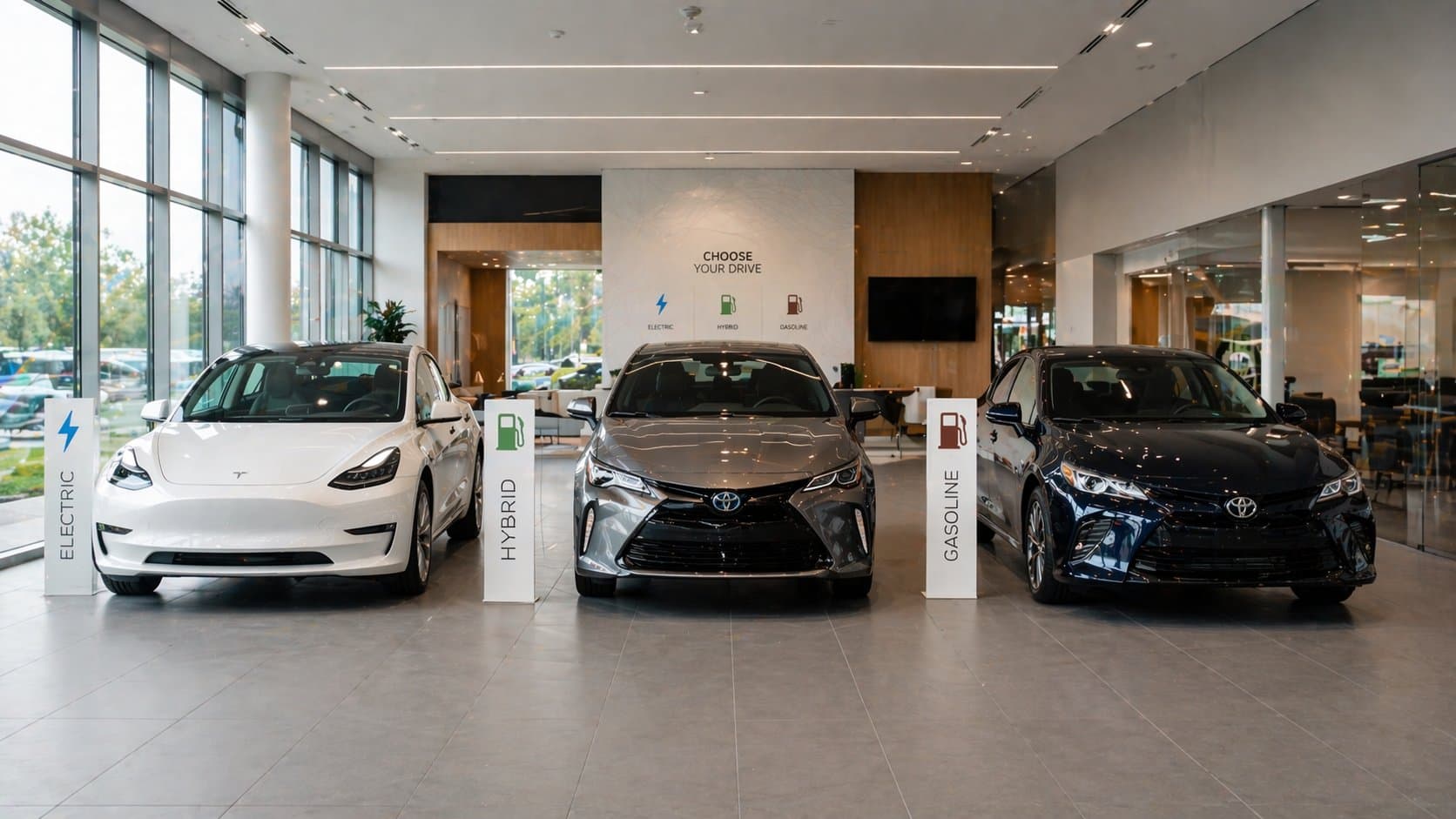
The powertrain decision in 2026 isn't as simple as “electric is the future, buy an EV.” For some drivers, a hybrid makes more financial sense. For others, a gas car is still the practical choice. And for many, an EV is genuinely the best option — but not for the reasons the marketing suggests. This guide strips away the ideology and looks at the math, the practicalities, and the real-world trade-offs of each powertrain for YOUR driving pattern in 2026.
The Quick Answer
If you drive fewer than 50 miles daily, have home charging, and keep cars 5+ years: buy an EV. The math is overwhelmingly in your favor.
If you drive long distances regularly, can't charge at home, or need to tow heavy loads: buy a hybrid. You get 40–60 MPG, fuel anywhere, and no range anxiety.
If you're budget-constrained, drive a beater, or live in an area with no charging infrastructure: gas is still fine. Don't feel pressured into a powertrain that doesn't fit your life.
The Real Cost Comparison
Purchase Price (MSRP)
The EV price premium has shrunk dramatically but still exists. Comparing equivalent vehicles in the compact SUV segment:
Toyota RAV4 (Gas): $30,525. Toyota RAV4 Hybrid: $33,425. Toyota bZ4X (EV): $37,070. Chevrolet Equinox (Gas): $30,300. Chevrolet Equinox EV: $33,900.
The EV premium ranges from $3,000–$7,000 over gas equivalents. The Equinox EV at $33,900 has nearly closed the gap with its gas counterpart — a $3,600 premium that's recovered in fuel savings within 2–3 years. See our full EV vs gas total cost of ownership analysis for a deeper dive.
Fuel Cost Per Mile
This is where EVs dominate:
Gas (30 MPG, $3.50/gal): $0.117 per mile — $1,750 annually at 15K miles. Hybrid (50 MPG, $3.50/gal): $0.070 per mile — $1,050 annually. EV ($0.14/kWh, 3.5 mi/kWh): $0.040 per mile — $600 annually. EV home off-peak ($0.08/kWh): $0.023 per mile — $345 annually.
An EV charging at home off-peak rates costs approximately $345 per year in fuel — compared to $1,750 for a 30 MPG gas car. That's $1,400 per year in savings, or $7,000 over five years — more than enough to recover any EV purchase premium. See our 2026 gas prices and EV savings breakdown for regional numbers.
Maintenance Cost
EVs have fewer moving parts: no oil changes, no transmission service, no timing belt, no spark plugs, no exhaust system. Annual maintenance for an EV averages $400–$600 versus $800–$1,200 for a gas car and $700–$1,000 for a hybrid.
Over five years, EV maintenance savings total $2,000–$3,000 compared to gas. Combined with fuel savings, the total cost of ownership advantage for EVs is $9,000–$10,000 over five years for a driver covering 15,000 miles annually.
When Each Powertrain Wins
Buy an EV When:
You have access to home charging (a garage with a 120V or 240V outlet), your daily driving is under 200 miles (the vast majority of people), you keep vehicles for 5+ years (maximizes fuel and maintenance savings), you have a second vehicle for rare occasions when you need gas-car flexibility, or your state offers additional EV incentives beyond the federal credit. Browse current EV deals to see what fits your budget.
Buy a Hybrid When:
You can't install home charging (apartment, street parking), you regularly drive 300+ miles in a day without time for charging stops, you tow boats, trailers, or heavy loads regularly (hybrid trucks like the Ford Maverick Hybrid offer 42 MPG + towing), you live in a rural area with limited charging infrastructure, or you want fuel savings without lifestyle changes.
Keep Your Gas Car When:
Your current gas car is paid off and reliable — the most environmentally and financially responsible choice is often keeping what you have rather than manufacturing a new vehicle. The break-even point on replacing a paid-off gas car with a new EV is typically 4–6 years — only worth it if you were going to buy a new car anyway.
The Environmental Question
If environmental impact is a deciding factor, the ranking is clear: EV produces the lowest lifetime emissions (even accounting for battery manufacturing and grid electricity), followed by plug-in hybrid, then conventional hybrid, then gas. However, the environmental benefit depends heavily on your local electrical grid — an EV charged on 90% coal power is cleaner than gas but not dramatically so. An EV charged on renewable energy is transformatively cleaner.
The Bottom Line
The 2026 powertrain decision should be based on math, not marketing. Run the numbers for YOUR driving pattern on our EV cost calculator. For most American drivers — suburban commuters with garages who drive 30–50 miles daily — an EV saves $9,000–$10,000 over five years compared to gas, with less maintenance and a better driving experience. For everyone else, hybrids offer a compelling middle ground. And keeping a reliable paid-off gas car is always a valid financial choice.
The best powertrain is the one that fits your life — not the one that fits a narrative.