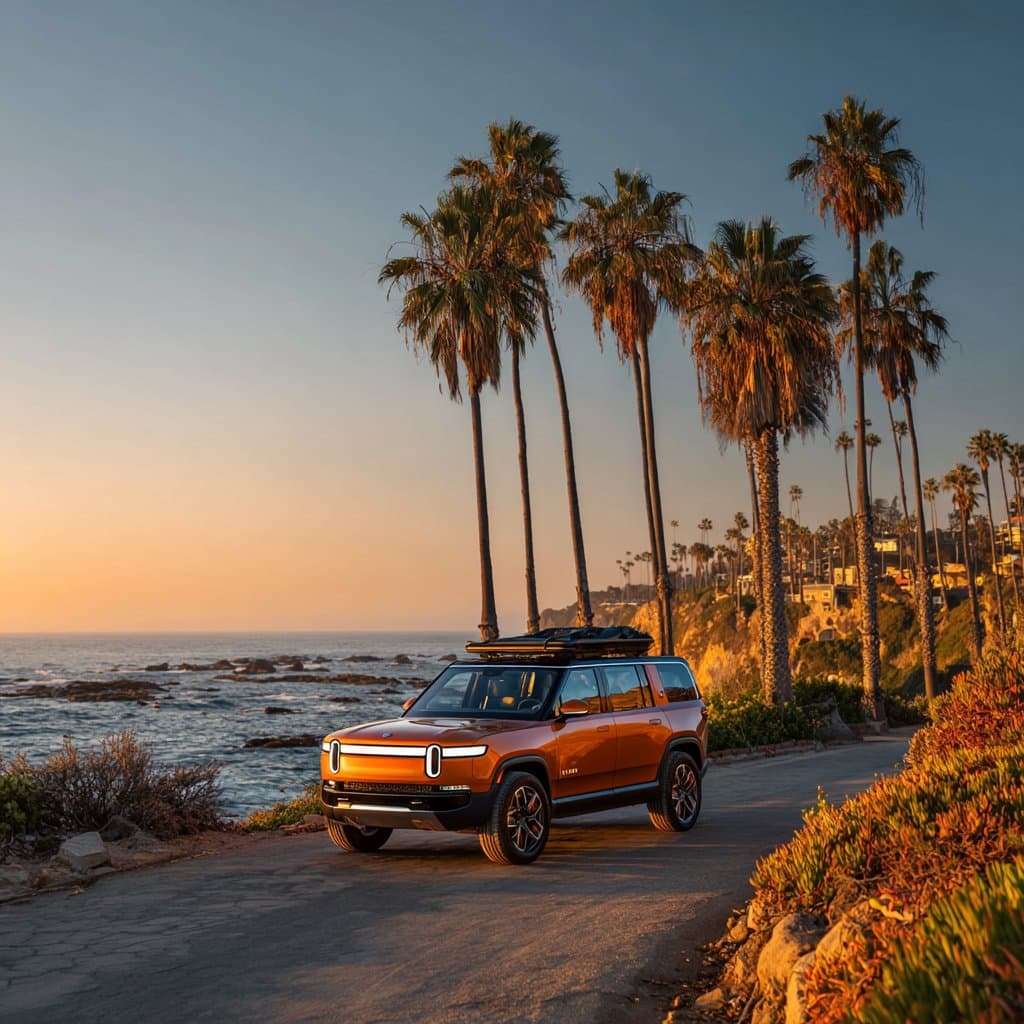
Rivian just had the kind of week that defines a company's trajectory. The R2 compact electric SUV won the 2026 Electric Green Car of the Year from Green Car Journal, beating out strong competition from Lexus, Jeep, Ford, and others across five award categories. And if that wasn't enough, the company also confirmed that its robotaxi service has struck a deal with DoorDash to develop self-driving delivery vehicles.
For a company that spent its early years fighting for survival against production delays, cash burn concerns, and a brutal market, Rivian is suddenly looking like the comeback story of the EV industry.
The R2 — why it won
The Rivian R2 isn't trying to be everything to everyone. It's trying to be one thing exceptionally well: the best compact electric SUV for Americans who actually use their vehicles.
Where the original R1T pickup and R1S SUV were priced above $70,000 — limiting them to a relatively small audience — the R2 brings Rivian's adventure-oriented design philosophy to a price point that real people can afford. Starting around $45,000, it slots directly against the Tesla Model Y, the Hyundai Ioniq 5, and the Ford Mustang Mach-E.
But it does something none of those competitors do quite as well: it makes you feel like every weekend should be an adventure.
The design is unmistakably Rivian — compact proportions, the signature stadium-light headlights, and a rugged-yet-refined stance that looks at home in both a downtown parking garage and a national park campground. The R2 maintains Rivian's signature gear tunnel (a lockable storage compartment that runs through the body of the vehicle between the rear seats and the trunk), though it's smaller than the R1's version.
Range sits at a competitive 300+ miles on the Long Range variant, with an 800-volt electrical architecture supporting fast charging. Rivian's software platform — which has consistently been praised as one of the best in the industry — runs the show, with a clean, responsive interface and over-the-air updates that genuinely add functionality over time.
The Green Car Journal jury specifically cited the R2's combination of “accessible pricing, genuine capability, and a design identity that gives the electric SUV segment personality it has been lacking.”
Robotaxis in Miami and San Francisco
Here's where Rivian's story takes a fascinating turn.
The micromobility company that spun out of Rivian last year has been quietly developing autonomous vehicle technology. They've now announced initial deployments of robotaxi services in San Francisco and Miami, planned for 2028, with an ambitious scaling plan to reach 25 cities by 2031. The total investment commitment: $1.25 billion.
For Florida residents, the Miami deployment is particularly significant. Miami's flat terrain, generally good weather, and grid-based street layout make it one of the more technically feasible cities for autonomous vehicle operations. The DoorDash partnership adds a commercial delivery angle alongside passenger rides, creating multiple revenue streams from the same autonomous vehicle fleet.
This doesn't mean you'll be hailing a self-driving Rivian in two years. Autonomous vehicle deployments always take longer than announced, face regulatory hurdles, and require extensive testing. But the strategic significance is real. Rivian is positioning itself not just as a vehicle manufacturer but as a technology and mobility company.
How the R2 stacks up
Rivian R2 vs Tesla Model Y: The Model Y has Tesla's Supercharger network, years of production refinement, and lower base pricing. The R2 counters with more distinctive design, adventure-ready personality, and Rivian's software experience.
Rivian R2 vs Hyundai Ioniq 5: The Ioniq 5 is one of the best values in the EV market with its 800-volt charging and competitive pricing. The R2 matches it on charging architecture and offers more ground clearance and rugged styling for adventurous buyers.
Rivian R2 vs Ford Mustang Mach-E: Ford's offering has excellent driving dynamics but has been losing sales momentum. The R2's fresher design and newer technology platform give it an edge for tech-forward buyers.
Rivian R2 vs Subaru Solterra: Subaru's electric crossover targets a similar outdoor-adventure buyer, but its specs lag behind in range and charging speed. The R2 is the EV that Subaru loyalists have been waiting for someone to build.

What this means for Florida buyers
The R2 is particularly well-suited to Florida lifestyles:
Beach and outdoor access. Florida's outdoor recreation — from the Keys to the Gulf beaches to the springs — demands a vehicle that's comfortable on highways but capable on unpaved access roads. The R2's raised ride height and standard AWD handle both.
Hurricane preparedness. Rivian vehicles support vehicle-to-load (V2L) capability, which means they can power your home during outages. In a state where hurricanes knock out power regularly, having a massive battery on wheels is genuinely valuable.
The Miami robotaxi connection. If Rivian's autonomous service launches in Miami as planned, early R2 owners in South Florida will have a front-row seat to one of the most significant transportation experiments in the state's history.
The bottom line
The Rivian R2 winning Electric Green Car of the Year validates what the automotive press has been saying since its reveal: this is the vehicle that could make Rivian a mainstream brand. At $45,000, it's competitive with the Model Y and Ioniq 5 while offering a personality and capability set that neither can match. For Florida buyers interested in the R2, production is ramping through 2026. Getting on the reservation list now positions you for delivery later this year or early 2027.