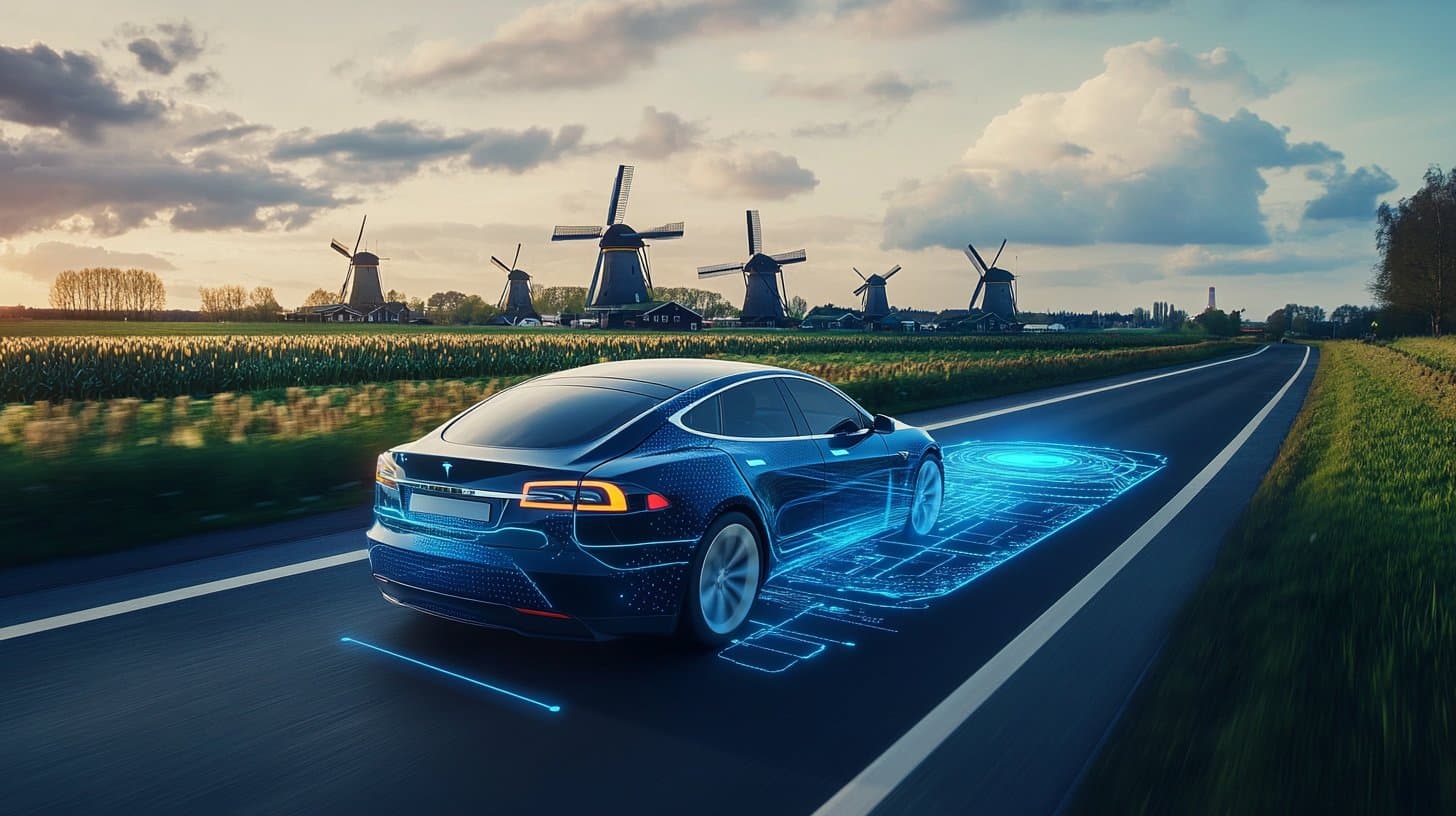
After nearly a decade of development, regulatory battles, and billions of miles of real-world data collection, Tesla's Full Self-Driving system has officially been approved for use on European roads. The European Union's type approval authority confirmed this week that FSD version 13.2 meets all requirements under the UN ECE R157 automated lane-keeping framework and EU General Safety Regulation — making Tesla the first automaker to receive broad approval for a supervised autonomous driving system across EU member states.
This is not a minor software update or a marketing milestone. This is a regulatory sea change. For years, Europe's strict safety standards and privacy regulations were considered an insurmountable barrier for Tesla's camera-based approach to autonomy. The approval signals that regulators have finally become comfortable with AI-driven driving systems — and it opens the door for every other autonomous driving company to follow.
Here's everything you need to know about what FSD can actually do, how Tesla overcame Europe's regulatory hurdles, and what this means for the future of driving on both sides of the Atlantic.
What Full Self-Driving can actually do now
Let's start with what FSD version 13.2 is actually capable of, because the name “Full Self-Driving” has been controversial since Tesla first used it. To be clear: FSD is still a Level 2+ supervised system. The driver must remain attentive and ready to take over at any moment. Tesla's cabin camera monitors driver attention, and the system will disengage if the driver looks away for too long.
That said, what FSD can do within that supervised framework is genuinely impressive. The system can navigate city streets from point A to point B with minimal driver intervention. It handles traffic lights, stop signs, unprotected left turns, multi-lane roundabouts, pedestrian crossings, and complex intersections. It can navigate construction zones, yield to emergency vehicles, and handle merging traffic on highway on-ramps and off-ramps.
On highways, FSD performs automatic lane changes, adjusts speed for traffic conditions, takes exits, and navigates through interchanges. In urban environments, it follows navigation routes through narrow European streets — something Tesla specifically trained the system for ahead of this launch, using data from European Tesla owners who had been running shadow-mode data collection for years.
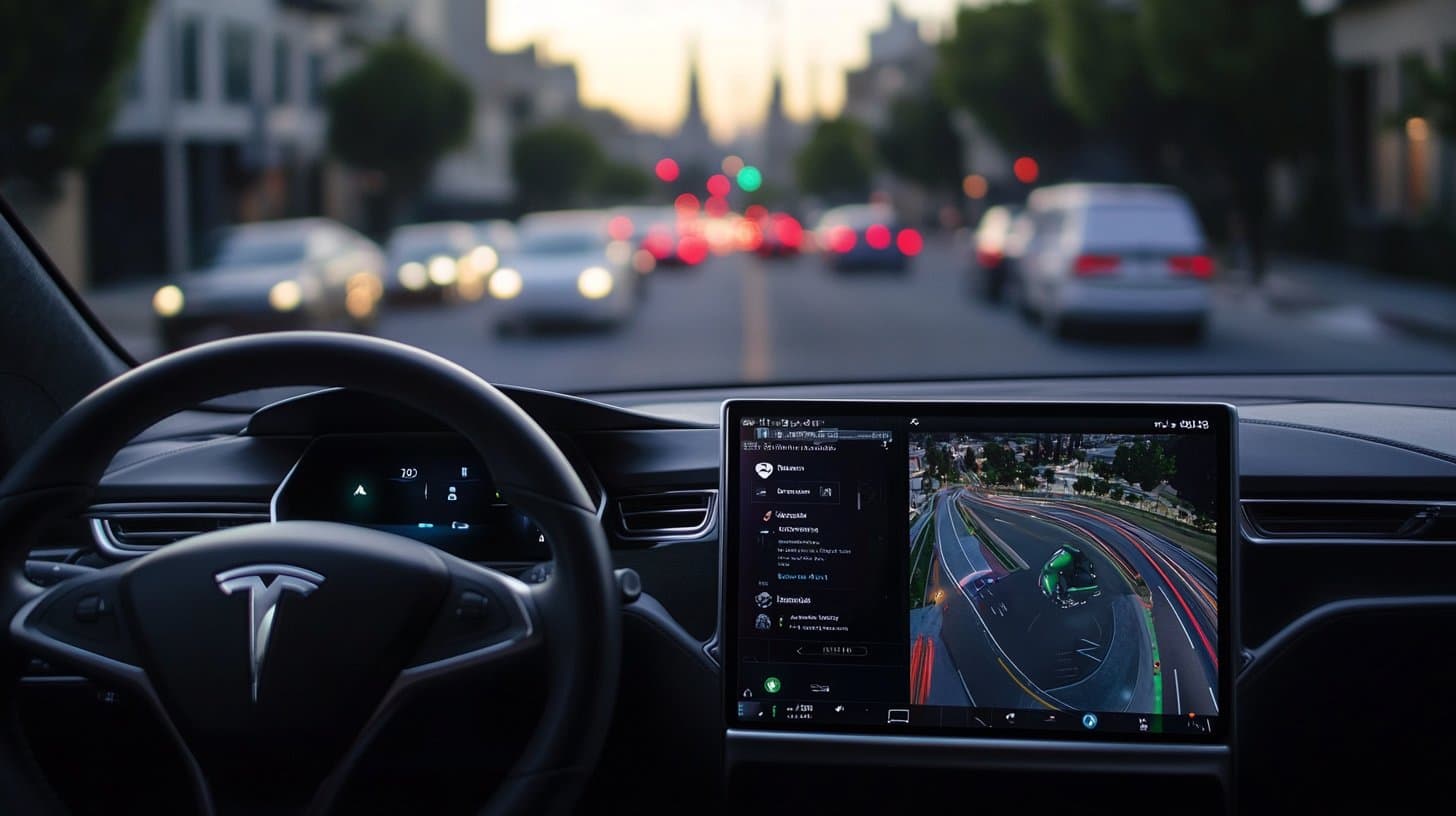
The system processes input from eight cameras, twelve ultrasonic sensors (reintroduced in 2025 after a brief removal), and a forward-facing radar unit that Tesla added to Hardware 4.0 vehicles. All processing happens on Tesla's custom AI inference chip, which runs the neural network models entirely on-vehicle — no cloud connection required for driving decisions.
How FSD differs from basic Autopilot
It's worth distinguishing FSD from Tesla's standard Autopilot, because many people conflate the two. Basic Autopilot is included free with every Tesla and provides traffic-aware cruise control and lane centering on highways. It's essentially a lane-keeping assist — useful on long highway drives but limited to staying in your lane and matching the speed of the car ahead.
Enhanced Autopilot adds automatic lane changes on highways, Navigate on Autopilot (automatic highway routing including taking exits), auto-park, and Summon. It's a significant step up but still confined to structured highway environments.
Full Self-Driving is the full package. It takes everything Enhanced Autopilot does and extends it to city streets, residential neighborhoods, parking lots, and essentially anywhere the car can legally drive. The difference is night and day. With basic Autopilot, you're doing most of the work in urban environments. With FSD, you're supervising the car as it drives itself through those same environments.
The regulatory hurdles Tesla overcame
Getting FSD approved in Europe was arguably harder than developing the technology itself. The EU has some of the strictest automotive safety and data privacy regulations in the world, and Tesla had to satisfy all of them.
UN ECE R157 compliance. This United Nations regulation governs Automated Lane Keeping Systems (ALKS) and sets the framework for how autonomous driving features must behave. Originally designed for Level 3 highway systems like Mercedes Drive Pilot, regulators expanded the framework in 2025 to accommodate Level 2+ supervised systems that operate in urban environments. Tesla had to demonstrate that FSD could safely handle thousands of predefined test scenarios, including edge cases like sensor failure, sudden obstacle appearance, and adverse weather conditions.
EU type approval. Unlike the US, where automakers can largely self-certify their vehicles, Europe requires third-party type approval through designated technical services. Tesla submitted FSD to TÜV SÜD in Germany for testing — a process that took over 18 months and involved more than 2 million kilometers of supervised test driving across 14 EU countries.
GDPR data privacy compliance. This was perhaps the biggest challenge. Tesla's FSD system relies on fleet learning — collecting driving data from Tesla vehicles to improve the neural network. European data privacy advocates argued this amounted to mass surveillance. Tesla's solution was a comprehensive data anonymization pipeline: all camera footage used for training is stripped of identifiable information (faces, license plates) before leaving the vehicle, location data is generalized to region-level accuracy, and European owners must explicitly opt in to data sharing. Tesla also established a dedicated EU data processing center in the Netherlands to ensure driving data never leaves European jurisdiction.
Cyber security certification. Under UN Regulation 155, Tesla had to demonstrate that FSD's software update pipeline is secure against cyber attacks. This included proving that over-the-air updates cannot be intercepted or tampered with, and that the vehicle's driving systems are isolated from its infotainment network.
The long road to approval — a timeline
Tesla's journey to this moment spans a full decade of development.
2016: Tesla begins shipping vehicles with Autopilot Hardware 2.0, which Musk claims contains all the hardware needed for full self-driving. This turns out to be optimistic by about eight years.
2018–2019: Tesla develops its custom Full Self-Driving Computer (Hardware 3.0), replacing the Nvidia-based system. FSD capability is sold as a $7,000 option, later rising to $15,000, despite no timeline for delivery.
October 2020: FSD Beta launches to a small group of US testers. The early versions are rough — impressive in ideal conditions but prone to alarming errors in complex scenarios.
2021–2023: Tesla gradually expands the FSD Beta to more US and Canadian users. Each version improves incrementally, but the system still relies on a stack-based approach with hand-coded rules for many driving scenarios.
Late 2023–2024: The breakthrough. Tesla rewrites FSD from scratch using an end-to-end neural network approach (FSD v12). Instead of explicit programming for every scenario, the system learns driving behavior from millions of hours of human driving data. The improvement is dramatic — interventions drop by over 80% compared to v11.
2025: Tesla introduces Hardware 4.0 with improved cameras and reintroduced radar, begins formal EU type approval testing, and launches the subscription model for FSD in additional markets.
April 2026: EU type approval granted. FSD v13.2 begins rolling out to European Tesla owners via over-the-air update.
How Tesla compares to Mercedes Drive Pilot
Tesla isn't the first company to offer autonomous driving features in Europe. Mercedes-Benz received approval for its Drive Pilot Level 3 system back in 2022 for use in Germany, and has since expanded to several other EU countries. But the two systems are fundamentally different in approach and capability.
Mercedes Drive Pilot is a true Level 3 system, meaning the driver can legally take their hands off the wheel and eyes off the road when it's active. However, it only works on pre-mapped highway segments, at speeds under 60 km/h (about 37 mph), in clear weather, during daylight hours. It's designed for traffic jams on specific stretches of autobahn — useful but extremely limited in scope.
Tesla FSD operates in far more environments — highways, city streets, residential areas, parking lots — but requires the driver to remain attentive at all times. In practice, FSD handles vastly more driving scenarios than Drive Pilot, but Mercedes takes on legal liability when Drive Pilot is active, which Tesla does not.
This legal liability distinction matters enormously. If a Mercedes crashes while Drive Pilot is engaged, Mercedes is responsible. If a Tesla crashes while FSD is engaged, the driver is responsible. It's a philosophical and legal difference that will likely be tested in courts across Europe in the coming years.
What European Tesla owners get
European Tesla owners with compatible hardware can access FSD through two options. The outright purchase price is set at €7,500 — lower than the current US price of $8,000, reflecting Tesla's strategy to drive adoption in a new market. Alternatively, owners can subscribe for €99 per month, matching the US subscription pricing.
Compatible vehicles include any Tesla built after mid-2023 with Hardware 4.0. Older vehicles with Hardware 3.0 are eligible for a paid upgrade to HW4, which involves replacing the computer module and camera suite — a process that takes about four hours at a Tesla service center and costs approximately €3,500.
The rollout is happening in phases. Initial availability covers Germany, France, the Netherlands, Norway, and the UK (which maintains its own type approval but has aligned with EU standards for this purpose). Additional countries will follow through Q2 and Q3 2026 as local regulatory requirements are finalized.
Implications for US regulation
Here's where it gets interesting for American drivers. The US has historically taken a lighter regulatory touch with autonomous driving — there's no federal type approval process, and regulation happens primarily at the state level. But the EU's approval of FSD puts pressure on NHTSA (the National Highway Traffic Safety Administration) to establish clearer federal guidelines.
Currently, FSD operates in the US under a patchwork of state regulations. It's fully legal in most states but faces restrictions in others. NHTSA has opened and closed multiple investigations into Autopilot and FSD-related crashes without issuing comprehensive regulations.
The EU approval gives Tesla a powerful argument: if the world's most stringent automotive regulator has certified FSD as safe, American regulators will find it harder to justify restrictive action. Industry analysts expect NHTSA to announce a formal framework for supervised autonomous driving systems before the end of 2026, largely influenced by the EU's approach.
What this means for the autonomous driving industry
Tesla's EU approval doesn't just matter for Tesla. It establishes precedent for every company working on autonomous driving technology. Waymo, Mobileye, Cruise (if GM revives it), and dozens of Chinese autonomous driving companies now have a regulatory template to follow.
The approval also validates Tesla's approach of iterating in the real world with supervised systems rather than waiting for perfect Level 4/5 autonomy. While companies like Waymo have focused on fully driverless robotaxis in geofenced areas, Tesla has put semi-autonomous technology in the hands of millions of drivers worldwide. The EU's decision suggests that regulators see merit in this incremental approach.
For the broader EV industry, this is another example of Tesla pushing boundaries that benefit everyone. Just as the Model S proved that electric cars could be desirable — a legacy we explored when Tesla discontinued the Model S and Model X — FSD's European approval proves that AI-driven autonomy can meet the world's toughest safety standards. While many EV projects have been canceled or delayed in 2026, Tesla continues to push forward on both vehicle technology and autonomous driving.
The road to truly autonomous driving — the kind where you can nap in the back seat while your car takes you to work — is still years away. But with FSD approved in Europe, we're closer than we've ever been. And for the first time, the world's most cautious regulators agree.
If you're in the market for an EV with cutting-edge technology, check out the full tracker of every new EV coming in 2026 or browse current EV deals to find the best prices on Tesla and other models equipped with advanced driver-assistance systems.