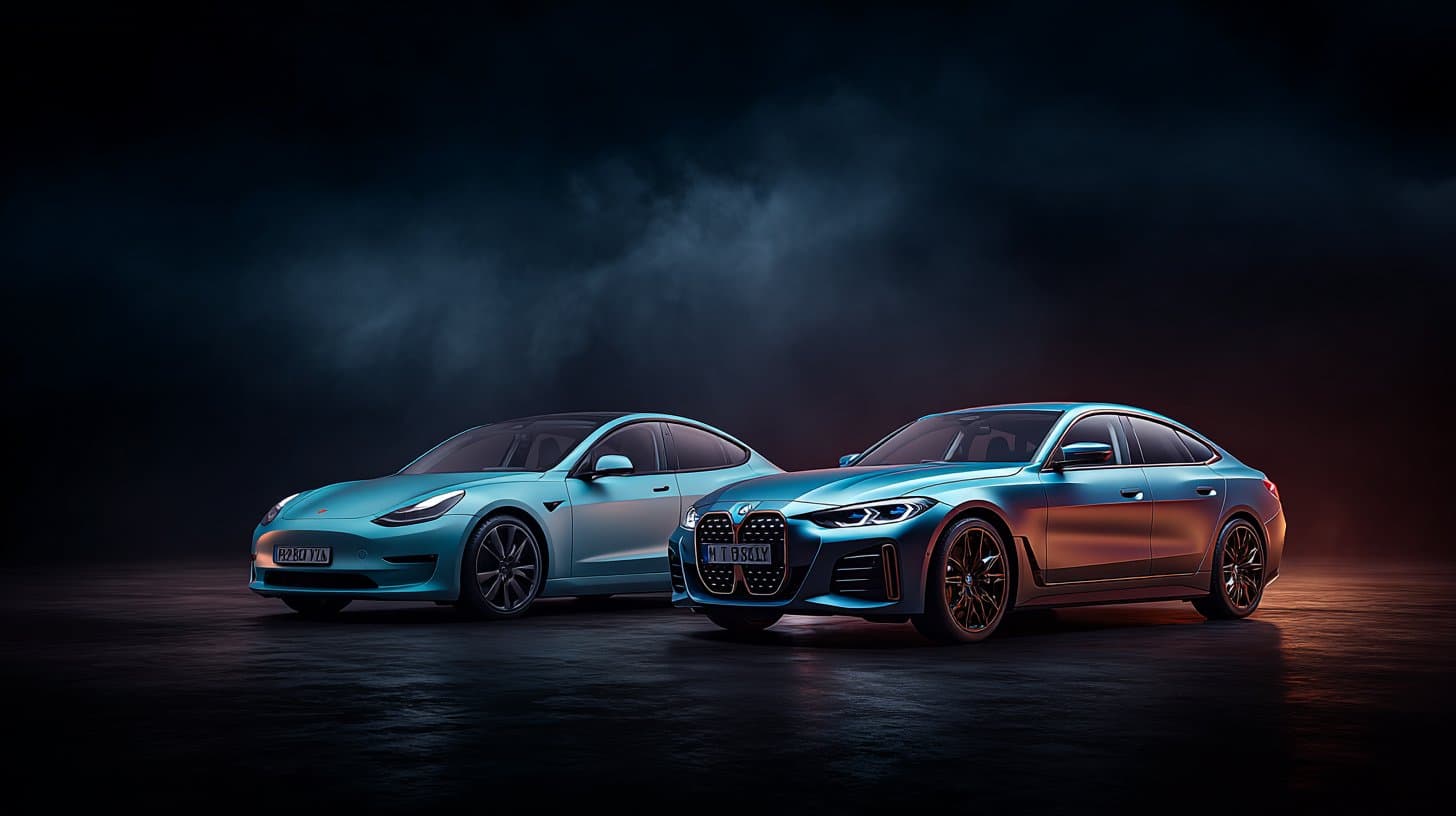
The Tesla Model 3 rewrote the rules for electric sedans. The BMW i4 answered with over a century of driving heritage wrapped in an electric powertrain. These two sedans represent fundamentally different philosophies — Silicon Valley minimalism versus Bavarian craftsmanship. In 2026, both are more refined than ever. Here's how they compare across every metric that matters.
Price & Value: Accessibility vs Premium
The Tesla Model 3 starts at approximately $40,240 for the rear-wheel-drive base model. The Long Range AWD sits around $47,240, and the Performance variant (now called Model 3 Performance) commands roughly $54,240. Tesla keeps its pricing straightforward with minimal options — you pick a color, wheel size, and whether you want Full Self-Driving capability ($12,000 add-on or $199/month subscription).
The BMW i4 starts at approximately $56,395 for the eDrive40. The i4 M50, BMW's performance variant with dual motors and M-tuned suspension, begins around $68,395. However, BMW's notorious options catalog can push prices significantly higher — adding the Driving Assistance Professional Package, premium Harman Kardon audio, and a Frozen paint finish can easily add $8,000–$12,000 to the sticker.
The price gap is substantial: the Model 3 undercuts the i4 by over $16,000 at the base level. Both may qualify for federal EV tax credits, though eligibility depends on the specific configuration and manufacturing location. Even at similar trim levels, the Tesla offers more car for less money in pure specification terms.
Range & Efficiency: Tesla's Edge
The Model 3 Long Range delivers up to 358 miles of EPA-estimated range, among the best in the segment. Even the base rear-wheel-drive model offers approximately 272 miles, which is more than sufficient for most daily driving patterns. Tesla's efficiency is exceptional — the Model 3 consistently achieves over 4.0 miles per kWh in real-world driving, thanks to its lightweight design and aerodynamic 0.23 Cd drag coefficient.
The BMW i4 eDrive40 provides up to 301 miles of EPA range from its 83.9 kWh battery (gross). The i4 M50 drops to around 270 miles due to its heavier dual-motor setup and performance-oriented tuning. While 301 miles is respectable, the Tesla's 57-mile range advantage with the Long Range model is meaningful on road trips. The i4 also weighs more — roughly 4,680 pounds versus the Model 3's 4,034 pounds — which impacts both efficiency and handling agility.
Charging: Network Matters
This is arguably Tesla's greatest competitive advantage. The Tesla Supercharger network remains the gold standard in EV charging infrastructure, with over 60,000 connectors across North America. Supercharger stations are reliably maintained, well-located, and integrated directly into the Model 3's navigation system with automatic route planning. Peak charging speeds reach approximately 250 kW, adding 175 miles in 15 minutes.
The BMW i4 uses the CCS (Combined Charging System) standard and can access a broad network of third-party chargers including Electrify America, EVgo, and ChargePoint. Peak DC fast charging reaches approximately 200 kW, taking around 31 minutes for a 10–80% charge. BMW also now offers a Tesla Supercharger adapter for NACS-compatible Supercharger access, though the experience isn't as seamless as it is for native Tesla vehicles. BMW's Charging app aggregates multiple networks, but reliability and availability of third-party chargers remain less consistent than Tesla's own stations.
Head-to-Head Spec Comparison
| Spec | Tesla Model 3 | BMW i4 |
|---|---|---|
| Starting Price | ~$40,240 | ~$56,395 |
| Max Range (EPA) | 358 miles (LR) | 301 miles (eDrive40) |
| 0–60 mph (Performance) | 2.9 sec | 3.7 sec (M50) |
| Peak Horsepower | 510 hp (Perf) | 536 hp (M50) |
| DC Fast Charging | 250 kW (Supercharger) | 200 kW (CCS) |
| Curb Weight | ~4,034 lbs | ~4,680 lbs |
| Cargo Space | 22.9 cu ft | 16.6 cu ft |
| Frunk | 3.1 cu ft | None |
| Display | 15.4” center screen | 14.9” curved display |
| Apple CarPlay | No | Yes (wireless) |
| OTA Updates | Frequent (monthly) | Periodic |
| Drag Coefficient | 0.23 Cd | 0.24 Cd |
Performance & Driving Dynamics
The Tesla Model 3 Performance rockets from 0 to 60 mph in a blistering 2.9 seconds, making it one of the fastest sedans under $55,000 regardless of fuel type. The acceleration is instant and relentless, with Tesla's single-speed drivetrain delivering power with zero lag. The Model 3 handles well for its class, with a low center of gravity and responsive steering, though the ride can feel firm over rough pavement.
The BMW i4 M50 reaches 60 mph in 3.7 seconds — not as quick as the Tesla, but the driving experience tells a different story. BMW's chassis tuning is masterful: the i4 M50 features adaptive M suspension, M Sport brakes, and variable sport steering that deliver a level of driver engagement and feedback that the Model 3 simply cannot match. The i4 feels like a driver's car through corners, with precise turn-in, progressive body roll, and a rear-biased AWD system that makes it feel playful rather than clinical. If driving enjoyment matters more than raw acceleration numbers, the BMW wins this category handily.
Interior: Minimalism vs Traditional Luxury
The Model 3's interior is famously sparse. Nearly every function lives behind the 15.4-inch center touchscreen — climate controls, mirror adjustments, glovebox opening, even windshield wiper speed. There are no traditional gauges, no instrument cluster, and minimal physical buttons. The materials are clean but not luxurious: vegan leather seats, a wood or carbon-fiber dash accent, and a glass roof. Tesla's approach is either refreshingly modern or frustratingly stripped-down, depending on your perspective.
The BMW i4 feels like stepping into a traditional luxury sedan that happens to be electric. The 14.9-inch curved display combines the instrument cluster and infotainment into one flowing panel, but BMW retains physical climate controls, a proper iDrive rotary controller, and tactile buttons for key functions. Materials include genuine leather, real aluminum trim, and soft-touch surfaces throughout. The seats offer more bolstering and long-distance comfort, and the optional Harman Kardon surround sound system is excellent. If interior quality and craftsmanship are priorities, the BMW justifies its premium.
Software & OTA Updates
Tesla leads the industry in over-the-air updates. The Model 3 receives frequent software updates — sometimes monthly — that add new features, improve performance, and refine the driving experience. Recent updates have added improved Autopilot behavior, new entertainment options, and even games. Tesla's software ecosystem is a living product that genuinely improves over time, and this is a major differentiator.
BMW offers OTA updates through iDrive 8, but they arrive less frequently and tend to focus on bug fixes and incremental improvements rather than transformative new features. BMW's controversial subscription model for certain features (heated seats, advanced driver assistance) has drawn criticism, though the company has partially walked back some subscription requirements in recent model years. The i4's software is polished and reliable, but it doesn't evolve at the pace of Tesla's platform.
Resale Value & Long-Term Ownership
Tesla Model 3 resale values remain among the strongest in the EV market, retaining approximately 65–70% of original value after three years. Tesla's brand recognition, the Supercharger network, and continuous software improvements all contribute to strong residual values. Maintenance costs are minimal — no oil changes, no transmission service, and Tesla's simple drivetrain requires little attention beyond tires and brakes.
The BMW i4 retains approximately 55–62% of value after three years, which is typical for the luxury segment but below Tesla. BMW's maintenance costs are higher, with the brand's recommended service intervals and premium parts pricing. However, BMW includes a 4-year/50,000-mile maintenance plan with new vehicles, covering routine services. The i4's 8-year/100,000-mile battery warranty matches Tesla's coverage.
The Verdict
Choose the Tesla Model 3 if...
- You want the best value for your money
- Range and efficiency are top priorities
- You value the Tesla Supercharger network
- You prefer cutting-edge software and frequent updates
- Raw acceleration performance excites you most
Choose the BMW i4 if...
- You prioritize driving dynamics and handling
- Interior luxury and material quality matter most
- You want Apple CarPlay and a traditional dashboard layout
- Brand prestige and German engineering appeal to you
- You prefer physical controls alongside the touchscreen
Ready to Decide?
Explore current pricing, incentives, and inventory for both models. Or try our EV Match tool to find the sedan that best fits your lifestyle and budget.