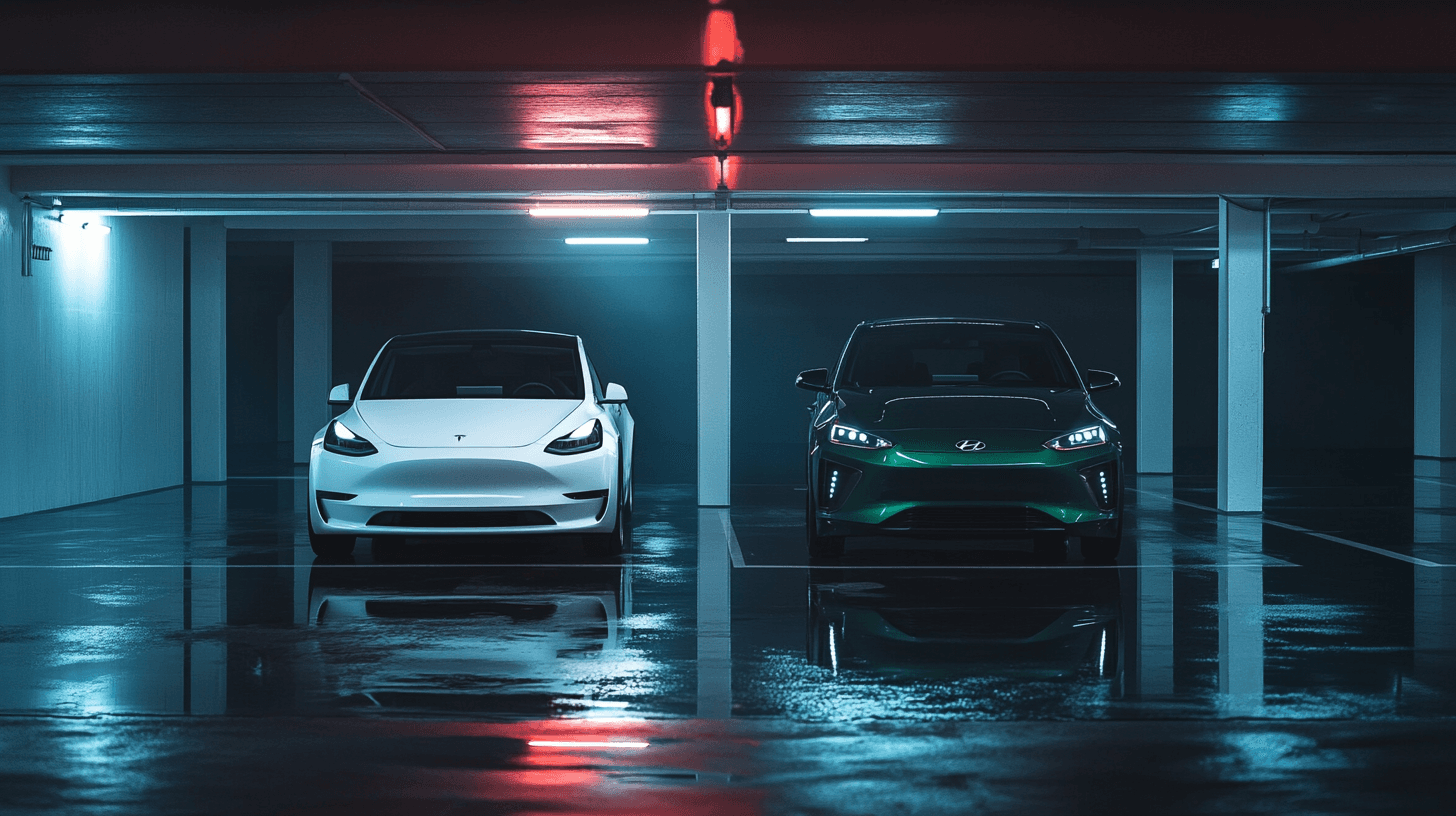
The Tesla Model Y and Hyundai Ioniq 5 are two of the most popular electric SUVs on the market, and for good reason. Both offer compelling range, technology, and value — but they take very different approaches to the EV experience. Here's an in-depth comparison to help you decide which one deserves your driveway.
Quick Specs Comparison
| Spec | Tesla Model Y (2026) | Hyundai Ioniq 5 (2026) |
|---|---|---|
| Starting MSRP | ~$44,990 | ~$43,800 |
| Range (EPA) | Up to 320 mi (LR AWD) | Up to 303 mi (LR RWD) |
| 0-60 mph | 4.8s (LR) / 3.5s (Perf) | 5.1s (AWD) |
| Charging Architecture | 400V | 800V |
| Peak DC Charging | 250 kW (Supercharger) | 350 kW (CCS / NACS) |
| 10-80% Charge Time | ~27 min | ~18 min |
| Cargo Space | 76 cu ft (seats down) | 59.3 cu ft (seats down) |
| V2L (Vehicle-to-Load) | No | Yes (standard) |
| Warranty | 4yr / 50k mi (basic) | 5yr / 60k mi (basic) |
Design and Exterior
The Model Y takes a conservative crossover shape — smooth, aerodynamic, and immediately recognizable as a Tesla. The 2026 refresh (codenamed "Juniper") brought a redesigned front end, new headlights, and a sleeker overall profile. It looks like a smaller Model X and prioritizes function over flash.
The Ioniq 5 is a deliberate contrast. Its retro-futuristic design borrows from the 1974 Pony concept with sharp pixel-style LED lights, a flat floor, and cladding that makes it look more like a concept car that escaped the auto show. It's polarizing — people either love it or find it too unconventional.
Edge: Comes down to personal taste. The Model Y is safe and modern. The Ioniq 5 is bold and distinctive.
Range and Efficiency
The Model Y edges ahead with up to 320 miles of EPA range on the Long Range AWD trim. Tesla's efficiency advantage comes from years of optimizing their drivetrain, heat pump system, and aerodynamics. In real-world highway driving, the Model Y tends to hit close to its rated range.
The Ioniq 5 offers up to 303 miles on the Long Range RWD trim. The AWD version drops to around 260 miles. Real-world range tends to fall a bit shorter than the EPA estimate, especially at sustained highway speeds above 70 mph.
Edge: Tesla Model Y — more range across all trims and better real-world efficiency.
Charging
This is where the Ioniq 5 fights back hard. Its 800V architecture enables charging speeds up to 350 kW, which means a 10-80% charge in roughly 18 minutes at a compatible charger. That's fast enough to add 200+ miles during a bathroom break.
The Model Y uses a 400V system and peaks at 250 kW on Tesla Superchargers, with 10-80% taking about 27 minutes. Tesla's advantage is network reliability — the Supercharger network remains the most extensive and reliable in North America with over 50,000 plugs.
The Ioniq 5 now ships with a NACS port, giving it full access to the Supercharger network alongside CCS stations. The playing field has leveled significantly on network access.
Edge: Ioniq 5 for charging speed. Tesla for network reliability (though the gap is narrowing).
Interior and Technology
The Model Y's interior is minimalist to a fault. Nearly everything runs through the central 15.4-inch touchscreen. There are no physical buttons for climate, no instrument cluster behind the wheel, and the materials are clean but not luxurious. The 2026 refresh added ambient lighting and improved seat materials, but it's still a "screen-first" cabin.
The Ioniq 5 takes a different approach with dual 12.3-inch screens, physical climate buttons, and an interior that feels more like a living room. The flat floor creates a genuinely open cabin. Materials are higher quality at comparable trim levels, and Hyundai offers sustainable interior options with recycled materials.
One Ioniq 5 standout: Vehicle-to-Load (V2L) capability. You can power appliances, tools, or even charge another EV from a standard 120V outlet built into the car. This feature doesn't exist on the Model Y.
Edge: Ioniq 5 for interior quality, ergonomics, and V2L. Model Y for seamless software integration.
Driving Dynamics
The Model Y drives like a tighter, sportier vehicle. It has a lower center of gravity, more responsive steering, and the Performance variant hits 0-60 in 3.5 seconds. Tesla's regenerative braking system is one of the best — true one-pedal driving that rarely requires the brake pedal.
The Ioniq 5 is tuned for comfort. The ride is smoother, road noise is better isolated, and the adjustable regenerative braking (via paddle shifters) gives you fine control over how aggressively the car slows down. It's not slow — the AWD version hits 0-60 in about 5.1 seconds — but it prioritizes being a comfortable cruiser over a performance machine.
Edge: Model Y for sportiness. Ioniq 5 for ride comfort.
Ownership Costs
- •Insurance — Tesla insurance tends to cost more due to higher repair costs and expensive parts. Hyundai is generally more affordable to insure.
- •Maintenance — Both are low-maintenance EVs. Tesla has a slight edge with no recommended service intervals. Hyundai recommends cabin air filter changes and brake fluid checks per their schedule.
- •Warranty — Hyundai wins with a longer 5-year/60,000-mile basic warranty and 10-year/100,000-mile powertrain warranty vs Tesla's 4-year/50,000-mile basic and 8-year/120,000-mile battery warranty.
- •Resale value — Tesla historically holds value better due to brand demand and the Supercharger network. However, the Ioniq 5's resale has been improving steadily.
- •Tax credits — Both may qualify for federal EV tax credits depending on the trim and where they're manufactured. Check current eligibility at the time of purchase.
Which Should You Buy?
Choose the Tesla Model Y if:
- •You want maximum range and efficiency
- •You prefer a sportier driving experience
- •You need more cargo space
- •You value Tesla's software ecosystem and OTA updates
- •You do a lot of long-distance road trips
Choose the Hyundai Ioniq 5 if:
- •You want the fastest DC charging available
- •You prefer a more comfortable, refined ride
- •You want V2L to power appliances and tools
- •You value a longer warranty and lower insurance costs
- •You want a more distinctive, head-turning design
Final Verdict
Both of these are excellent electric SUVs. The Model Y wins on range, efficiency, cargo space, and driving dynamics. The Ioniq 5 wins on charging speed, interior quality, warranty, and unique features like V2L.
If you're cross-shopping these two, you genuinely can't go wrong with either. The best move is to test drive both and see which cabin, driving feel, and ownership experience aligns with how you actually use a car.