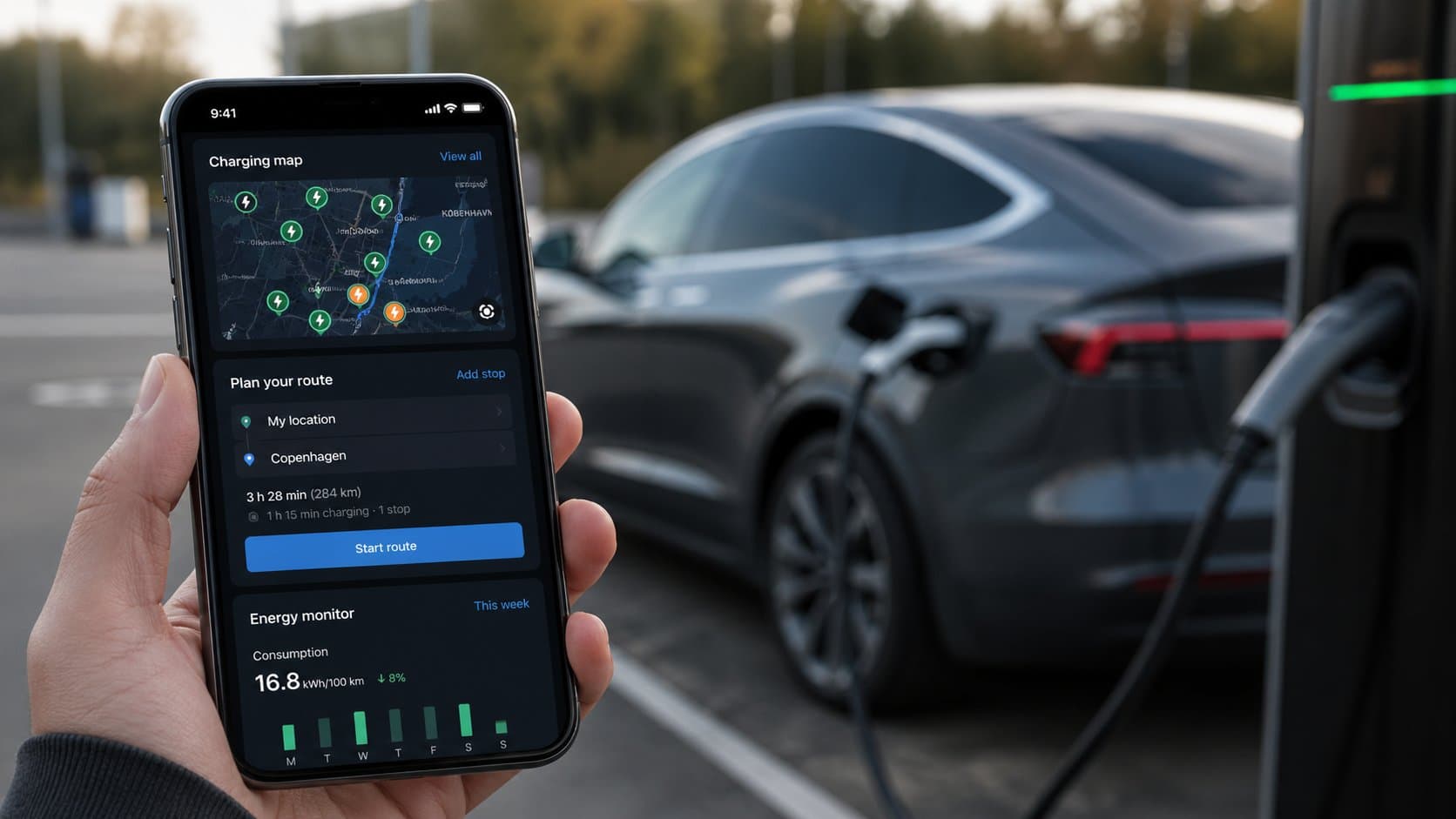
Road trips in an EV require planning that gas cars do not — specifically, knowing where to charge, how long each stop will take, and whether the chargers at your planned stops are actually working. The right app transforms an EV road trip from an anxiety-filled gamble into a predictable, enjoyable journey. The wrong app (or no app) leads to the stressed-out, low-battery highway moments that make anti-EV headlines. Here is what each major route planning option does well, where it falls short, and which combination covers all scenarios.
A Better Route Planner (ABRP)
What It Is
ABRP is the most sophisticated EV route planner available — a dedicated application built specifically for electric vehicle trip planning. You enter your vehicle model, starting charge level, and destination. ABRP calculates the optimal charging stops including which chargers to use, how long to charge at each stop, and your estimated battery level at arrival.
What Makes It Best
ABRP uses real-world energy consumption data crowdsourced from thousands of EV drivers — not the manufacturer's optimistic EPA estimates. This means ABRP's range predictions are more accurate than your car's built-in navigation in most scenarios. The app accounts for elevation changes along your route (climbing mountains consumes significantly more energy than flat highway driving), weather conditions (headwinds, temperature, and precipitation all affect range), your specific driving speed (driving 80 mph versus 65 mph can reduce range by 20%), and real-time charger availability from connected charging networks.
ABRP also lets you set preferences: maximum charging stop duration, preferred charging networks, minimum arrival battery percentage, and driving speed. This customization creates route plans that match YOUR preferences rather than generic optimization.
Where It Falls Short
ABRP requires manual setup — entering your vehicle model, preferred settings, and sometimes linking your car's telematics for live battery data. The interface is functional rather than beautiful. And ABRP is a planning tool, not a navigation tool — you plan the route in ABRP, then use Google Maps, Apple Maps, or your car's navigation for turn-by-turn directions between stops.
Cost
Free with basic features. Premium subscription ($4.99/month or $49.99/year) adds live charger data integration, weather-based range adjustment, and saved vehicle profiles.
PlugShare
What It Is
PlugShare is the most comprehensive EV charger map in the world — listing over 500,000 charging locations globally with user reviews, photos, real-time status reports, and detailed station information. It is not primarily a route planner — it is a charger finder that tells you what is available and whether it is working. For our take on which networks are most reliable, see the EV charging network report card.
What Makes It Best
PlugShare's user community is its superpower. Drivers check in at chargers, report working or broken units, upload photos of the station, and leave reviews with practical tips (“charger #3 is behind the building, not in the main parking lot”). This real-time community data is more reliable than the automated status feeds from charging networks, which often show broken chargers as “available.”
The filtering system lets you find chargers by network (Tesla, Electrify America, ChargePoint, etc.), connector type (CCS, NACS, CHAdeMO), minimum power level (50 kW, 150 kW, 350 kW), cost (free vs paid), and amenities (restaurants, restrooms, WiFi nearby).
Where It Falls Short
PlugShare is a charger map, not a route planner. It shows you where chargers exist but does not calculate optimal stops, estimate charging times, or account for your vehicle's specific energy consumption. You need to combine PlugShare with ABRP or your car's navigation for trip planning — PlugShare verifies that the chargers in your plan are actually working.
Cost
Free.
Built-In Vehicle Navigation
What It Is
Most modern EVs include built-in navigation that automatically calculates charging stops. Tesla's navigation is the gold standard — it routes through Superchargers automatically, shows real-time stall availability, estimates charge time at each stop, and calculates arrival battery level. Hyundai, Kia, Ford, and GM have improved their built-in systems significantly in recent years but still trail Tesla in accuracy and reliability.
What Makes It Best
Zero setup. You enter a destination and the car figures out the charging stops. For Tesla owners, the Supercharger-integrated navigation is so good that many never use a third-party app. The built-in system has access to your car's real-time battery data, energy consumption, and climate system load — information that third-party apps may estimate rather than measure directly.
Where It Falls Short
Built-in navigation typically only routes through its manufacturer's preferred charging network. Tesla routes through Superchargers. Hyundai/Kia routes through Electrify America. Ford routes through BlueOval Charge Network. If a non-preferred network has a better-located or faster charger, the built-in navigation will not suggest it. Built-in systems also tend to be more conservative than ABRP — adding unnecessary charging stops that extend the trip duration.
Cost
Included with the vehicle.
The Optimal App Combination
The best EV road trip setup uses all three tools in combination.
Use ABRP for initial trip planning. Enter your route, review the suggested charging stops, and customize based on your preferences. ABRP gives you the optimal plan with the fewest stops and shortest total trip time.
Use PlugShare to verify charger status. Before departing, check recent user reports at each planned charging stop. If a station has recent “broken” or “offline” reports, identify an alternative in ABRP before you are on the road with a dwindling battery.
Use built-in navigation for turn-by-turn driving. Your car's navigation provides real-time driving directions between stops and updates range estimates based on actual driving conditions. If conditions change mid-trip (unexpected traffic, weather, or detour), the built-in system recalculates with live battery data.
This three-app approach covers planning (ABRP), verification (PlugShare), and execution (built-in navigation) — eliminating the gaps that any single tool leaves. The total cost is $0–$5 per month, and the confidence it provides is priceless on a 500-mile road trip. For a deeper walkthrough of the planning process itself, check our EV road trip planning 101 guide.
The Bottom Line
No single app handles every aspect of EV road trip planning perfectly. ABRP is the best planner. PlugShare is the best charger verifier. Built-in navigation is the best real-time driver. Use all three — ABRP to plan, PlugShare to verify, built-in to drive — and your EV road trips will be predictable, efficient, and stress-free. Download ABRP and PlugShare before your first road trip. They are the two apps that convert “EV road trip anxiety” into “EV road trip confidence.”
Looking for the right vehicle for your next adventure? See our picks for the best EVs for road trips in 2026, or browse the public charging landscape on our charging hub.