The best deal in the auto market right now isn't a new car. It's a used electric vehicle.
In early 2026, depreciation has done what years of incentives couldn't — pushed quality EVs into legitimately affordable territory. A 2020 Tesla Model 3 with 60,000 miles. A 2022 Hyundai Kona Electric with the original battery warranty still active. A 2023 Chevy Bolt EUV with 250 miles of real-world range. All of these now sit comfortably under $25,000 in markets across the United States.
But there's a catch. The used EV market in 2026 is split between genuine bargains and expensive mistakes, and the difference often isn't visible at first glance. Two cars with the same year, mileage, and asking price can have wildly different battery health — and battery health, on a used EV, is the entire game.
This guide walks you through what to actually buy, what to avoid, where to shop, and how to verify you're getting a healthy car before you hand over the money. It covers dealers, certified pre-owned programs, specialized EV platforms, and yes — Facebook Marketplace and private sellers, where the savings are biggest and the risks are real.
Why Used EVs Are the Best Deal of 2026
Three things converged to make 2026 a remarkable moment for used EV buyers.
The first was simple oversupply. After two years of aggressive new-EV production and lease deals, the used market began absorbing a flood of off-lease vehicles in late 2025 and early 2026. By spring 2026, dealers were reporting used EV inventory levels significantly above their typical baselines, and that inventory was sitting longer. We covered this dynamic in detail in The EV Lease Return Surge.
The second was the end of the federal used EV tax credit. The program that gave qualifying buyers up to $4,000 toward a used EV purchase ended September 30, 2025. With that incentive gone, dealers had less reason to hold prices firm, and the market adjusted downward to find the new equilibrium without subsidy support.
The third was a quiet but important reality check on battery longevity. Recurrent's 2026 data showed that modern EV battery packs are durable in ways that early adopters worried they wouldn't be. Most mainstream EVs retain 80–90% of original capacity after five to six years of use, with some models doing even better. The narrative that drove a generation of buyers to fear used EVs — that the battery would be shot before the car was fully paid off — has not held up under real-world data.
The result: many 2021–2022 EVs now sell for roughly half of their original MSRP, with the majority of their useful life still ahead. For a buyer paying attention, that's a once-in-a-decade window.
What Actually Matters on a Used EV
A traditional used car is judged on mileage, accident history, and how well the previous owner maintained it. A used EV is judged on those things plus one more factor that overshadows the others: battery state of health.
A modern EV battery pack typically represents 30–40% of the car's original cost. If it's healthy, you've bought a car. If it's degraded, you've bought a project. Replacement costs run $14,000–$22,000 depending on the model — often more than the car is worth used.
Battery state of health (SOH) is expressed as a percentage of original capacity. A new battery is at 100%. Most EV manufacturers warranty their batteries to at least 70% capacity for 8 years or 100,000 miles. A healthy used EV in 2026 should typically show:
- 90%+ SOH on cars under three years old
- 85–90% SOH on cars three to five years old
- 80–85% SOH on cars five to seven years old
- Below 80% means the price needs to reflect significantly more wear
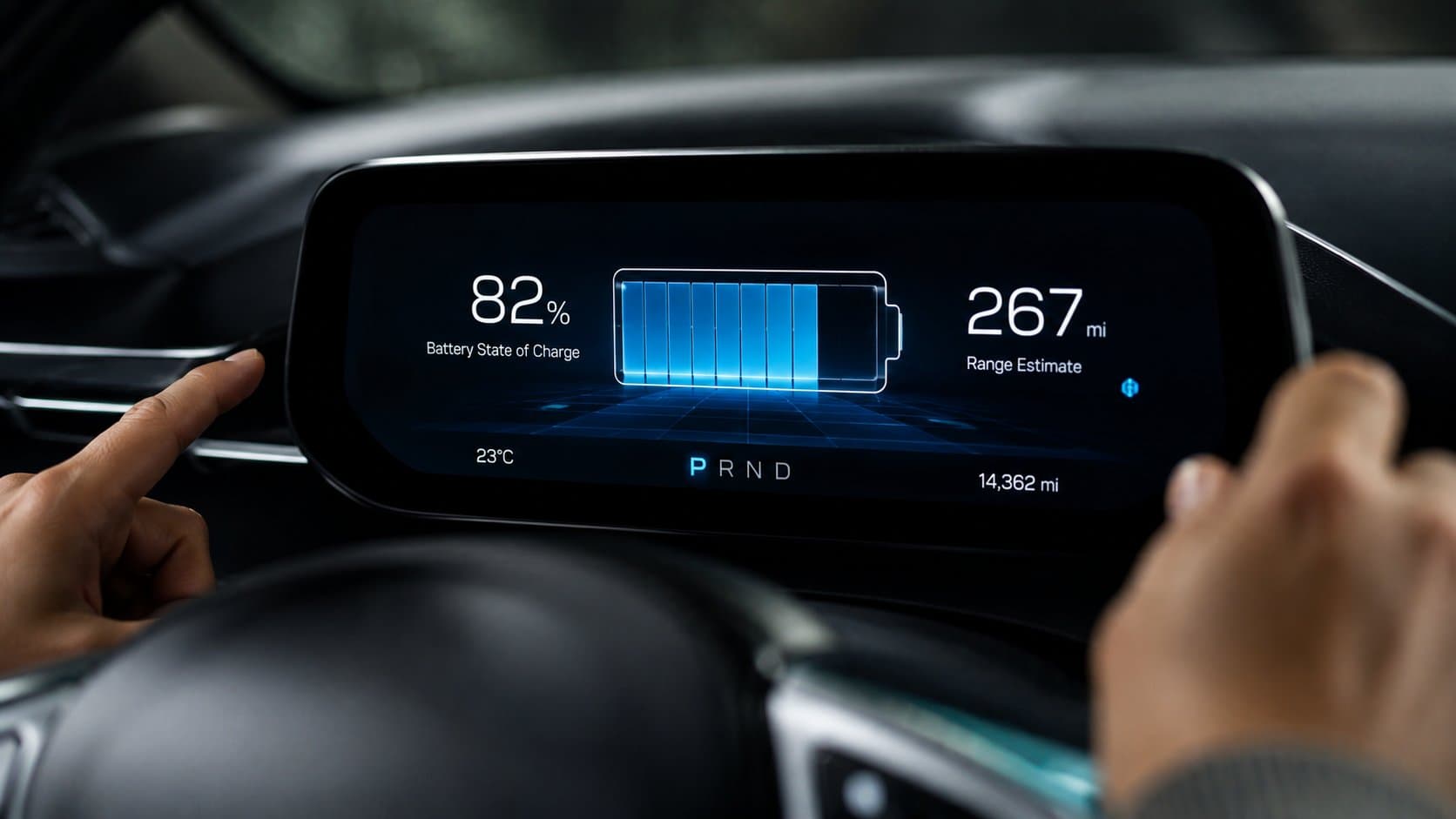
The simplest way to spot-check battery health without specialized tools: charge the car to 100% and compare the displayed range to the original EPA rating. If a 2020 Chevy Bolt with 259 miles of original EPA range shows 230 miles at 100%, that's roughly 89% SOH — perfectly healthy. If it shows 200 miles, that's 77% — usable, but worth a price reduction.
For a more accurate reading, OBD-II Bluetooth adapters with apps like LeafSpy (Nissan), Scan My Tesla, or generic Car Scanner can pull exact SOH percentages from the battery management system. These tools cost $30–$80 and pay for themselves the first time they catch a problem.
Beyond battery health, the four other things to verify:
Charging history. Cars that lived on DC fast chargers in hot climates degrade faster than home-charged cars in moderate climates. Tesla owners can see Supercharger history. Other brands require asking the seller about typical charging habits.
Software lock status. Tesla owners need to transfer the car in their app. Some Hyundai/Kia models require app re-registration. If this isn't handled before sale, the new owner can have access issues.
Recall completion. Several EV models have had high-profile battery recalls (the 2017–2019 Chevy Bolt being the most famous). Buy only post-recall examples or verify the recall work was completed.
Tire condition. EVs eat tires faster than gas cars due to weight and instant torque. A used EV with original tires at 50,000+ miles is a yellow flag — those tires are likely past safe life.
Top Picks Under $25,000 in 2026
These five models consistently appear in current used EV value rankings, with verified availability under $25,000 in most U.S. markets in early 2026.
Best Overall Value: Chevrolet Bolt EV / Bolt EUV (2019–2023)
The Bolt is the workhorse of the affordable EV market, and 2026 is when it became almost unfairly cheap. Typical 2026 prices:
- Bolt EV (2019–2022): $14,000–$20,000
- Bolt EUV (2022–2023): $20,000–$25,000
Range when new: 238–259 miles depending on year. Real-world range in 2026 with healthy batteries: typically 200–230 miles in mixed driving.
What you're getting: a compact hatchback (Bolt EV) or small crossover (Bolt EUV) with enough range for almost any commute and weekend trip, plus DC fast charging that — while not the fastest in 2026 — is good enough for occasional road trips.
Critical caveat: the 2017–2019 Bolts had a serious battery recall. GM eventually replaced affected packs with new ones. For 2026 buyers, this means: post-recall Bolts have effectively new batteries with full warranty resets, which is genuinely valuable. Pre-recall or unreplaced Bolts are not buying. Always verify recall status with the VIN before purchase.
The Bolt EUV's available Super Cruise on some trims is a meaningful feature that competitors at this price don't offer. If you can find a Premier trim Bolt EUV with Super Cruise, that's a particularly strong value.
Best Long-Range Budget: Hyundai Kona Electric (2019–2022)
The Kona Electric is the quiet overachiever of the used EV market — efficient, well-made, and now genuinely affordable. Typical 2026 prices:
- 2019–2020: $15,000–$20,000
- 2021–2022: $18,000–$24,000
Range when new: 258 miles EPA. Real-world range with healthy battery: 220–250 miles.
What you're getting: a subcompact crossover that punches well above its weight class. Hyundai engineered this car with efficiency as the priority, and it shows in real-world range that often beats larger, more expensive competitors.
The Kona Electric also benefits from Hyundai's 10-year/100,000-mile battery warranty, which means a 2021 example purchased in 2026 still has substantial warranty runway. Look for transferability — most Hyundai/Kia battery warranties transfer to subsequent owners.
Watch for: early Konas had a smaller battery recall affecting some 2019–2020 cars. Check VIN with Hyundai dealer before purchase.
Best Practical SUV Feel: Kia Niro EV (2019–2022)
The Niro EV trades a bit of the Kona's efficiency for more cabin space and a more conventional crossover feel. Typical 2026 prices:
- 2019–2020: $15,000–$20,000
- 2021–2022: $18,000–$23,000
Range when new: 239 miles EPA. Real-world: 200–225 miles with healthy battery.
What you're getting: an honest small crossover with hatchback flexibility, comfortable ride tuning, and Kia's 10-year/100,000-mile battery warranty. The interior feels more functional than premium — this isn't a car that wins on flair — but it's spacious for the segment and the cargo area is genuinely useful.
The Niro is a particularly good fit for buyers prioritizing practicality over features. Where the Bolt feels like an econobox and the Kona feels small, the Niro feels like a normal small SUV that happens to be electric.
Most Premium for the Price: Tesla Model 3 (2018–2021)
Earlier Model 3s have finally drifted into the under-$25K territory. Typical 2026 prices:
- 2018 (Standard Range Plus, RWD): $18,000–$22,000
- 2019–2020: $20,000–$25,000
- 2021 base trim: $22,000–$25,000+
Range varies by trim and battery generation: base cars in the 220-mile zone, Long Range Performance versions retaining 280–320 miles real-world.
What you're getting: access to the Tesla Supercharger network, which remains the most reliable fast-charging infrastructure in North America. Strong over-the-air update support. Better resale value than competitors when you eventually sell.
What you're not getting: physical buttons (most controls live in the touchscreen, which some drivers love and others hate). A user manual you can read on paper. The plush ride of equivalent Hyundai or Kia products.
Critical for 2026: verify the car is set up for full Supercharger network access (some configurations have limitations). Verify the previous owner has fully transferred ownership in the Tesla app — if they haven't, you can have access issues. Test the autopilot capability that came with the car versus what's promised in the listing.
Hidden Gem: Hyundai Ioniq 5 (Early Used, 2022)
This one stretches the budget — early 2022 Ioniq 5 examples now appear in the $20,000–$25,000 range with higher mileage, and the value proposition is exceptional. The Ioniq 5 was originally a $40,000+ car with 800-volt fast-charging architecture, comfortable ride, and aggressive styling.
What you're getting at the under-$25K price point: a 2022 model with significant remaining battery warranty, charging speeds that exceed most competitors, and a driving experience that genuinely feels premium. Range when new: 220–303 miles depending on trim.
Watch for: early Ioniq 5s had an Integrated Charging Control Unit (ICCU) issue that Hyundai has addressed via service campaigns. Verify completion before purchase. Range of trims and configurations is wide — research the specific trim before you make an offer.
This is a stretch pick for the budget, but if you can find a clean example, the Ioniq 5 represents the most “premium” feel available under $25K in 2026.
Models to Approach Carefully
A few EVs frequently appear in under-$25K listings but warrant extra caution.
Early Nissan Leafs (2011–2017). Older Leaf batteries lacked active thermal management, which means they degraded faster in hot climates. A 2015 Leaf with 24 kWh battery often shows 50–70% SOH in 2026 — meaning real-world range under 50 miles. These can work as cheap city cars for buyers with very specific use cases, but they are not general-purpose EVs in 2026.
BMW i3 (any year). Quirky, charming, and deeply impractical for many buyers. Range is short by 2026 standards (114 miles new on most trims). Replacement parts are increasingly difficult to source. The range-extender (REX) versions add complexity. Buy only if you specifically want a unique car for short trips.
Pre-recall Chevrolet Bolts (2017–2019, unverified). Mentioned above but worth repeating: the battery recall on early Bolts was not optional. Cars without verified completion are a gamble at any price.
Salvage and rebuilt titles. Especially common on Teslas in private sales. EV battery damage from collisions can be invisible from the outside but expensive to address. Salvage-title EVs trade at significant discounts for good reason. Avoid unless you have specific expertise.
Where to Buy: The Real Landscape
Most “best used EV” articles list CarMax and Carvana and stop. But the channel you buy from significantly affects both your price and your risk. Here's the honest breakdown of all the meaningful options.
Big Online Retailers — CarMax, Carvana, Driveway
What you get: wide inventory, return policies (typically 7–10 days), financing built in, no haggling, professional reconditioning.
What you pay for it: prices typically 10–20% above private market for the same car, limited EV-specific knowledge from sales staff, sometimes a long process to actually take delivery.
Best for: first-time used car buyers, people who want a simple transaction, buyers who value the return window in case something goes wrong.
Manufacturer Certified Pre-Owned (Tesla, Hyundai, Kia, etc.)
What you get: extended warranties, factory inspection, battery health verification, sometimes battery health certification.
What you pay for it: highest prices in the used market, limited inventory, often requires shipping from another region.
Best for: buyers who want maximum peace of mind and have a strong preference for one specific brand. This is the right channel if a 5–10% price premium is worth a smoother ownership experience.
Traditional Dealers
What you get: financing options, trade-in possibilities, mechanic on-site, often willing to negotiate.
What you pay for it: highly variable quality, sales staff often unfamiliar with EVs, sometimes overpriced relative to the online retailers, sometimes underpriced if the dealer doesn't know what they have.
Best for: buyers who want to test drive multiple options in person and have the patience to comparison-shop. Some of the best used EV deals come from non-EV-focused dealers who took an EV in trade and want it gone.
Specialized Used EV Platforms (Recharged, others)
What you get: battery health reports as standard, EV-specific listings, expert knowledge, often nationwide delivery.
What you pay for it: smaller inventory than the big retailers, higher prices than private party.
Best for: buyers who care most about battery data and verified condition. The battery report alone is often worth the price difference for buyers who don't want to inspect themselves.
Private Party — Facebook Marketplace, Craigslist, Autotrader Private Sellers
What you get: 10–20% lower prices than the same car at retail, often EV enthusiasts as sellers (who took good care of the car), direct access to the previous owner's knowledge, no dealer fees or add-ons.
What you pay for it: no warranty beyond what the manufacturer provides, no return policy, financing is harder, real scam risk, you handle paperwork yourself.
Best for: experienced buyers, mechanically savvy people, those willing to do real legwork. The savings are real but the risk management is on you.
How to Buy from a Private Seller Without Getting Burned
Private party transactions on Facebook Marketplace, Craigslist, and Autotrader are where the best deals live in 2026. They're also where most scams happen. The good news: with discipline, the risk is manageable. Here's the protocol.
Before you contact the seller
Run the listing photos through reverse image search. Scammers reuse photos from other listings or dealer sites. If the same images appear elsewhere, walk away.
Check the seller's Facebook profile (if Marketplace). New accounts, no friends, no posting history are red flags. Established profiles with real activity are reassuring.
Note the listing language. Phrases like “moving and need to sell fast,” “military deployment,” “death in family” are pressure tactics. Real sellers are usually patient. Listings with urgency baked in are often scams.
The first contact
Ask for the VIN before scheduling a viewing. Run it through Carfax or AutoCheck — both cost about $40 for unlimited monthly reports. Verify there are no liens, no salvage title, no flood damage, no major accidents.
Ask the seller specific questions about the car: how it was charged (mostly Level 2 home charging is ideal), where it was driven, what the battery health currently shows. Sellers who answer specifically are usually genuine. Sellers who say “the battery is fine” without numbers are either uninformed or lying.
Ask to see service records. Real owners have them. Curbstoners (people who buy and resell cars without dealer licenses) often don't.
The viewing
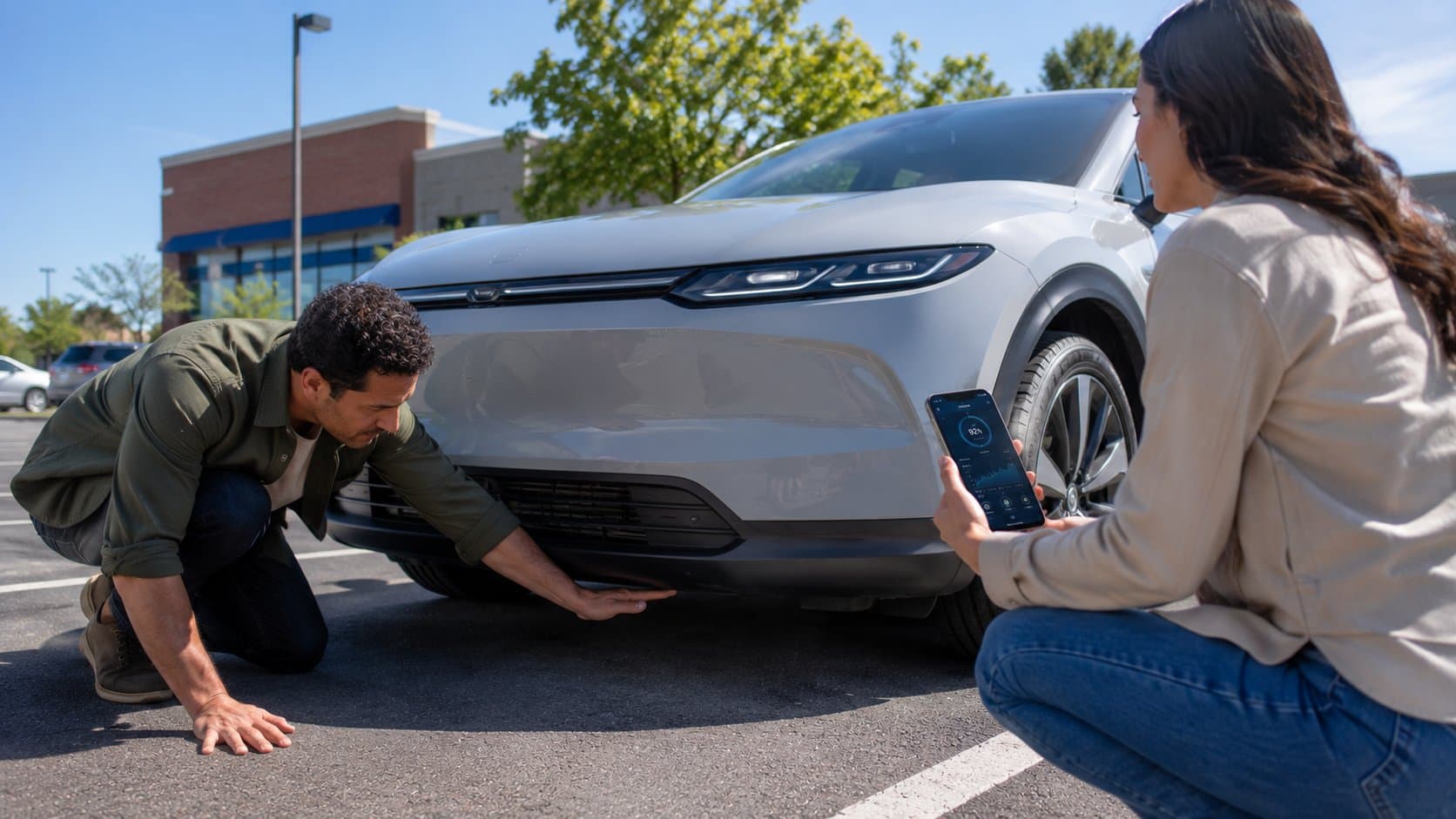
Meet during daylight hours, in a public place. The seller's house can work if you're confident, but a bank or police station parking lot is safer.
Ask the seller to charge the car to at least 80% before you arrive. A car at 30% won't tell you much about battery health.
Bring an OBD-II adapter and the appropriate app for the brand (LeafSpy for Nissan, Scan My Tesla for Tesla, Car Scanner for most others). With the seller's permission, plug it in and pull battery state of health. This takes 5–10 minutes and is the single most important check on a used EV.
Verify the VIN on the car matches the VIN in the listing and your history report. Common locations: driver-side door jamb, lower left windshield.
Take a real test drive — at least 30 minutes including highway speeds. Watch how the state of charge percentage drops relative to miles driven. Healthy batteries drop predictably. Batteries with cell imbalance issues drop faster than expected.
If possible, ask to plug into a DC fast charger during the test drive. Charging speed at fast chargers is an excellent diagnostic — slower-than-rated charging often indicates battery issues.
The decision and payment
For high-value purchases ($15,000+), seriously consider an independent EV pre-purchase inspection. Mobile EV inspection services exist in most metros for $200–$400. On a $22,000 purchase, that's cheap insurance.
Negotiate based on data. Print out three to five comparable listings with prices. If their car is asking $24,000 and similar examples are at $21,000–$22,500, your offer is $20,500. Real sellers will negotiate. Scammers won't.
Never pay before completing the inspection and seeing the title.
Pay safely. Best option: meet at the seller's bank, hand them a cashier's check from your bank, have them deposit it while you watch, then transfer the title. Wire transfers, gift cards, and cash app payments are all riskier and several are irreversible if something goes wrong.
Verify the title transfer is complete and registered before you drive away. Verify the seller has logged out of any vehicle apps (Tesla, Hyundai, Kia all have app-based account links).
Walk away signs
The seller refuses to let you check battery health, won't let you bring an OBD adapter, or rushes the inspection.
The seller can't or won't show the title.
The seller insists on payment before you see the car or before inspection.
The seller's story keeps changing about ownership, mileage, or where the car came from.
The price is dramatically below market. Real bargains exist, but a $15,000 ask on a car that should sell for $22,000 is usually a problem.
When in doubt, walk. There are always more EVs.
The Honest Tradeoff Math
To make the dealer-vs-private-party decision concrete, here's a real comparison.
A 2020 Tesla Model 3 Standard Range Plus with 65,000 miles in good condition.
- CarMax or Carvana: $24,500 with 7-day return, financing available, professional inspection
- Private seller, Facebook Marketplace: $20,000–$21,000, no warranty, no return, financing harder
The savings on the private route: $3,500–$4,500. The cost of that savings: you handle inspection, you carry transaction risk, you have no return option.
For a buyer who knows EVs, has the time to inspect properly, and can pay cash: the private route is usually the better deal. The savings are real, the risk is manageable with discipline, and the experience is direct.
For a first-time used car buyer, especially without an EV-experienced friend to help: the dealer premium is often worth it. A $4,000 mistake on a private-party purchase erases years of fuel savings.
There's no universally right answer. The honest answer depends on your experience, your time, and your tolerance for managing transaction risk yourself.
Final Pre-Purchase Checklist
Before you sign anything, work through this list:
- VIN run through Carfax or AutoCheck — clean title, no liens, no major accidents, no salvage history
- Battery state of health verified (90%+ for cars under three years old, 80%+ for older cars)
- Original EPA range vs. current displayed range at 100% charge — within 10–15% is healthy
- All recall work completed (verify by VIN at manufacturer service site)
- Service records reviewed
- Real-world test drive of at least 30 minutes including highway speeds
- DC fast charging tested if possible
- Tire condition acceptable (or factor replacement cost into price)
- Battery warranty status verified — years and miles remaining
- Title in seller's name, no liens, no salvage brand
- Payment method secure (cashier's check or bank wire from a branch, not Cash App or wire to a private account)
- App accounts (Tesla, Hyundai, Kia, etc.) properly transferred or logged out before you leave
If everything on this list checks out, you're buying with eyes open. If two or more items don't check out, the price needs to come down significantly or you should walk.
The Bottom Line
The 2026 used EV market is the most buyer-friendly moment for electric vehicles in their entire history. Depreciation has done what subsidies couldn't: made quality EVs genuinely affordable. The battery longevity data has gotten more reassuring, not less. The charging network is finally reaching the maturity that early adopters spent a decade waiting for.
But “buyer-friendly” is not the same as “no work required.” The buyers who get the best outcomes in 2026 are the ones who treat battery health verification as non-negotiable, understand the tradeoffs between dealer and private-party purchases, and have the discipline to walk away from deals where the data doesn't add up.
Do that work, and a used EV under $25,000 in 2026 can be the best automotive purchase decision you make this decade. Skip it, and you can buy yourself an expensive problem.
The math is on your side. The data is available. The cars are out there. Whether you take advantage of it is up to you.