“But what about the batteries?” is the most common question skeptics ask about EVs — and it deserves an honest answer. The concern is valid: EV batteries contain lithium, cobalt, nickel, and manganese, all of which require mining and all of which could cause environmental harm if landfilled. The good news is that the EV battery end-of-life story in 2026 is far more nuanced and far more positive than the skeptics suggest. Here's what actually happens.
How Long Do EV Batteries Actually Last?
First, the lifespan question. Modern EV batteries (2020 and newer) are engineered to outlast the car itself. Current data shows that most EV batteries retain 80–90% of their original capacity after 200,000 miles. Tesla's batteries average 12% degradation after 200,000 miles. Hyundai and Kia's E-GMP batteries show similar longevity profiles.
Most EV manufacturers warranty their batteries for 8 years or 100,000 miles — whichever comes first. Many batteries will significantly exceed this warranty period. The “EV batteries die after 8 years” myth comes from confusing the warranty period with the actual lifespan — the same way a 3-year tire warranty doesn't mean tires only last 3 years.
Realistically, an EV battery purchased in 2026 will likely function acceptably for 15–20 years or 300,000+ miles before degrading to the point where replacement is considered.
What “Dead” Actually Means
An EV battery doesn't “die” like a gas engine seizes. It gradually loses capacity. A battery that started at 300 miles of range might offer 240 miles after 150,000 miles and 210 miles after 250,000 miles. At some point — typically when it retains 70–80% of original capacity — the owner decides the reduced range no longer meets their needs. But the battery still works. It still holds a charge. It still cycles. It's just not optimal for vehicle use anymore.
This distinction matters enormously because a battery that's “done” as a car battery still has a decade of useful life ahead of it in less demanding applications.
Second Life: Grid Storage and Beyond
When an EV battery degrades below 70–80% of its original capacity, it enters its “second life” — repurposed for stationary energy storage where weight and volume don't matter but cost and capacity do.
Grid-Scale Energy Storage
Used EV batteries are being assembled into grid-scale storage systems that store solar and wind energy for use during peak demand. A single used EV battery pack (60–100 kWh) can power a home for 2–3 days. Hundreds of packs assembled together create utility-scale storage that helps stabilize the electrical grid.
Companies leading this space include B2U Storage Solutions (using thousands of retired Nissan Leaf and Honda batteries in California solar farms), Volkswagen (repurposing ID.3 and ID.4 batteries for grid storage in Germany), and BMW (second-life battery partnerships for commercial building energy storage).
Home Energy Storage
Used EV batteries are finding second lives as home energy storage systems — essentially creating a DIY Powerwall from retired car batteries. A used Tesla Model 3 battery module (5.3 kWh) can be purchased for $800–$1,500 and integrated into a home solar system. Several companies now offer pre-built second-life home storage systems using verified used EV batteries at 40–60% of the cost of new purpose-built home batteries.
Commercial and Industrial Backup
Data centers, cell towers, and commercial buildings use second-life EV batteries for backup power. These applications need reliable energy storage but don't require automotive-grade power density or weight constraints — making retired EV batteries ideal.
The second-life phase typically extends the battery's useful service by 7–10 additional years, bringing the total useful life of an EV battery to 20–30 years from manufacture.
Recycling: What Happens After Second Life
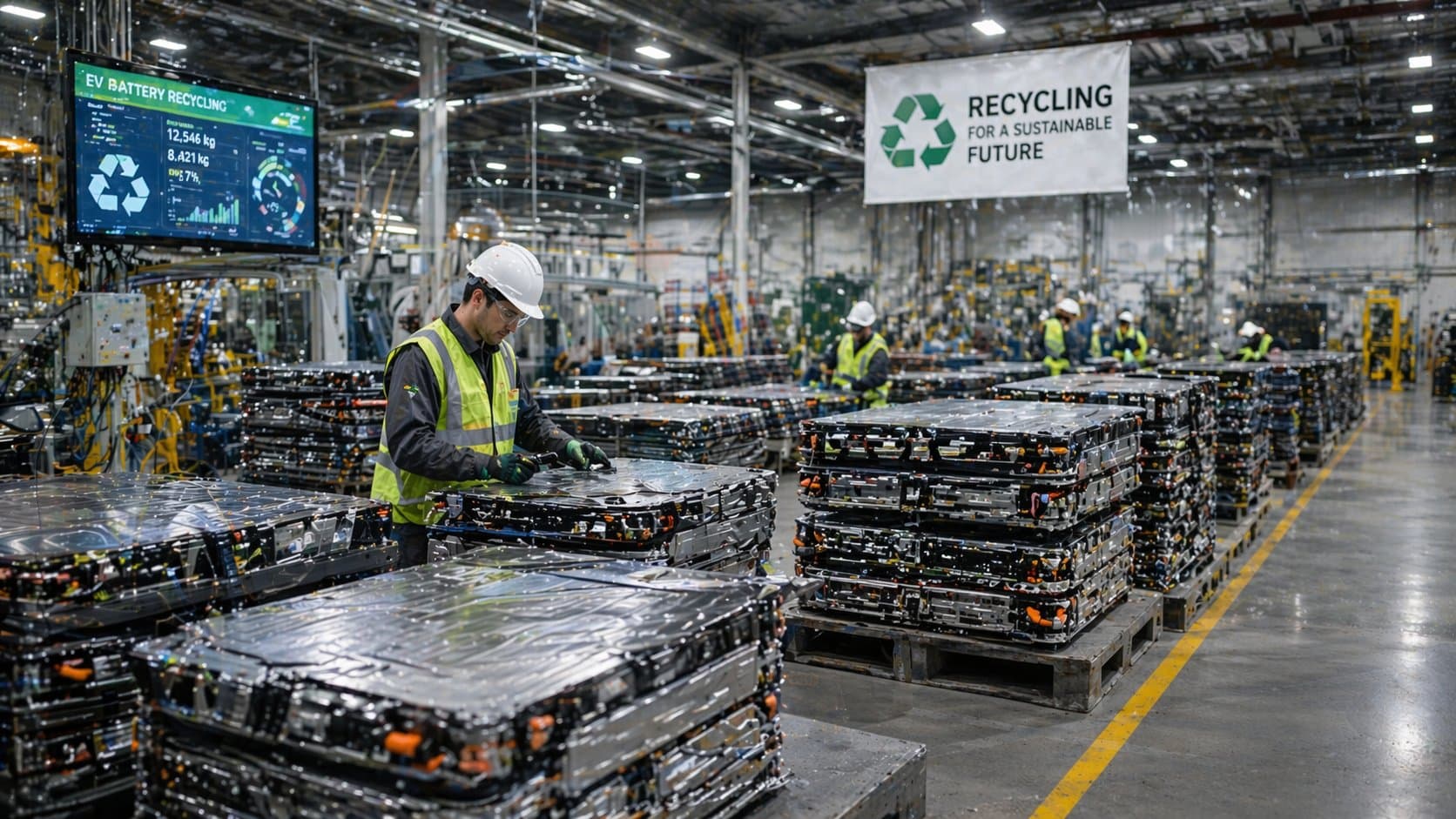
When a battery reaches the end of both its vehicle life and its second life, recycling recovers the valuable materials for manufacturing new batteries. EV battery recycling has advanced dramatically since 2020.
What's Recovered
Modern recycling processes recover 95%+ of critical minerals. Lithium recovery rates now exceed 90% (up from 50% in 2020). Nickel, cobalt, and manganese are recovered at 95%+ rates. Copper, aluminum, and steel from the pack structure are standard recycling. The recovered materials are refined to battery-grade purity and re-enter the battery supply chain — creating a closed loop that reduces the need for new mining.
Major Recycling Players
Redwood Materials (founded by former Tesla CTO JB Straubel) operates the largest battery recycling facility in North America. They process batteries from Tesla, Ford, Toyota, and other manufacturers, recovering materials that go directly back into new battery cathode production.
Li-Cycle operates commercial recycling hubs in New York, Alabama, and Ontario, using a hydrometallurgical process that recovers materials without the high-temperature smelting that older recycling methods required.
Cirba Solutions (formerly Retriev Technologies) has been recycling batteries since 1992 and processes over 10,000 tons of lithium-ion batteries annually.
The Economics Are Improving
Battery recycling was originally unprofitable — the cost of processing exceeded the value of recovered materials. That equation has flipped as raw material prices have increased, recycling technology has improved efficiency, and government regulations (particularly the EU's Battery Regulation requiring minimum recycled content in new batteries) have created guaranteed demand for recycled materials.
By 2030, analysts project that recycled materials will supply 10–15% of new battery production — growing to 30–40% by 2040 as the first wave of mass-market EVs reaches end-of-life. Looking forward, solid-state battery technology promises even higher recyclability and longer service life.
The Environmental Bottom Line
The lifecycle environmental impact of an EV battery — from mining through manufacturing, vehicle use, second life, and recycling — is substantially better than the gasoline equivalent. A typical EV battery enables 150,000–300,000 miles of zero-emission driving, then provides 7–10 years of grid energy storage, and then returns 95% of its materials to the supply chain through recycling.
Compare this to gasoline: every gallon burned is gone forever. The carbon is released permanently. There is no “second life” for combusted fuel. There is no recycling. The materials are consumed and converted to atmospheric CO2 with zero recovery.
The EV battery lifecycle isn't perfect — mining has environmental and social impacts that the industry must continue to address. But the “what about the batteries?” concern, while valid in 2015, has been largely answered by 2026's recycling technology, second-life applications, and dramatically improved battery longevity. For buyers considering whether an off-lease EV still has plenty of life left, our used EV buyer's guide walks through what to look for — or browse current EV deals to see how affordable modern batteries have become.