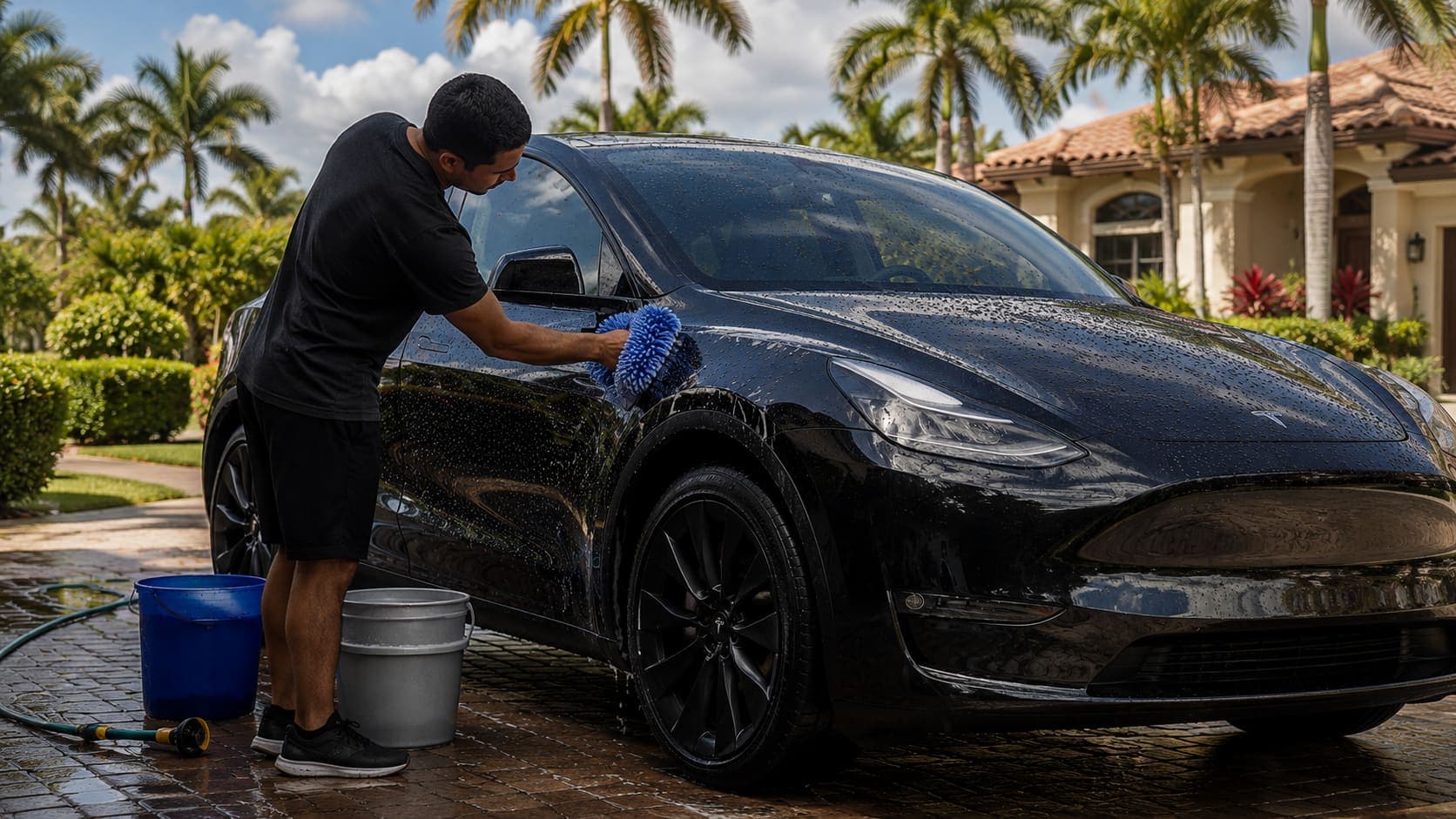
Most advice about washing a car was written for cars with engines.
That's fine for the basics — soap is still soap, and a microfiber towel doesn't care what's under the hood. But a Tesla brings a handful of genuine differences that a general detailing guide won't mention, and two of them can cost you real money if nobody tells you.
Here's what actually changes when the car is electric, and what changes again when the car lives in Central Florida.
Start Here: Tesla Has a Setting for This
Before anything else — if you own a Tesla and you've never used Car Wash Mode, this is the single most useful thing in this article.
Tesla's own owner's manual is direct about it. Car Wash Mode closes all the windows, locks the charge port, and disables the windshield wipers, Sentry Mode, walk-away door locking, and parking sensor chimes. You enable it through Controls → Service → Car Wash Mode, with the car stationary and not actively charging.
Why it matters: Tesla states plainly that failing to use it can result in damage — the charge port and the wipers being the two it names. And it adds a line worth reading twice: damage caused by car washes is not covered by the warranty.
Two practical notes:
- Use it for hand washes too, not just automatic ones. Keeping the charge port locked and the auto-wipers still is just as useful in your own driveway.
- If the wash uses a conveyor, Enable Free Roll keeps the car in neutral and stops it applying the parking brake if you step out.
What Tesla Actually Recommends (and What It Warns Against)
Straight from the manual, not from forums:
- Touchless washes only if you're using an automatic wash — meaning no brushes or anything else that physically contacts the paint.
- No chemical-based wheel cleaners or pre-wash products. Tesla says these can damage the wheel finish.
- Never spray high-velocity water toward the charge port while the car is charging. This is a safety instruction, not a cosmetic one.
- Make sure the wipers are off before washing.
The paint itself has a reputation among detailers for being on the soft side, which is why brush washes come up so often in owner complaints — swirl marks show up more readily than on a harder finish. Treat that as widely-reported experience rather than a published specification, but it's consistent enough that erring toward touchless or hand washing is the safe call.
The Sensors Are Part of the Car Now
A modern EV's exterior isn't just bodywork. Cameras, sensors, and a motorized charge-port door are all out there getting sprayed.
- Don't aim high pressure directly at cameras, sensors, or mirror housings. Rinse them, don't blast them.
- A smeared or filmy camera lens can affect driver-assist features. If a warning appears after a wash, a clean, dry microfiber wipe on the lens is usually all it takes.
- Sentry Mode off during a wash saves you a pile of pointless recordings and a bit of battery. Car Wash Mode handles this for you.
Brakes: Less Dust, Different Problem
Here's a real EV difference that cuts both ways.
Because regenerative braking does most of the slowing, EV brake pads see far less use than on a comparable gas car. The upside is obvious to anyone who's switched: dramatically less brake dust, so wheels stay clean much longer.
The downside is specific to humid climates like ours. Brake components that rarely get used can develop surface corrosion. This isn't a detailing problem exactly, but it's worth knowing, and it's worth mentioning to whoever services your car — a shop that works on EVs regularly will already be looking for it. A shop that doesn't may not be.
Now the Florida Part
This is where Orlando ownership genuinely differs from owning the same car in Seattle.
Love bugs are a paint problem, not just a mess
Central Florida gets two love bug flights a year — roughly late April through May, and again from late August into September, each running several weeks.
The reason detailers take them seriously: love bug residue is acidic, and it gets worse as it decomposes in heat. University of Florida research has found measurable paint etching when residue is left on a vehicle for around 24 hours or more in warm conditions. Florida sun accelerates the whole process.
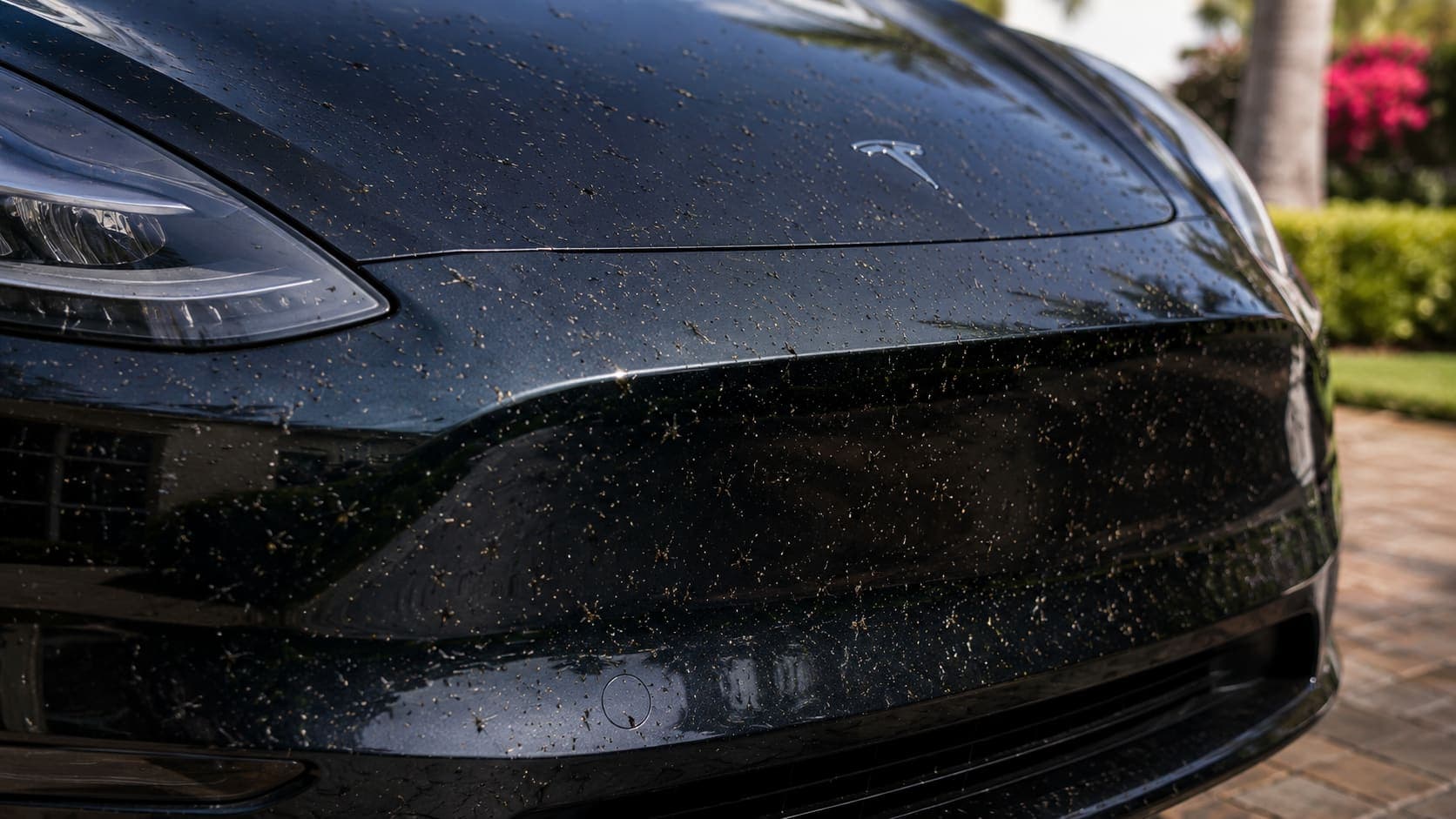
What that means practically during the flights:
- Rinse the front end promptly after highway driving. Days matter, not weeks.
- Soak before you wipe. Dry-wiping dried residue drags grit across the clear coat.
- Work on cool paint in shade. Chemicals flash-dry on hot panels and leave their own marks.
- Skip harsh solvents. UF's extension guidance leans toward prompt washing and gentle methods over aggressive chemistry.
If you commute I-4 during a flight, a weekly wash schedule during those two windows will save you a paint correction later.
Heat, sun, and afternoon storms
Orlando summers run mid-90s with humidity that pushes the heat index past 105°F. Three consequences for paint care:
- Never wash in direct midday sun. Water and soap dry before you can remove them, and you get spotting instead of cleaning.
- Hard water spots bake on fast. Dry the car rather than letting it air-dry.
- Afternoon thunderstorms aren't a rinse. Rainwater carries dust and leaves its own deposits.
Is a ceramic coating worth it here?
Honest answer: it's a stronger case in Florida than in most of the country, but it isn't magic.
What a quality ceramic coating genuinely does is make the surface far easier to clean and far more resistant to bonding — bug residue, pollen, and water spots sit on top rather than grabbing hold, so a quick rinse handles what would otherwise need scrubbing. During love bug season that's a meaningful difference in both effort and risk.
What it doesn't do is make paint scratch-proof, and it doesn't remove the need to wash. It reduces how hard washing has to be.
Paint protection film is the other option, and it's a physical barrier rather than a chemical one — genuinely useful on the front end, where highway bug impact concentrates. It costs considerably more, and it's usually applied to high-impact panels rather than the whole car.
Neither is a decision to make from an article. Both are worth pricing from a shop that will show you their work on an EV.
What to Ask an Orlando Detailer Before You Book
The shop matters more than the package name. Questions that separate a genuine EV-capable detailer from one that just accepts EVs:
- Have you detailed Teslas before, and do you know Car Wash Mode? If they don't know what it is, that tells you something.
- Is your wash touchless or hand-only? For a Tesla, both are fine; brushes are not.
- How do you handle cameras and sensors? You want a specific answer, not a shrug.
- What's your love bug season process? A Central Florida shop should have one.
- If you're quoting a ceramic coating — what product, what warranty, and what's the prep? Prep and paint correction are most of what you're paying for. A coating over unprepared paint locks in the defects.
- Are you insured for high-value vehicles?
The Short Version
Turn on Car Wash Mode. Stay away from brushes. Keep high pressure off the cameras and the charge port. Wash promptly during the two love bug flights, and never in the midday sun.
That's most of it. An EV isn't harder to look after than a gas car — the maintenance load is genuinely lighter. It's just different in a few specific ways, and nearly all the expensive mistakes come from treating it like it isn't.
Find EV-Safe Detailing in Orlando
Ready to book? See our Orlando car detailing directory for local providers.
Product recommendations, seasonal timing, and manufacturer guidance were verified in 2026 but can change — confirm current details with your vehicle's owner's manual and your detailer before booking. Consult your owner's manual for guidance specific to your model and year.