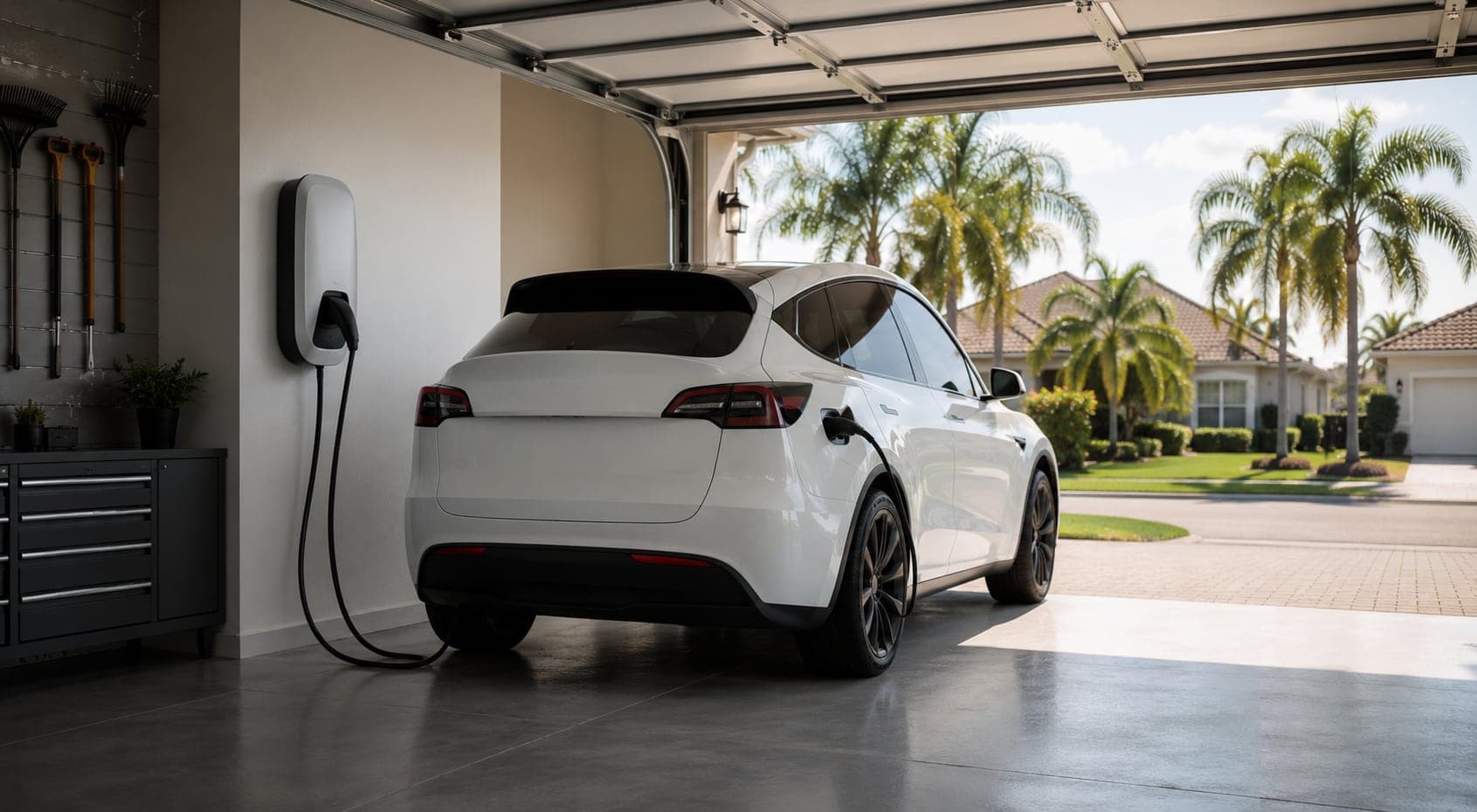
Real compatibility, Florida-heat considerations, permitting, current incentives, and how to find a trusted local installer.
Buying a Tesla Model Y is exciting. Choosing the right home charger usually isn't.
Spend an hour researching online and you'll find dozens of conflicting recommendations. Some sites insist the Tesla Wall Connector is the only logical choice. Others say a NEMA 14-50 outlet is all you'll ever need. Then there are the third-party chargers, each claiming to be the fastest, smartest, or most future-proof.
The truth is simpler. For most Model Y owners in Central Florida, nearly every quality Level 2 charger will fully recharge the car overnight. So the useful question isn't “Which charger is fastest?” It's:
Which charger makes the most sense for your specific Model Y, your electrical panel, your budget, and Florida's climate?
This guide answers exactly that — with verified specs, honest trade-offs, and Orlando-specific permitting and incentive facts as of 2026.
First: What Does a Tesla Model Y Actually Need?
The Model Y uses Tesla's NACS connector (North American Charging Standard, now also standardized as SAE J3400). For home charging, you want Level 2 (240-volt) charging, which restores enough range overnight for essentially any daily commute.
But here's a detail almost every other guide gets wrong, and it can save you money:
Not every Model Y charges at 48 amps. Several Model Y trims — including many rear-wheel-drive and dual-motor configurations — have a 32-amp (7.7 kW) onboard charger limit and top out around 30 miles of range per hour no matter how powerful your wall charger is. Other Model Y trims accept the full 48 amps (11.5 kW), or about 44 miles of range per hour.
Why does this matter? Because a 48-amp charger only delivers 48 amps if three things all agree: your electrical panel, the circuit/breaker and wiring your electrician installs, and your car's onboard charger. If your Model Y caps at 32 amps, paying extra for a 48-amp charger and the larger 60-amp circuit it needs is money spent on speed you physically can't use.
Before you buy, confirm your specific Model Y's onboard charger rating. It determines whether a 40-amp charger is already all you need.
Hardwired vs. NEMA 14-50 Outlet
This is the biggest installation decision you'll make.
Hardwired — the charger is permanently wired to your panel.
- Cleaner look, no receptacle to wear out
- Required to reach the full 48 amps on chargers that support it
- Best for long-term homeowners
- Less portable; requires a licensed electrician and a permitted dedicated circuit
NEMA 14-50 plug-in — the charger plugs into a heavy-duty 240V outlet.
- Often lower upfront cost, and you can unplug and take the charger if you move
- Typically capped around 40 amps (still ~38 miles/hour — plenty for most drivers)
- Important: not every 14-50 outlet is safe for EV charging. Per NEC continuous-load rules the receptacle must be industrial/commercial grade and continuous-duty rated (brands like Hubbell, Bryant, Leviton, or Eaton). A standard residential outlet is not built for the sustained load of nightly charging and can overheat.
For many Orlando households either option works well. If your Model Y caps at 32–40 amps, a quality 40-amp plug-in setup may be all you'll ever need.
Our Top Recommendations
All four units below are confirmed compatible with a NACS Model Y. Prices are approximate as of mid-2026 — always confirm current pricing before buying.
Best Overall — Tesla Wall Connector (~$475)
The natural choice if you own only Teslas. Native NACS plug, up to 48 amps / 11.5 kW, 24-foot cable, Tesla-app integration, and a 4-year warranty — the longest in the category. Weather-resistant and suitable for outdoor installation. Note there are two versions: the standard Wall Connector (NACS only, requires a Tesla account) and the Universal Wall Connector (~$595–$650, adds a J1772 plug to charge any EV). For a Tesla-only home, the standard version is all you need.
Best Value — Emporia Level 2 (NACS version) (~$449)
Emporia now sells a native-NACS model — no adapter needed — that even opens the Model Y's charge-port door from the handle, just like Tesla's. Up to 48 amps hardwired (~46 mi/hr) or 40 amps plug-in, UL-listed and ENERGY STAR certified, with genuinely good home-energy-monitoring in its app. Excellent feature-for-price.
Best for Future Flexibility — ChargePoint Home Flex (~$500+)
One of the first non-Tesla chargers to offer a native NACS connector, so it charges a Model Y with no adapter, and up to 50 amps (your Model Y will draw its own max). A strong pick if you might add a different EV brand later. Polished app with utility-program integrations.
Best Budget — Grizzl-E Classic (~$399)
Rugged, simple, NEMA-4 metal enclosure, up to 40 amps / 9.6 kW. One honest caveat: the base Classic ships with a J1772 connector, so charging a Model Y requires a J1772-to-NACS adapter (Teslas have historically included one). If you want a no-adapter setup, choose one of the native-NACS options above. But for dependable, no-frills overnight charging, the Grizzl-E is hard to beat on price.
A money-saving note: both the Emporia and Grizzl-E offer Dynamic Power Management (DPM). If you have a 100-amp panel loaded near capacity, DPM can let you run a 40- or 48-amp charger without a full panel upgrade — potentially saving you hundreds to thousands of dollars. Ask your electrician whether it fits your setup.
Florida Heat Matters
Central Florida garages routinely climb well above outdoor temperatures. When comparing chargers, weigh:
- Weather rating (NEMA 4 / IP-rated if mounted outdoors)
- UV-resistant, heat-flexible cable jacket (some cables stiffen or degrade in extremes)
- Manufacturer operating-temperature range
- Warranty (Tesla's 4-year is the category standard to beat)
A charger that's excellent in a mild climate isn't automatically the best long-term choice for Florida.
One coastal note: most Level 2 chargers handle rain and humidity fine, but few are salt-air (NEMA 4X) rated. Inland Orlando installs are unaffected; if you're near the coast, ask about added protection.
Cable Length — Don't Overlook It
Before buying, measure the distance between your panel, your desired mounting spot, and your Model Y's charge port (rear driver's side). A 24–25-foot cable (standard on most units here) reaches most garage layouts comfortably. Longer is more flexible but messier if not managed with a holster.
Do You Need a Permit in Orlando?
Yes. An electrical permit is required for an EV-charger circuit in both the City of Orlando and unincorporated Orange County. The City of Orlando accepts applications through its eTRAKiT online permit system; a licensed electrical contractor typically handles the filing, the load calculation, and scheduling the final inspection.
A few specifics worth knowing:
- Level 2 chargers need a dedicated 40–60 amp, 240V circuit. Under NEC Article 625, that circuit must be rated at 125% of the charger's maximum continuous output.
- Permit fees in Orlando/Orange County typically run about $100–$200 (verify current fees when you apply).
- In Orange County, simple EV-charger permits are often approved within three to five business days.
Skipping the permit can create insurance and home-resale problems later — and a properly permitted, professionally installed charger is a genuine asset when you sell.
Are There Incentives Right Now? (The Honest 2026 Answer)
Incentives change, and a lot of older guides still list ones that no longer exist. Here's the accurate current picture:
- Federal (30C) tax credit — EXPIRED. The federal Alternative Fuel Vehicle Refueling Property Credit (Section 30C), which covered 30% of a home charger install up to $1,000, expired on June 30, 2026, with no extension currently pending. If a website tells you to “claim the federal credit,” that information is out of date.
- Florida does not currently offer a statewide tax credit for residential EV chargers.
- Your utility is the place to look. OUC (Orlando Utilities Commission) and Duke Energy periodically offer off-peak / time-of-use programs that lower what you pay to charge overnight. These are ongoing savings rather than upfront rebates, and terms change — check your specific utility's current EV programs before you buy.
We'd rather tell you the credit is gone than send you chasing money that isn't there.
What If Your Electrical Panel Needs an Upgrade?
This is the single biggest cost variable — and a real concern in Orlando's established neighborhoods. Homes in areas like Conway, College Park, and parts of Winter Park were often built with 100-amp panels that may already be near capacity with the A/C and other large loads.
A licensed electrician performs a load calculation (NEC 220.82) to determine whether your panel can safely add an EV circuit. Good news: many homes don't actually need an upgrade — and features like Dynamic Power Management (above) can sometimes avoid one entirely. But if your panel is maxed out, a panel upgrade is the practical fix, and it's better to know before you buy the charger than after.
Typical Orlando installed costs (2026): a straightforward Level 2 install generally runs $800–$2,500 all-in (charger unit ~$400–$800 plus labor/materials), depending mainly on the wire-run distance from your panel. Jobs needing a panel upgrade or long runs can exceed $3,000.
Choosing the Right Installer
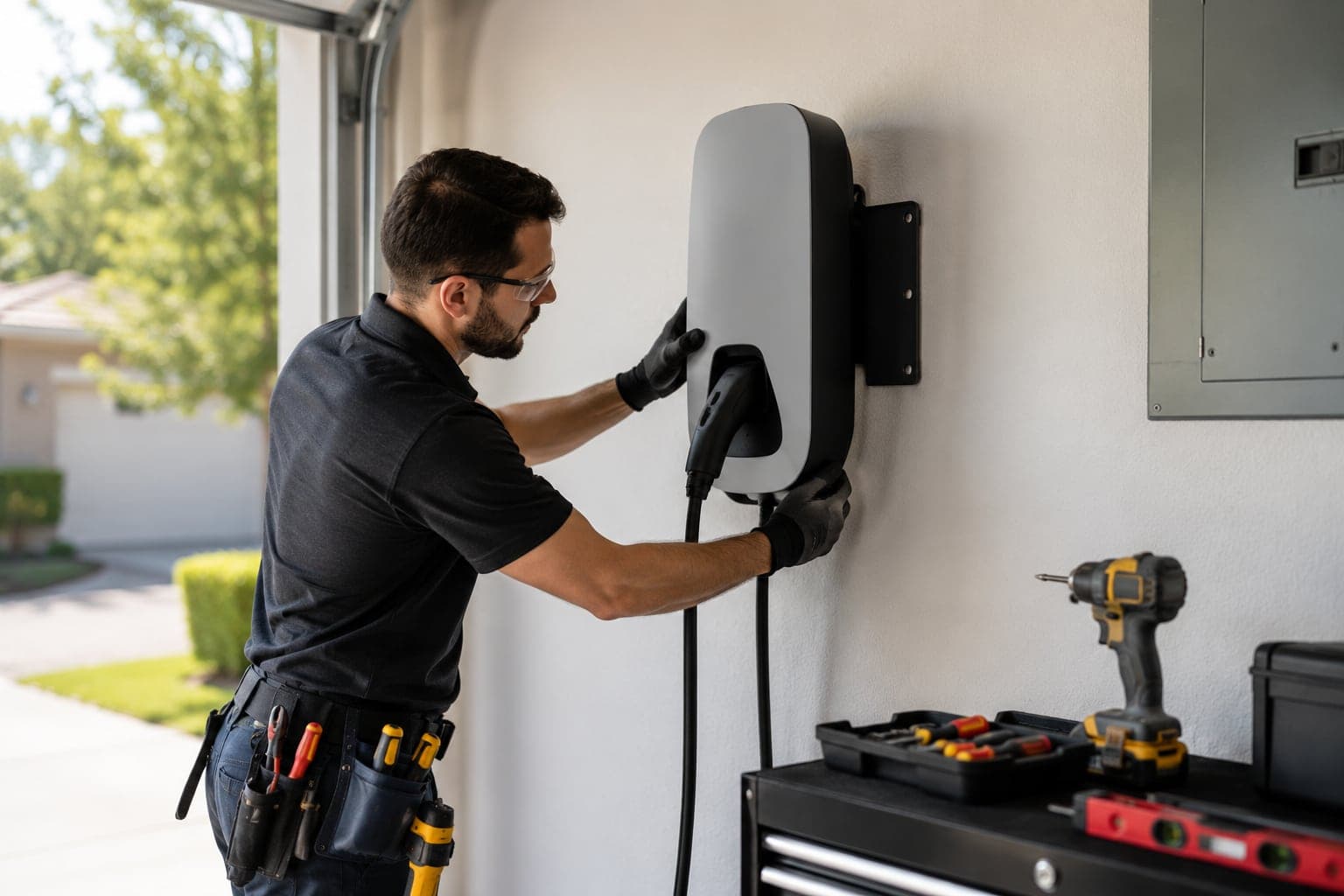
The installer matters as much as the charger. Look for someone who:
- Is licensed and insured in Florida
- Pulls the required permit and schedules the inspection
- Has real EV-charger experience
- Will explain a load calculation if your panel is near capacity
- Provides a written warranty
Tesla also maintains a directory of Certified Installers for the Wall Connector who typically bundle permitting and inspection.
Questions to ask before you hire anyone:
- Will a panel upgrade be necessary — and can Dynamic Power Management avoid it?
- Is hardwired or a NEMA 14-50 plug-in better for my home?
- What charging speed will my specific Model Y and setup actually support?
- Will you pull the permit and schedule the inspection?
- Are there any HOA requirements I need to handle?
- Is the install expandable if I add a second EV later?
Our Recommendation
If you're keeping your Model Y for several years and charging at home regularly, a professionally installed, hardwired Level 2 charger is usually the best long-term setup — provided your Model Y can use the extra amperage. If it caps at 32–40 amps, a quality NEMA 14-50 plug-in setup is just as good and often cheaper and more flexible.
The best charger isn't the one with the highest amperage or the longest spec sheet. It's the one that fits your Model Y's onboard charger, your home's electrical system, your daily driving, and your long-term plans.
Find a Trusted Orlando EV Charger Installer
Our directory of verified, licensed Orlando EV-charger installers is coming soon. Only verified, licensed local installers will appear here, consistent with Healvanna's verification standard.
Charger specs, prices, permit fees, and incentive programs were verified in 2026 but can change — confirm current details with the manufacturer, your utility, and your local building department before purchasing or installing. This guide is educational and not tax or electrical advice; consult a licensed electrician and a tax professional for your specific situation.