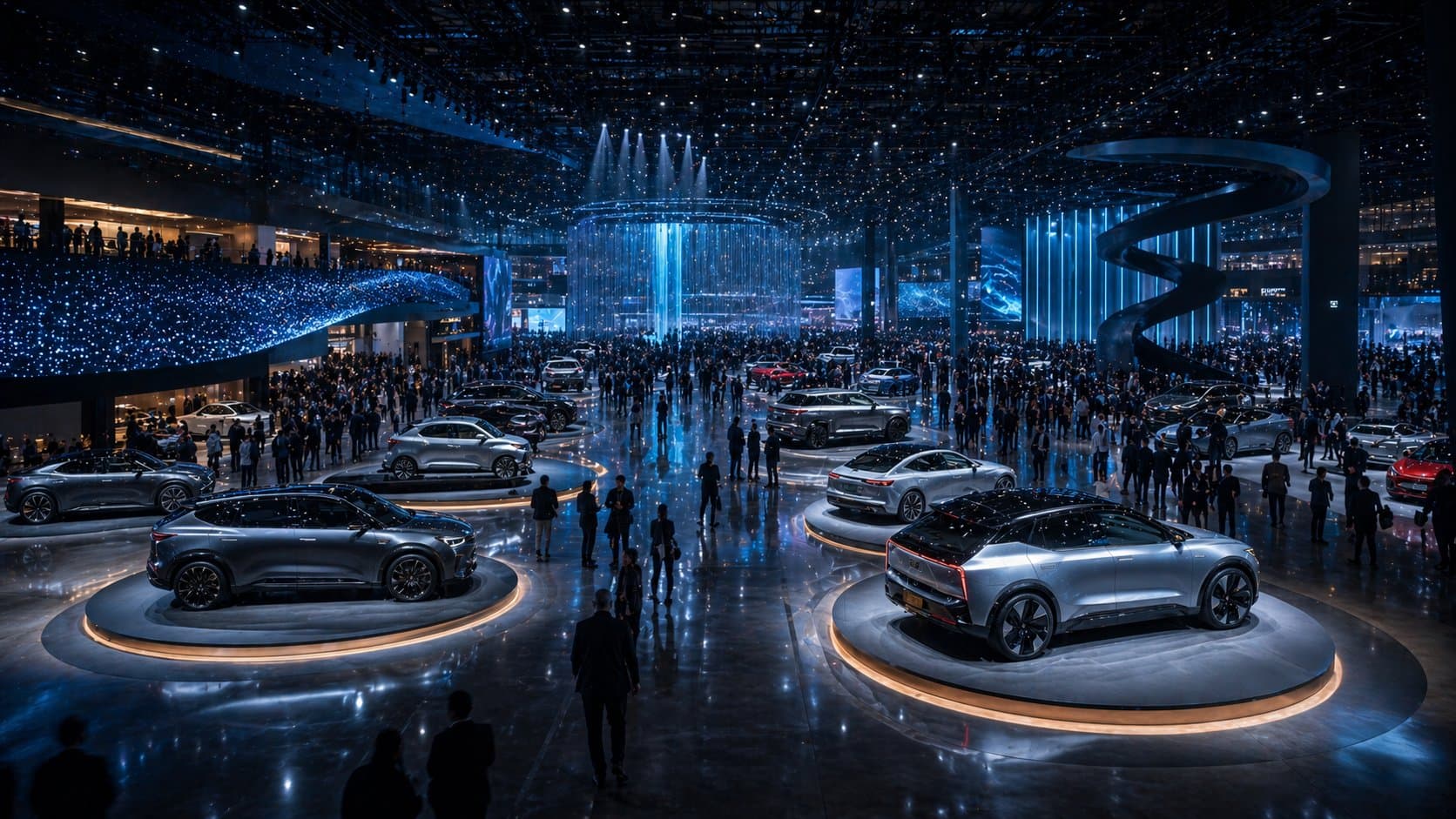
The 2026 Beijing International Automotive Exhibition closed its doors on May 3 after ten days of debuts, demos, and the kind of industry-watching that now seems to happen only in China. Across 380,000 square meters of exhibition space, 1,451 vehicles were on display — including 181 global premieres and 71 concept cars — making this the largest auto show in the world by a comfortable margin. While auto shows in Europe, North America, and Japan continue to shrink or disappear entirely, Beijing 2026 drew 1.28 million visitors and confirmed something the industry has been processing slowly for years: the center of gravity in automotive innovation has moved.
If you missed the show or only caught fragments through social feeds, here are the ten reveals that mattered most.
1. BYD Yangwang U9 Xtreme — The $2.9 Million Statement
The headline-grabbing moment of the entire show belonged to BYD's ultra-luxury sub-brand Yangwang. The production version of the U9 Xtreme — limited to just 30 units globally — was sold for over 20 million yuan ($2.9 million) per car, with the first delivery going to Australian entrepreneur Nick Politis. Wang Chuanfu, BYD's chairman and president, presented the vehicle personally on the opening day.
The car is the most expensive production vehicle BYD has ever sold, and the technical credentials match the price tag. It is built on the world's first mass-produced 1,200-volt high-voltage platform, with four electric motors producing a combined 2,977 horsepower. In September 2025, the U9 Xtreme became the first pure-electric production car to lap Germany's Nürburgring in under seven minutes, posting a time of 6:59.157.
For BYD, this isn't really about selling supercars. It's about establishing that a Chinese brand can occupy the absolute top of the market — a position that was unimaginable five years ago.
2. BYD Seal 08 — Blade Battery 2.0 Goes Mainstream
If the U9 Xtreme was the statement, the BYD Seal 08 was the strategy. The new flagship sedan debuted with BYD's second-generation Blade Battery, claiming over 1,000 kilometers of CLTC range and what the company calls “megawatt-level flash charging” — adding 400 kilometers in five minutes. It charges from 10 to 70 percent in those same five minutes.
The Seal 08 sits on an 800-volt architecture and produces 684 horsepower in its all-wheel-drive configuration. Pricing has not been finalized, but Chinese market expectations place it between 300,000 and 350,000 yuan (roughly $42,000 to $49,000 USD) when it launches in Q2 2026. For comparison, a Mercedes-Benz EQS 580 4Matic with similar capability starts above $130,000 in the United States.
This is the threat European luxury brands have been quietly worried about for years, now made concrete.
3. AITO M9 — Huawei's Smart-SUV Flagship
The next-generation AITO M9 was unveiled with six Huawei-developed LiDAR sensors and the latest Qiankun ADS 4.1 advanced driver assistance system. Pre-orders opened during the show. The M9 sits at the top of the Huawei-backed Harmony Intelligent Mobility Alliance, which now includes five major brands (AITO, LUXEED, STELATO, MAEXTRO, and Shangjie).
What makes the M9 significant isn't just the spec sheet — it's the model. Huawei doesn't manufacture cars itself. Instead, it provides the smart cockpit, autonomous driving stack, and software architecture that turn partner-brand vehicles into deeply Huawei-integrated products. AITO is the most successful example of that strategy, and the new M9 is its most refined product yet.
4. Nio ES8 — The Family SUV Approaching 100,000 Sales
While the new ES9 attracted attention as Nio's halo product, the more telling story was the Nio ES8, which is approaching 100,000 deliveries in just seven months on the market. The ES8 has led the large SUV segment in China for four consecutive months, and it represents what Nio's CEO has described as a critical model in the company's path to full-year profitability in 2026.
The full-size, three-row, six-seater electric SUV has gone from being a niche category — pioneered by the Li Auto ONE — to one of the highest-margin and fastest-growing segments in China's car market. Annual sales for the segment now exceed 100,000 units across multiple manufacturers.
5. BMW Neue Klasse iX3 LWB — Built for China, From China
BMW used Beijing for the global debut of the Neue Klasse iX3 in long-wheelbase form, built specifically for the Chinese market. The vehicle features an 800-volt system with over 900 kilometers of CLTC range and 400 kilometers of range replenishment in 10 minutes.
The deeper signal at BMW's booth wasn't the iX3 itself — it was the depth of localization. About 70 percent of the software was developed in China. The voice assistant runs on large language models from Alibaba and DeepSeek. Navigation comes from Amap. Driver assistance is built with Momenta. Huawei integration covers Digital Key, HiCar, and HarmonyOS NEXT.
BMW is no longer just selling German cars to Chinese buyers. It is building Chinese cars under a German badge.
6. Mercedes-Benz GLC EV Long-Wheelbase — A Premium Counterattack
Mercedes-Benz brought 40 vehicles to the show, headlined by the global premiere of the long-wheelbase pure-electric GLC SUV. Built on the new MB.EA platform with an 800-volt architecture and silicon-carbide inverter, the GLC EV represents Mercedes' most serious attempt yet to match Chinese EVs on the technical credentials that buyers in this market have come to expect.
Mercedes also showed a refreshed S-Class designed to fend off ultra-luxury Chinese challengers like the Yangwang U8L and the Denza Z, plus the AMG GT XX concept previewing the brand's electric performance future. The strategy is unmistakable: stop trying to win on heritage alone, start competing on the metrics Chinese buyers actually care about.
7. Audi A6L e-tron — Pure Electric on the PPE Platform
Audi covered both the combustion and electric tracks. The pure-electric A6L e-tron debuted on the PPE platform with 800V high-voltage fast charging. More notably, the new-generation combustion A6L introduced Huawei's Qiankun Intelligent Driving System for the first time on an Audi vehicle.
That last detail tells the story of the show. A German luxury brand integrating Chinese ADAS technology into one of its core sedans would have been unthinkable a few years ago. In 2026, it's competitive necessity.
8. Volvo's Pure Electric Flagship 90 Family — EX90, ES90, EM90
Volvo Cars debuted its full “Pure Electric Flagship 90 Family” at the show, comprising the EX90 SUV, the ES90 sedan, and the EM90 MPV. The lineup gives Volvo full coverage across the three core categories that matter in the premium Chinese market: SUVs, sedans, and the chauffeur-driven MPV segment that barely exists in Europe but is enormous in China and parts of Southeast Asia.
This three-vehicle approach reflects something the show made abundantly clear: every serious automaker now plans for the Chinese market with a luxury MPV in the lineup. It is no longer a niche category.
9. CATL's Energy Technology Experience Area — The Battery Wars Made Visible
Power-train suppliers got their own booths at this year's show, and CATL took a 1,500-square-meter “Energy Technology Experience Area” at the entrance of the exhibition hall. The display showed CATL's full chain — battery cell production, battery-swapping networks, recycling, and cascade utilization.
CATL's newly unveiled Naxtra Sodium-ion Battery, targeting mass production by the end of 2026 for entry-level and cold-weather applications, was a major draw. CALB and BYD Battery (BYD's battery division) also showed their latest cells. Multiple manufacturers indicated solid-state and sodium-ion batteries will reach mass production between 2027 and 2028. The fast-charging arms race between CATL and BYD — both now claiming sub-10-minute charging times — has moved from press release to product reality.
10. The Brand Consolidation Pattern — China's NEV Market Maturing
A less photogenic but arguably more important story at the show was the visible maturation of China's new-energy vehicle market. The number of active Chinese NEV brands climbed from roughly 60 in 2018 to a peak of about 135 in 2022, then collapsed to around 55 by 2026 as the price war and tightening capital environment forced consolidation.
The surviving brands are now organizing themselves into rational sub-brand structures. BYD has Dynasty and Ocean for volume, Denza and Yangwang for premium, Fang Cheng Bao for off-road. Geely has Galaxy, Lynk & Co, Zeekr, plus Volvo, Polestar, and Lotus globally. SAIC has IM, Roewe, and the Buick joint venture. Huawei's HIMA alliance covers AITO, LUXEED, MAEXTRO, and Stelato.
This is what a mature industry looks like. The chaos of 2022 has given way to a smaller number of stronger players, each capable of competing across multiple body styles and price points.
What This Means for the Industry
If Beijing Auto Show 2026 had a single takeaway, it was that 800V architecture, sub-10-minute charging, and AI-driven driver assistance are no longer flagship features — they are baseline expectations. What was a differentiator eighteen months ago is now table stakes. Manufacturers that cannot meet those specifications will not be competitive in the Chinese market, which increasingly sets the global pace for electric vehicle development.
For Western automakers, the show offered both a warning and a roadmap. The warning is that competing on heritage alone is no longer sustainable. The roadmap is that integration with Chinese technology partners — Huawei for ADAS, Alibaba and DeepSeek for AI, CATL and BYD for batteries — is becoming the path most foreign brands are taking to remain relevant.
The next major test comes at the Frankfurt and Tokyo shows later this year. After Beijing 2026, the bar has been raised again. For deeper analysis on the headline cars, our deep dive on the Yangwang U9, AITO M9, and Nio ES9 covers the cars that defined the show, while our battery technology breakdown explores what the show revealed about next-generation EV batteries.