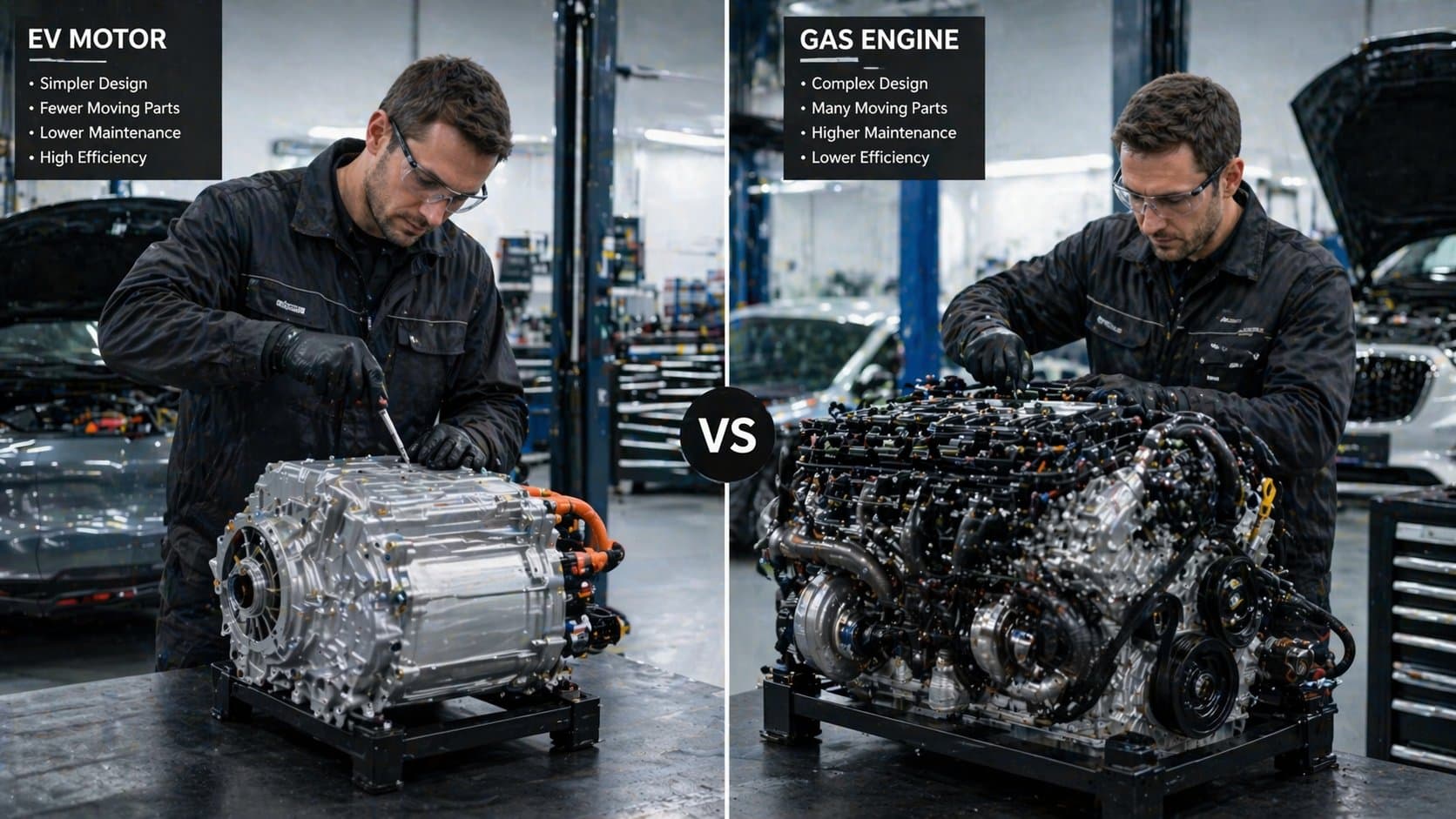
The maintenance cost advantage of EVs is one of the most repeated claims in automotive marketing — and one of the least understood by actual car buyers. “EVs have fewer moving parts” is technically true but practically meaningless until you see the real dollar amounts. This guide provides the actual 5-year maintenance costs for popular EVs versus their gas counterparts, using data from service records, manufacturer maintenance schedules, and owner-reported expenses. No estimates. No marketing. Just the real numbers.
Why EVs Cost Less to Maintain
The explanation is mechanical. An internal combustion engine has approximately 2,000 moving parts. An electric motor has approximately 20. Fewer moving parts means fewer things that wear out, break, or need periodic replacement.
Specifically, EVs eliminate these maintenance items entirely:
Oil changes: Gas cars need oil changes every 5,000–10,000 miles ($50–$100 each). Over 5 years and 75,000 miles, that's 8–15 oil changes costing $400–$1,500 total. EVs: $0.
Transmission service: Automatic transmissions need fluid changes every 30,000–60,000 miles ($150–$300 each). EVs have single-speed reducers that require no service.
Spark plugs: Replacement every 30,000–100,000 miles ($100–$400 per set). EVs: no combustion, no spark plugs.
Timing belt/chain: Replacement at 60,000–100,000 miles ($500–$1,500). EVs: no engine, no timing system.
Exhaust system: Catalytic converters, mufflers, exhaust pipes — all absent on EVs.
Fuel system: Fuel injectors, fuel pump, fuel filter — all absent on EVs.
Engine cooling: Radiator, thermostat, coolant hoses — EVs have battery cooling systems, but they're sealed and rarely need service.
What EVs Still Need
EVs aren't maintenance-free. They share several maintenance items with gas cars:
Tires: EVs are heavier and produce instant torque, both of which wear tires faster. EV-specific tires cost $150–$300 each and may need replacement every 25,000–35,000 miles versus 40,000–50,000 for gas cars. Over 5 years: EV tires cost approximately $1,200–$2,400 versus $800–$1,600 for gas car tires.
Brakes: Ironically, EV brakes last much longer — often 100,000+ miles — because regenerative braking handles 70–80% of deceleration. Over 5 years, most EV owners never replace brake pads. Gas car brake pad replacement (every 30,000–50,000 miles): $300–$800 per axle.
Cabin air filter: Every 15,000–25,000 miles, $30–$60 per replacement. Same for both EVs and gas cars.
Windshield wipers: Annual replacement, $20–$40. Same for both.
12V battery: Replacement every 3–5 years, $100–$250. Same for both.
Coolant for battery thermal management: Some EVs recommend coolant replacement at 100,000–150,000 miles, $100–$200. Most owners won't reach this in 5 years.
The 5-Year Cost Comparison
Based on 75,000 miles over 5 years (15,000 miles/year):
Tesla Model 3 vs Toyota Camry
Tesla Model 3 5-year totals: Oil changes $0, transmission service $0, spark plugs $0, brake pads $0 (regen braking), tires $1,800 (2 sets), cabin air filter $150 (3 replacements), wipers $150, 12V battery $200, coolant $0, engine air filter $0. 5-Year Total: $2,300. Annual average: $460.
Toyota Camry 5-year totals: Oil changes $750 (10 changes), transmission service $300 (1 service), spark plugs $200 (1 set), brake pads $600 (1 replacement), tires $1,200 (1.5 sets), cabin air filter $150 (3 replacements), wipers $150, 12V battery $150, coolant $150, engine air filter $100. 5-Year Total: $3,750. Annual average: $750.
Savings: $1,450 over 5 years, or $290 per year.
Chevrolet Equinox EV vs Chevrolet Equinox (Gas)
Equinox EV 5-year totals: Oil changes $0, transmission service $0, brake pads $0, tires $1,600, other routine items $400. 5-Year Total: $2,000. Annual average: $400.
Equinox Gas 5-year totals: Oil changes $900 (12 changes), transmission service $350, brake pads $700, tires $1,100, other routine items $600. 5-Year Total: $3,650. Annual average: $730.
Savings: $1,650 over 5 years, or $330 per year. For a deeper look at ongoing costs, see our EV maintenance costs vs gas cars guide.
The Tire Cost Caveat
Tires are the one maintenance category where EVs cost MORE than gas cars. EV-specific tires (designed for the extra weight and instant torque) cost 10–30% more per tire and wear faster. Over 5 years, expect to spend $400–$800 more on tires for an EV than an equivalent gas car.
This is the honest caveat that EV enthusiasts often skip. Tires partially offset the oil change and brake savings — reducing the net maintenance advantage from “dramatic” to “meaningful.” The EV still wins on total maintenance cost, but not by as much as the “no oil changes!” marketing implies.
The Unscheduled Repair Factor
Unscheduled repairs (things that break unexpectedly) are harder to compare because EVs haven't been on the road long enough for comprehensive long-term reliability data. Early data from Consumer Reports suggests that EVs have slightly more unscheduled repair visits in the first 3 years than gas cars (primarily for software issues, 12V battery failures, and fit/finish problems), but the cost per visit is lower because there are fewer expensive mechanical components to fail.
The wild card is battery replacement. If an EV battery fails outside warranty, the replacement cost is $5,000–$15,000 — a single expense that would wipe out a decade of maintenance savings. However, this is exceedingly rare for batteries less than 10 years old, and warranty coverage (8 years/100,000 miles standard) protects against early failures.
Combined Savings: Fuel + Maintenance
The real EV ownership story combines fuel AND maintenance savings:
Fuel (5-year): EV $1,700–$3,400 vs Gas Car $8,750 — EV saves $5,350–$7,050.
Maintenance (5-year): EV $2,000–$2,300 vs Gas Car $3,650–$3,750 — EV saves $1,350–$1,750.
Total 5-year cost: EV $3,700–$5,700 vs Gas Car $12,400–$12,500 — EV saves $6,700–$8,800.
Combined fuel and maintenance savings of $6,700–$8,800 over 5 years. That's $1,340–$1,760 per year — enough to offset a significant portion of any EV purchase price premium. For a complete three-way comparison, see our EV vs hybrid vs gas breakdown, check the latest gas prices and EV savings data, or browse current EV deals to run these numbers against a specific model and your own electricity rates.