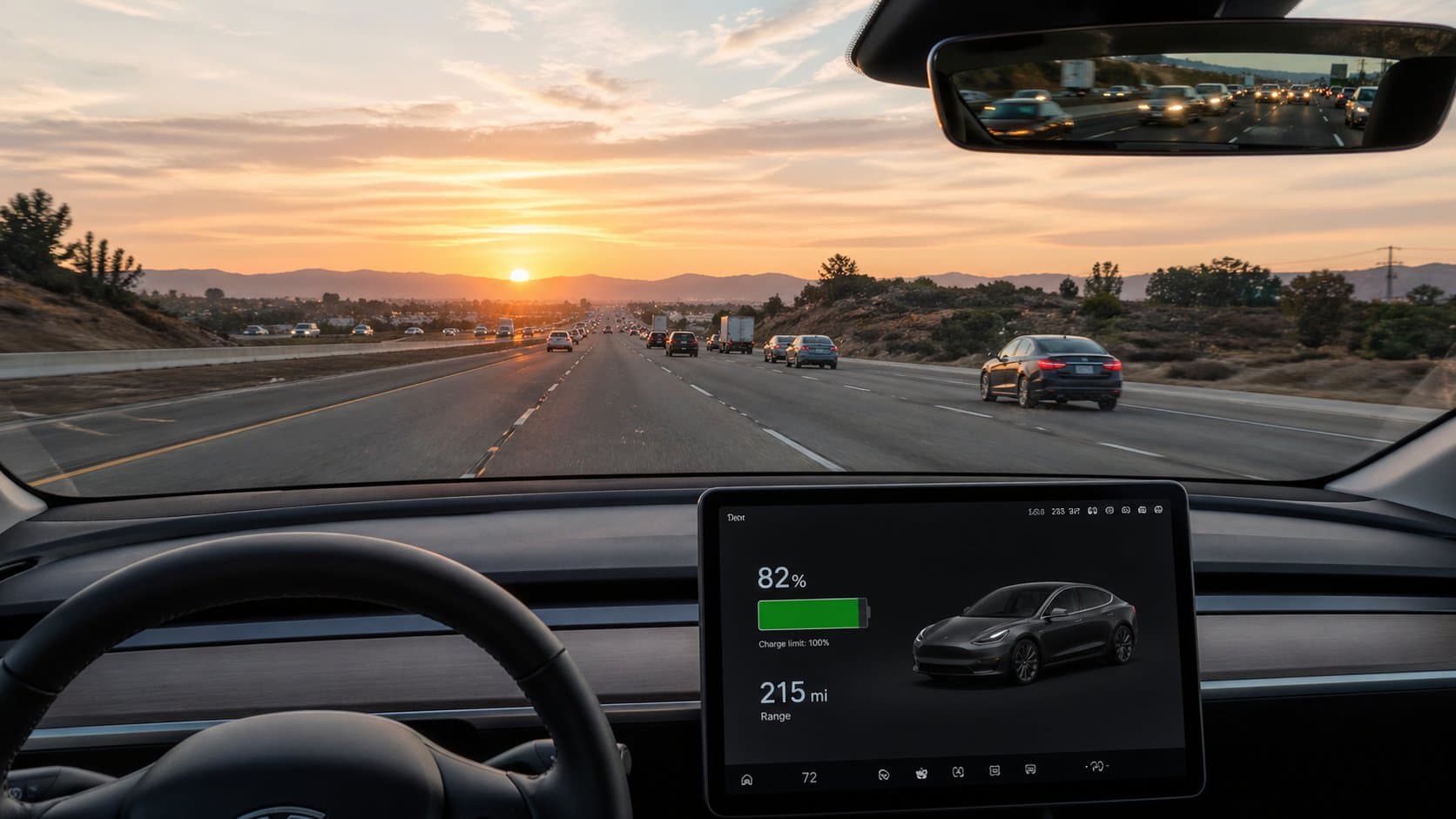
You picked up the keys. The car is in the driveway. The battery shows 87%. Now what? The first week with an EV is a recalibration — not just of how you drive, but of how you think about driving. Every habit from decades of gas-car ownership gets examined, and most of them change. Here is the honest, day-by-day guide to your first week of EV ownership based on what thousands of new EV owners actually experience.
Day 1: The Silence and the Range Number
The first thing every new EV owner notices is the silence. You press the start button, and nothing happens — or so it seems. There is no engine vibration, no exhaust rumble, no idle noise. The dashboard lights up, the car is “on,” but your ears receive nothing. This silence is disorienting for approximately 30 seconds and delightful for the rest of your ownership.
The second thing you notice is the range number on the dashboard. Whatever it reads — 280 miles, 310 miles, 250 miles — you will stare at it more than any other number you have ever seen on a car dashboard. This is normal. Every new EV owner obsessively watches the range for the first 1–2 weeks. This obsession fades completely by week three.
What to Do Day 1
Just drive. Go to the grocery store. Pick up the kids. Drive your normal routes. Do not attempt a road trip. Do not attempt to “test the range.” Do not drive to a fast charger “to see how it works.” Just drive normally and observe. You will use 10–30 miles of range — a fraction of what the battery holds.
When you get home, plug in. If you have a 120V outlet in the garage, plug in the included Level 1 charger. You will gain 3–5 miles per hour overnight. That is enough to replace the 10–30 miles you used today. You are now an EV owner who charges at home. It was that simple.
Day 2: One-Pedal Driving
Today you discover regenerative braking — the feature that slows the car and recovers energy when you lift your foot off the accelerator. In most EVs, you can enable “one-pedal driving” mode where lifting off the accelerator applies strong regenerative braking, slowing the car enough that you rarely need the brake pedal.
One-pedal driving feels strange for the first 20 minutes. The car decelerates more aggressively than you expect when you lift off the gas. By minute 30, it feels natural. By the end of day 2, it feels superior to gas-car driving — you are controlling speed with one pedal instead of constantly switching between two. Many EV owners describe one-pedal driving as the single feature they would miss most if they returned to a gas car.
The Brake Pedal Still Works
One-pedal driving does not eliminate the brake pedal — it just means you use it far less. Emergency stops, steep downhill descents, and the final stop at red lights may still require the brake pedal. The car still has a full conventional braking system. One-pedal driving is an addition, not a replacement.
Day 3: The Range Anxiety Check
By day 3, you have driven approximately 60–90 total miles across normal daily driving. Your battery still shows 70–80% remaining. The range anxiety that you read about online starts to feel absurd — you have used a fraction of the battery across three full days of normal driving, and you have been plugging in overnight, so the battery is actually higher than when you started if your daily driving is under 40 miles.
This is the day when most new EV owners have their first “aha” moment: the range is not a countdown timer like a gas tank. It is a reservoir that refills every night. You are not “using up” the battery and heading toward empty. You are dipping into it daily and refilling it nightly. The mental model shifts from “gas tank draining toward zero” to “phone battery that starts full every morning.”
Day 4: You Forget to Plug In
It happens to every new EV owner in the first week: you get home tired, walk inside, and forget to plug in. You wake up the next morning with the same battery level as last night. Depending on your daily driving and Level 1 charging, this means you might have 220 miles instead of 250 miles.
This is fine. You drive 30 miles today. You still have 190 miles remaining. The margin is enormous. Forgetting to plug in one night is the EV equivalent of forgetting to fill your gas tank when it is three-quarters full — a non-event.
The lesson: EV charging is forgiving. Unlike a gas car where you MUST visit a gas station when the tank is low, EV charging has built-in buffer because the battery holds days of driving range. Missing one overnight charge is meaningless for daily driving.
Day 5: Someone Asks You About the Car
By day 5, a coworker, neighbor, or family member asks about the EV. The questions are always the same: “How far does it go?” (tell them your EPA range), “Where do you charge?” (at home, overnight), “How long does it take to charge?” (overnight while I sleep — I never think about it), and “Do you miss gas stations?” (you will pause here, because the honest answer is no, and you are surprised by how fast that happened).
The conversation usually ends with them saying “I'm thinking about getting one” or “I'm not ready yet.” Both responses are fine. You are not an EV evangelist. You are just a person who drives a car that happens to plug in instead of fill up.
Day 6: The First Public Charger Visit
Even though you do not need to public charge for daily driving, curiosity drives most new EV owners to try a public charger during the first week. Find a Level 2 charger at a nearby shopping center (use the PlugShare app to locate one). Plug in while you shop. Come back 45 minutes later to 30–40 extra miles added.
The experience is underwhelming in the best way — you plug in, you walk away, you come back to more range. No gas smell on your hands. No standing in the cold holding a pump. No watching the dollar counter spin at $4 per gallon.
If you want to try a DC fast charger, find a Supercharger or Electrify America station nearby. The first fast-charge session is nervously exciting — will the cable fit? Do I need an app? How do I pay? — and boringly routine by the second visit. The anxiety is front-loaded and burns off quickly. Learn more about EV charging costs before your first session.
Day 7: The New Normal
By the end of week one, the EV is just your car. The silence is normal. One-pedal driving is natural. Plugging in at home is a 5-second habit like plugging in your phone. The range number on the dashboard has stopped being a source of anxiety and started being background information that you glance at once a day.
The most common week-one realization: EV ownership is dramatically simpler than gas-car ownership. No gas stations. No oil changes. No transmission service. No exhaust fumes in the garage. Plug in at night, drive during the day, repeat. The car requires less thought and less maintenance than any vehicle you have previously owned.
You will also notice that your relationship with driving has changed. The instant torque makes merging and passing effortless. The quiet cabin makes phone calls and conversations clearer. The smooth acceleration makes passengers (especially children) more comfortable. These are not features you shop for — they are quality-of-life improvements you discover through daily use.
The Bottom Line
Your first week with an EV follows a predictable arc: day 1 silence shock, day 2 one-pedal discovery, day 3 range anxiety dissolving, day 5 answering questions, day 7 total normalcy. The transition from gas to electric is faster and easier than every new owner expects. The car does not require a lifestyle change — it requires a 5-second habit change (plugging in at night instead of stopping for gas). By day 7, that habit is automatic and the EV is just your car. Check out our first-time buyer guide for more tips on making the transition smooth, or explore charging options to plan your home setup.