BYD announced a five-minute EV charge in early 2026. Headlines exploded. Social media declared range anxiety dead. But what actually happened — and how close is five-minute charging to becoming your daily reality? The honest answer is more nuanced than the headlines suggest, and understanding the gap between the announcement and your driveway matters for anyone considering an EV purchase today.
What BYD Actually Demonstrated
BYD's demonstration charged a Sealion 7 from approximately 10% to 80% in under five minutes using a proprietary 1,000-volt, 600 kW charging system. That is genuinely impressive — and genuinely misleading if you assume it translates directly to consumer experience.
The demonstration used a custom-built charging station with capabilities that do not exist in any public charging network today. The highest-power public chargers in North America currently deliver 350 kW (Electrify America's fastest units). BYD's demo required nearly double that power level. Building, certifying, and deploying 600 kW charging stations across a national network is a multi-year, multi-billion-dollar infrastructure project that has not started. For a state-of-the-network look, see our EV charging network report card.
The Physics of Ultra-Fast Charging
Charging an EV battery in five minutes requires moving enormous amounts of electrical energy in a very short time. A 75 kWh battery charged from 10% to 80% (52.5 kWh of energy delivered) in five minutes requires a sustained charging rate of 630 kW. For context, 630 kW is enough electricity to power approximately 200 homes simultaneously.
This creates three engineering challenges that must all be solved simultaneously.
Challenge 1: Heat Management
Pushing electricity into battery cells at extreme rates generates significant heat. Lithium-ion cells operate safely between approximately 15°C and 45°C. Above 45°C, the electrolyte degrades, lithium plating occurs on the anode, and permanent capacity loss accelerates. Five-minute charging generates enough heat to push cells above safe temperatures unless the cooling system can remove heat faster than the charging generates it.
Current liquid cooling systems in production EVs handle 150–350 kW charging adequately. Cooling 600+ kW charging requires next-generation thermal management — immersion cooling, advanced cold plates, or pre-conditioning systems that chill the battery before charging begins. These technologies exist in laboratories and prototypes but are not yet in mass-production vehicles. Solid-state chemistry could change the math — we covered that in our Toyota solid-state battery deep-dive.
Challenge 2: Cable and Connector Design
A 600 kW charging session at 800 volts requires 750 amps of current flowing through the charging cable and connector. Current CCS and NACS connectors are rated for approximately 500 amps maximum. Higher current requires thicker cables (heavier, harder to handle) or liquid-cooled cables (more complex, more expensive, more failure-prone).
Challenge 3: Grid Connection
A single 600 kW charging station draws as much power as a small commercial building. A charging station with 8 such stalls would require 4.8 megawatts of grid connection — equivalent to a small factory. Most existing charging station locations do not have grid connections capable of supporting this load. Upgrading the grid connection at each site costs $500,000 to $2,000,000 and takes 12–24 months of utility coordination.
Where We Actually Are in 2026
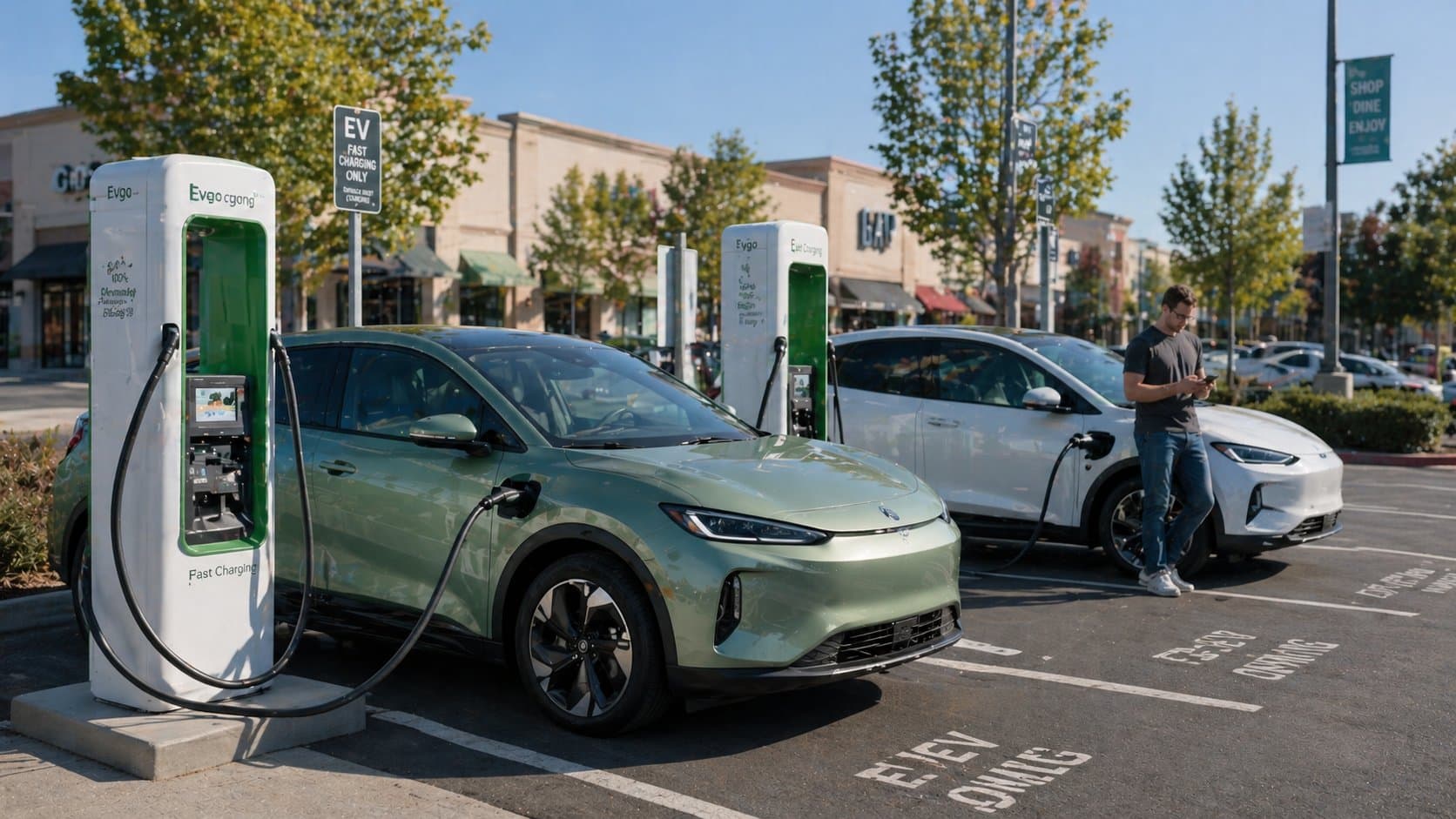
The realistic fast-charging landscape in 2026 looks like this. Tesla Supercharger V4 stations deliver up to 350 kW, with a real-world 10–80% charge time of 15–20 minutes for compatible vehicles (Tesla Model 3/Y, Hyundai Ioniq 5/6, Kia EV6/EV9, and other 800V EVs). Electrify America's fastest stations deliver 350 kW with similar charge times. ChargePoint and EVgo stations typically deliver 150–350 kW depending on location.
For the average EV owner in 2026, the realistic fast-charging experience is 15–25 minutes for a 10–80% charge — not five minutes, but dramatically faster than even two years ago. To budget for charging costs, see our breakdown of EV charging costs explained.
The Timeline to Five-Minute Charging
2026–2027: 400–500 kW Stations Begin Testing
Several charging networks have announced pilot programs for 400–500 kW stations. These will reduce 10–80% charge times to approximately 8–12 minutes for compatible vehicles. However, only vehicles with 800V+ architecture and advanced thermal management will benefit — most EVs on the road today will still charge at their vehicle's maximum rate regardless of the station's capability.
2028–2030: 600+ kW Stations in Limited Deployment
Expect to see 600+ kW stations at highway corridor locations along major interstates. Coverage will be limited to high-traffic routes initially — not neighborhood charging stations or suburban strip malls.
2030+: Widespread Availability
Five-minute charging as a routine, everywhere-available experience is likely a 2030+ reality. The infrastructure build-out, grid upgrades, vehicle compatibility, and economic viability all need to align — and that alignment takes time.
What This Means for Buyers Today
If you are buying an EV in 2026, do not buy based on the promise of five-minute charging. Buy based on today's reality: 15–25 minute fast charging at highway stations, and overnight Level 2 charging at home for daily driving. Both of these are mature, reliable, and available right now.
However, choosing an EV with 800-volt architecture (Hyundai Ioniq 5/6, Kia EV6/EV9, Porsche Taycan) does future-proof your vehicle for faster charging as infrastructure improves. These vehicles will automatically charge faster as higher-power stations deploy — without requiring any vehicle modification.
The Bottom Line
Five-minute EV charging is real technology, not vaporware — but it is 4–5 years away from being a routine consumer experience. The infrastructure, grid capacity, and vehicle compatibility requirements are significant but solvable. In the meantime, 2026's fast-charging reality of 15–25 minutes is already fast enough for road trips and vastly faster than most people expect. Don't wait for five-minute charging to go electric — but do choose an 800V vehicle if you want the fastest path to benefiting when it arrives. Find current public stations and home charging guidance on our charging hub.