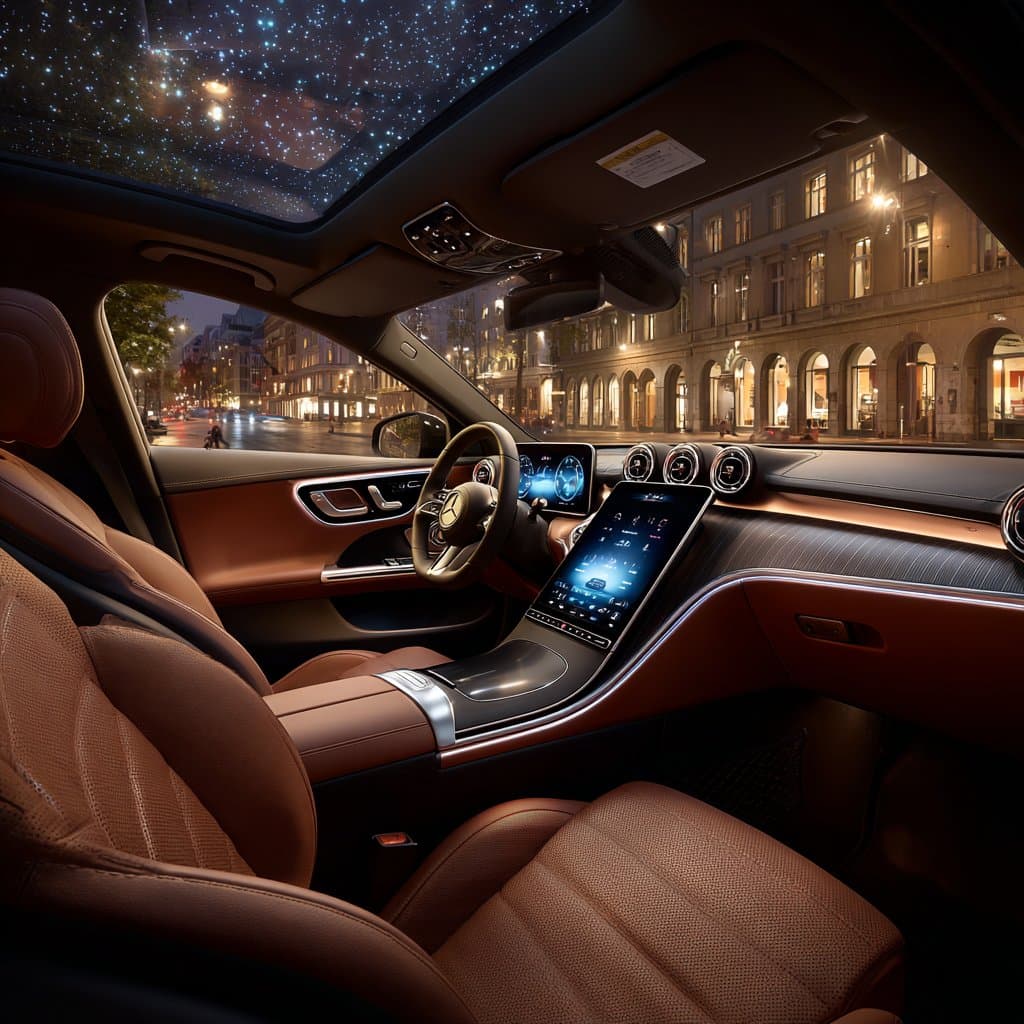
Mercedes-Benz teased it on April 16, and now the full curtain drops tomorrow. The all-new C-Class Electric makes its world debut on April 20, 2026 in Seoul, South Korea — a deliberate choice of venue that signals just how central the Asian luxury market has become to Mercedes's next chapter. But the headline feature isn't the location, the powertrain, or even the silhouette. It's a single, breathtaking piece of glass: a 39.1-inch MBUX Hyperscreen that stretches from one A-pillar to the other, making it the largest screen ever fitted to a production car. In one stroke, Mercedes has turned the dashboard into a statement — and served notice that the company that invented the automobile intends to redefine what a luxury sedan cabin feels like in the electric era.
The 39.1-Inch Hyperscreen: A Technological Flex
Let's start with the obvious question: why 39.1 inches? The simple answer is that Mercedes could. The more interesting answer is that the C-Class Electric's new Hyperscreen is about reclaiming the narrative. For the last half-decade, the largest screens in production vehicles have come from Tesla, BYD, Nio, and Xpeng — brands that built their identities around dashboard real estate. The EQS flagship already carried a 56-inch Hyperscreen, but that display was curved and segmented across three distinct panels. The C-Class's version is different. It is a single, continuous, edge-to-edge display stretching the full dashboard width, and it is the most ambitious piece of automotive glass currently in production.
Customers who want a more traditional layout can opt for the alternative MBUX Superscreen, a triple-display configuration that echoes the approach used in the CLA 250+ Electric. Both setups run on MB.OS, Mercedes's new in-house operating system. MB.OS ships with native Google Maps integration, native Google Places search, and a full complement of Google services, meaning navigation, points of interest, and voice search all inherit the power of Google's cloud stack — while the user interface, vehicle integration, and driver-assistance layer remain firmly under Mercedes's control. There's also an AI-powered assistant capable of contextual suggestions, calendar integration, and increasingly natural conversational interactions.
It is, in short, Mercedes's response to two separate pressures. From the West, Tesla has conditioned buyers to think of the screen as the car. From the East, Chinese luxury brands like Nio, Zeekr, and Li Auto are arriving in Europe with screen-forward cabins that make even the EQS feel restrained. The C-Class Electric's Hyperscreen is Mercedes declaring it can play that game — and win it on its own terms, with better materials, better integration, and better software.
Under the Skin — The MMA Platform
The C-Class Electric rides on the Mercedes Modular Architecture (MMA) platform, the same dedicated electric skateboard that underpins the recently launched CLA 250+ Electric. That shared lineage matters for two reasons. First, it means the C-Class inherits MMA's central advantage: an 800-volt electrical architecture paired with silicon-carbide inverters and industry-leading efficiency. Second, it signals that Mercedes is no longer building bespoke electric flagships on one platform and bespoke electric entry cars on another. MMA is becoming the backbone of an entire generation.
Powertrain details will be officially confirmed at the Seoul reveal, but Mercedes insiders and supplier filings point toward a shared setup with the upcoming GLC EV: a dual-motor arrangement producing 489 PS (360 kW) of combined output, a 94 kWh NMC battery pack, and DC fast charging peaking at up to 330 kW. Mercedes is quoting a WLTP range target of 800 kilometers — roughly 497 miles on the European test cycle. The more sober real-world estimate, once the C-Class lands on EPA test equipment in the U.S., lands in the 350 to 400 mile window. That's still class-leading territory for a midsize luxury electric sedan and puts it squarely ahead of the Tesla Model 3 Long Range, BMW i4, and Genesis G80 Electrified on paper.
The 330 kW DC fast-charging figure deserves a moment of its own. It means a ten-to-eighty-percent replenishment in roughly 20 minutes on a high-capacity charger — comfortably inside the range of a long coffee and bathroom stop. For long-distance drivers, that is arguably the single most important specification in any modern EV, and it places the C-Class Electric among the fastest-charging production vehicles on sale.
Design and Exterior
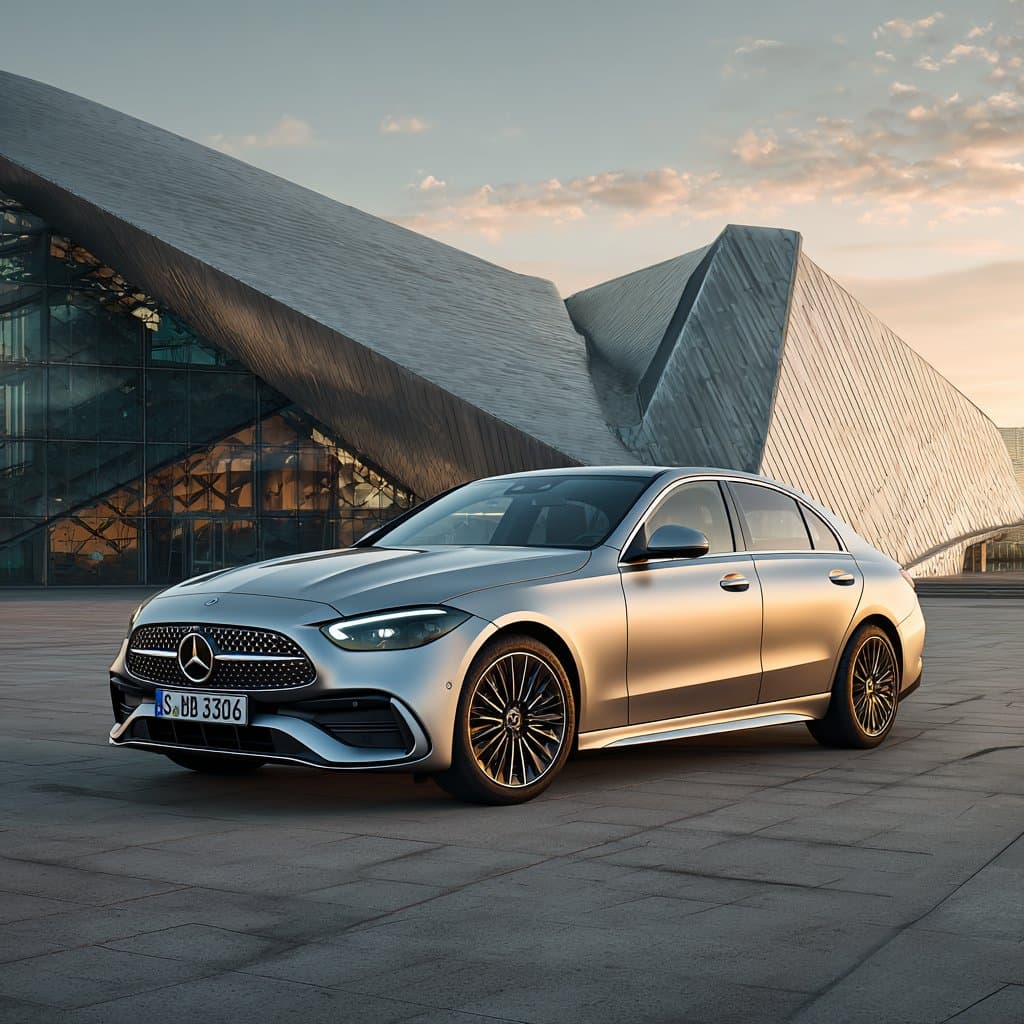
Perhaps the most important choice Mercedes has made with the C-Class Electric is what it is not: it is not an EQ-series experiment. Where the EQE and EQS adopted aggressively futuristic, jellybean silhouettes that divided opinion, the C-Class Electric reimagines the classic three-box sedan with just enough aerodynamic tuning to hit efficiency targets without losing the proportions that made the C-Class a two-million-unit-per-generation success.
Expect a drag coefficient of below 0.24 Cd, achieved through shorter overhangs, a flat underbody, active grille shutters, flush door handles, and carefully tuned wheel aero covers. The front fascia retains the vertical emphasis of the current C-Class but replaces the traditional grille with an illuminated three-pointed star motif. The rear adopts a full-width light bar. The greenhouse is subtly lower and more steeply raked than the combustion C-Class, but not so much that it reads as a dedicated EV. From twenty feet away, this car looks like what buyers have loved about the C-Class for four decades — which is exactly the point.
Mercedes will offer multiple wheel designs ranging from 18 to 20 inches, with the lower-diameter options unlocking the maximum range figure and the larger sizes delivering the aggressive stance that luxury buyers expect on the showroom floor. Exterior colors will include several new matte and pearlescent finishes introduced specifically for the electric line.
Inside — Vegan Options and the Sky Control Roof
The cabin is where Mercedes reveals the full weight of its luxury playbook. Beyond the Hyperscreen, the most interesting interior story is one of materials philosophy. For the first time in a C-Class, buyers can specify a fully vegan interior certified by The Vegan Society. That means no leather, no wool-blend carpets, no animal-derived adhesives — but crucially, no compromise on the tactile richness Mercedes customers expect. The synthetic upholsteries developed for the car use microfiber and recycled-polymer weaves that feel closer to high-grade Nappa than to the vinyls of the 2010s.
Then there is the Sky Control panoramic glass roof. On paper it is a conventional switchable-opacity panorama. In practice, it integrates 162 star-like illuminated LEDs embedded into the headliner, creating a subtle constellation effect at night that echoes the luminous starfield first introduced on the EQS. It is a feature that reads as a gimmick in a spec sheet and as pure magic when you are riding down Ocean Drive at 9 p.m. with the roof tinted and the ambient lighting pulsing gently in the background.
Standard equipment includes four-zone climate control, active noise cancellation, 64-color ambient lighting, Burmester audio on higher trims, heated and ventilated seats front and rear, and a full suite of Level 2+ driver-assistance features with preparation for Level 3 where regulation permits. The rear cabin, often an afterthought in compact sedans, benefits from the flat MMA floor and wheelbase-forward packaging. Legroom and foot space are measurably improved compared with the combustion C-Class.
How It Compares to BMW i3 and Tesla Model 3
The C-Class Electric arrives into a segment that is about to get genuinely crowded. Its two most direct rivals are the upcoming BMW i3 sedan, built on BMW's Neue Klasse platform, and the established Tesla Model 3, which remains the benchmark on price and charging.
The Tesla Model 3 starts at $38,990 and still offers the most extensive Supercharger network in North America. But the Model 3's interior, while improved over earlier generations, remains deliberately minimalist. The C-Class Electric will compete on a completely different axis: materials, finish quality, and badge prestige. There will be buyers who cross-shop these two cars and find that the $15,000 to $20,000 delta is worth every dollar for what the Mercedes delivers in cabin experience. There will be others for whom the Tesla's price-per-mile math is simply unbeatable.
The BMW i3 is the more interesting comparison. BMW's new sedan is expected to price in the $55,000 to $60,000 window, putting it in direct spec-for-spec competition with the C-Class Electric. BMW's advantages are the company's traditional strengths: driving dynamics, steering feel, and potentially longer range given the efficiency targets baked into Neue Klasse. The Mercedes counters with the Hyperscreen, the Sky Control roof, richer interior materials, and an arguably more prestigious badge in the luxury segment. Read our full coverage of the BMW iX3 U.S. launch for context on how BMW is positioning its Neue Klasse vehicles for the American market.
The short version: Tesla wins on price and charging. BMW wins on driving feel and potentially range. Mercedes wins on interior, technology spectacle, and brand cachet. Serious cross-shoppers will want to drive all three back-to-back before committing.
Production and US Availability
Production of the C-Class Electric takes place at Mercedes's plant in Kecskemét, Hungary, which has been extensively retooled for MMA platform assembly. Series production begins in Q2 2026, with European deliveries starting in the summer. The U.S. launch is expected in early 2027 — in line with Mercedes's standard pattern of prioritizing home-market deliveries before shipping volume to North America.
Pricing for the U.S. market has not been officially announced, but the expected starting figure lands around $55,000 before options and destination. One critical caveat for American buyers: because the C-Class Electric is built in Hungary, it will not qualify for the $7,500 federal EV tax credit under current Inflation Reduction Act rules, which require final assembly in North America. This places the C-Class at a structural disadvantage versus domestically assembled competitors like the Tesla Model 3 and Model Y, but it puts it on equal footing with imported luxury rivals like the BMW i4 and Audi A6 e-tron.
Mercedes dealers are expected to begin accepting reservations in late Q3 2026 for early 2027 delivery. Given the combination of segment, spec, and Hyperscreen theater, initial allocation is likely to be tight.
Why This Matters for Mercedes' EV Strategy
Step back from the spec sheet and the C-Class Electric starts to look less like a product launch and more like a corporate pivot. For the better part of six years, Mercedes's EV strategy could be summarized in one word: flagship. The EQS was a six-figure statement. The EQE slotted in just below it. Both vehicles were brilliantly engineered but priced far out of reach for most of the buyers who have kept Mercedes dealerships in business for decades.
That era is over. With the CLA 250+ Electric delivering 370 miles for under $50,000, and now the C-Class Electric extending that playbook into the compact-executive segment, Mercedes is finally bringing MMA — and genuine EV competitiveness — to the price points where the company actually moves metal. The strategic targets are obvious:
First, Tesla's pricing pressure. The Model 3 and Model Y together account for a huge share of luxury-adjacent EV sales, and every year Mercedes loses to Tesla is a year of customer lifetime value evaporating. The C-Class Electric is Mercedes's direct answer. Second, BMW's Neue Klasse momentum. The iX3 and upcoming i3 are the most credible products BMW has built in years, and Mercedes cannot afford to cede the segment. Third, Chinese EV makers, who have quietly launched luxury-segment products in Europe with feature sets that rival or exceed anything from the established German trio. The Hyperscreen is, in part, a direct response to what Nio and Zeekr have done with in-cabin technology.
Taken together, the CLA and C-Class Electric represent the most coherent EV strategy Mercedes has ever articulated. The EQ era was about proving the company could build electric cars. The MMA era is about proving the company can sell them.
The Bottom Line
The C-Class Electric is Mercedes-Benz's most important electric launch of 2026. Not because of its range — plenty of EVs now exceed 400 miles — and not because of its charging speed, which is impressive but no longer unique. It is important because it signals that Mercedes is finally serious about the mainstream luxury EV market. When it arrives at American dealerships in early 2027 at roughly $55,000, it will compete directly with the BMW i3, the Tesla Model 3 Performance, and its own sibling the CLA Electric. That is the field Mercedes needs to win, and the C-Class Electric is the car built to win it.
For the full picture of where Mercedes is heading, read our deep dive on Mercedes steer-by-wire technology arriving in 2026 and our coverage of the CLA 250+ Electric under $50,000. To see how the Neue Klasse rival stacks up, check our BMW iX3 U.S. launch breakdown. And when you're ready to shop today, browse the latest EV deals and incentives for what's available right now.