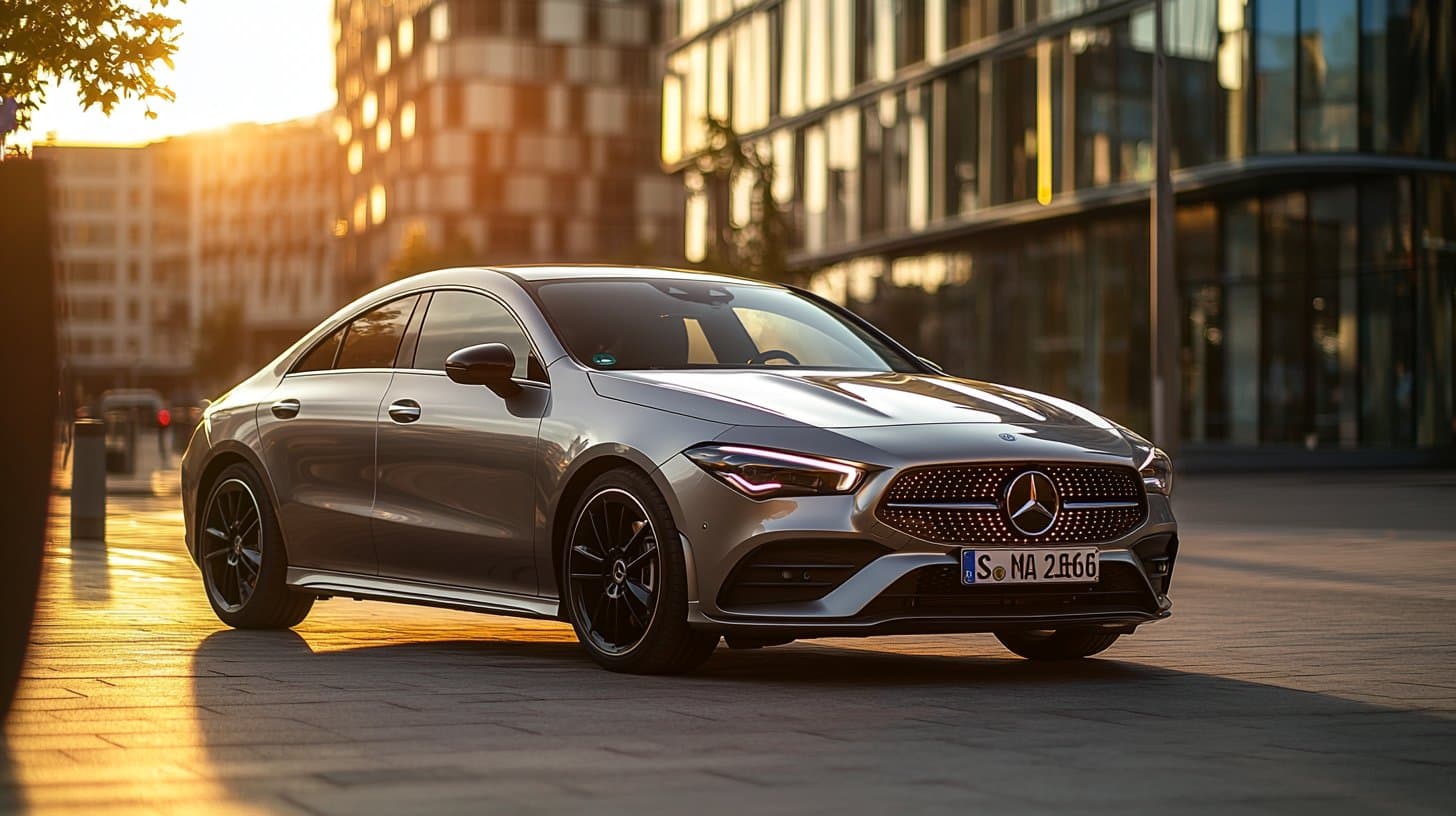
Mercedes-Benz has just done something that seemed unlikely even two years ago: built a fully electric luxury sedan with 370 miles of WLTP range for under $50,000. The CLA 250+ Electric is the first vehicle on Mercedes's new MMA (Mercedes Modular Architecture) platform, and it represents a fundamental shift in how the company approaches electric vehicles. Where the EQS and EQE were engineered as six-figure flagships, the CLA 250+ is engineered to sell in volume — bringing genuine Mercedes luxury to the price point where most Americans actually buy cars.
The Specs That Change the Conversation
Let's start with the number that matters most: 370 miles of WLTP range. For American buyers, the WLTP figure typically translates to an EPA rating approximately 15 to 20 percent lower, which puts the CLA 250+ at an estimated 310 to 320 miles of EPA range. That would make it competitive with the Tesla Model 3 Long Range (315 miles), the BMW i4 eDrive40 (301 miles), and substantially better than the Polestar 2 Long Range (270 miles).
The range achievement is even more impressive when you consider the battery size. The CLA 250+ uses a 69 kWh usable battery pack — significantly smaller than the 75–82 kWh packs used by its competitors. The secret is efficiency. Mercedes claims a class-leading 4.2 miles per kWh (WLTP), which translates to approximately 3.6 mi/kWh under EPA testing conditions. For context, the Tesla Model 3 achieves about 3.8 mi/kWh EPA, and the Hyundai Ioniq 6 leads the segment at approximately 4.0 mi/kWh. The CLA would slot in among the most efficient EVs on the market despite being a luxury vehicle with more sound insulation, heavier materials, and more equipment.
How does Mercedes achieve this? The MMA platform was designed from the outset for aerodynamic efficiency and minimal energy waste. The CLA 250+ has a drag coefficient of just 0.22 Cd — among the lowest of any production sedan. The electric drive unit, developed in-house at Mercedes's new eDrive campus in Stuttgart, uses an 800-volt silicon carbide inverter and a permanently excited synchronous motor with over 93 percent peak efficiency. Every watt is managed with the precision you'd expect from the company that invented the automobile.
MMA: Why This Platform Changes Everything for Mercedes
The CLA 250+ is the inaugural vehicle on the Mercedes Modular Architecture (MMA), and understanding the platform explains why this car matters far beyond its individual specs. Mercedes's previous electric vehicles — the EQS, EQE, EQB, and EQA — were built on two different platforms: EVA2 for the large sedans and SUVs, and a modified combustion-car platform for the compact models. Neither was ideal. The EVA2 cars were expensive to produce, limiting them to the $70K+ price range. The compact EVs were compromised by their shared architecture with gas models, resulting in mediocre range and packaging.
MMA is a ground-up electric architecture designed for volume production at a target price point of $40,000 to $60,000. It's lighter than EVA2, more efficient, and critically, cheaper to manufacture. Mercedes has invested over $5 billion in the MMA platform and its associated factory tooling, with the goal of producing multiple vehicle types — sedans, crossovers, and SUVs — from the same architecture. The CLA is just the first. Expect an MMA-based GLA crossover and GLB compact SUV to follow within 12 to 18 months.
The engineering differences between MMA and EVA2 are substantial. MMA uses a flat battery pack integrated into the vehicle floor structure, similar to Tesla's structural battery approach. This reduces weight, lowers the center of gravity, and improves torsional rigidity compared to a bolt-in battery pack. The front and rear subframes are designed for single-piece aluminum castings (a technique Tesla popularized with the Model Y), reducing part count and assembly complexity. The result is a vehicle that costs less to build while delivering equal or better structural performance.
Interior and Technology: MBUX Superscreen Arrives
Mercedes has never been content to let Tesla own the technology narrative, and the CLA 250+ makes that ambition explicit. The headline interior feature is the optional MBUX Superscreen — a trio of displays that span the entire width of the dashboard, from the driver's A-pillar to the passenger's A-pillar. The driver gets a 12.3-inch instrument cluster, the center stack houses a 12.8-inch OLED infotainment display, and the passenger receives their own 12.3-inch entertainment screen with a privacy filter that prevents the driver from seeing video content while driving.
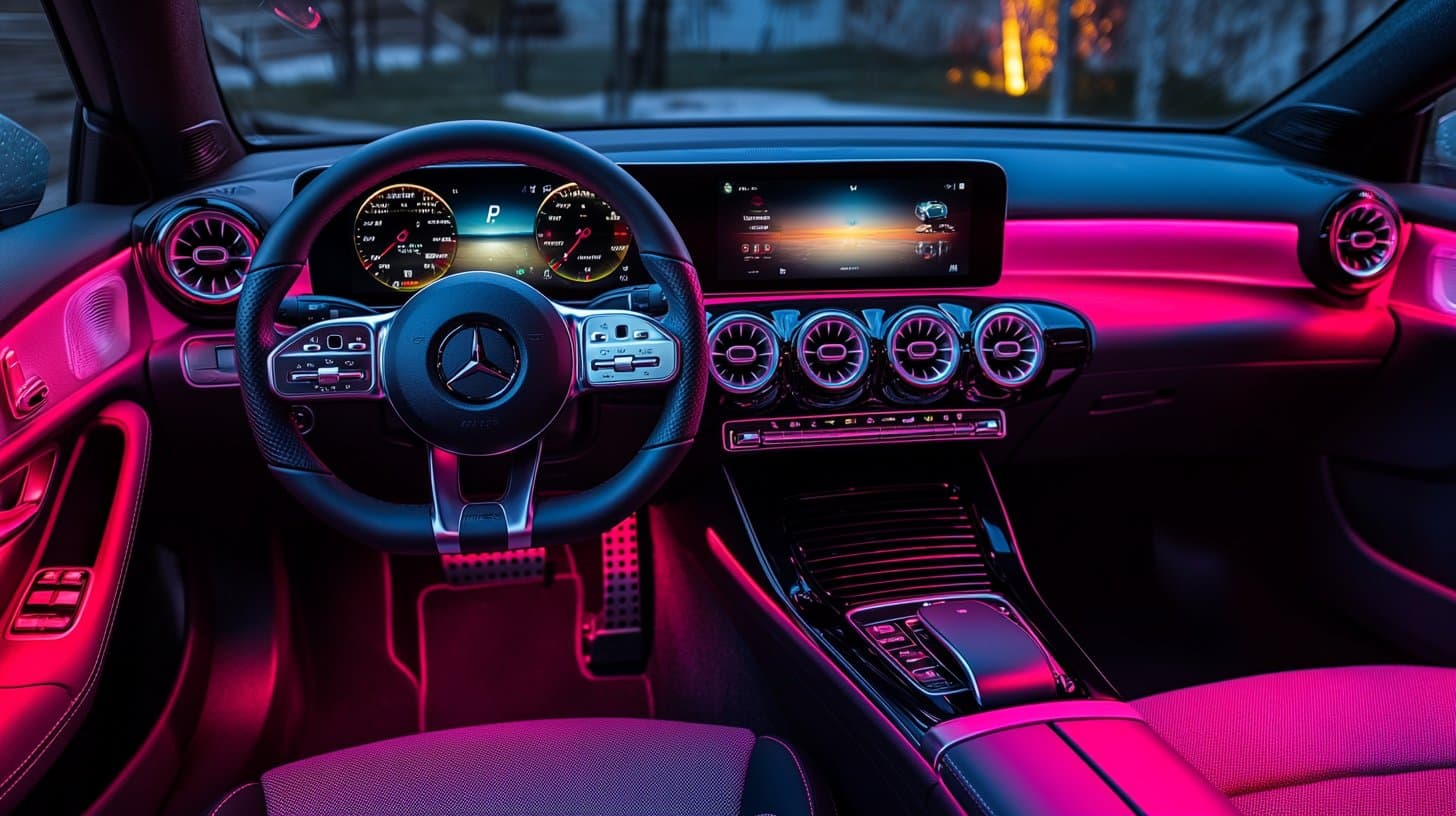
Underneath the screens runs MB.OS, Mercedes's entirely new operating system that replaces the NTG6 system used in current models. MB.OS is built on a unified software architecture that consolidates vehicle functions previously spread across dozens of independent electronic control units. The practical benefit for owners: faster processing, more responsive touch inputs, better voice recognition, and — critically — over-the-air updates that can modify not just infotainment features but also driving dynamics, battery management, and driver assistance behavior.
Google Maps and Google apps are natively integrated, meaning CLA owners get real-time traffic routing, Google Places search, and Google Assistant voice control alongside Mercedes's own MBUX voice system. It's a dual-stack approach: Google handles the content and connectivity layer, while Mercedes controls the vehicle integration and user interface. Apple CarPlay and Android Auto remain available for those who prefer their phone ecosystem.
The CLA 250+ also launches with Mercedes's latest driver assistance suite, including Level 2+ hands-free highway driving assist as standard equipment. An optional package adds hardware and software preparation for Level 3 conditional automation, which Mercedes has already certified for use in Germany and Nevada with the EQS. When regulatory approval expands (expected in additional U.S. states throughout 2026–2027), CLA owners with the Level 3 prep package will receive the capability via over-the-air update.
Competitive Comparison: Where the CLA Fits
Vs. Tesla Model 3 ($38,990 – 272 mi base / 315 mi LR)
Tesla wins on price — there's no way around it. The Model 3 starts $10,000 less than the CLA 250+ and offers a comparable range in its Long Range variant. Tesla's Supercharger network remains the most extensive and reliable in North America. Where the CLA counters: interior quality, ride comfort, noise isolation, and material richness are in a different league. The Model 3's interior is deliberately minimalist; the CLA's is deliberately luxurious. For buyers who spend significant time in their car and value the tactile environment, the Mercedes premium may be worth every dollar. For buyers who optimize purely on price-per-mile, Tesla remains the rational choice.
Vs. BMW i4 eDrive40 ($52,200 – 301 mi)
The i4 has been the default choice for luxury EV sedan buyers who don't want a Tesla, but the CLA 250+ attacks it on two fronts. First, range: the CLA offers an estimated 310–320 EPA miles versus the i4's 301. Second, price: the CLA undercuts the i4 by approximately $3,000–5,000 at comparable equipment levels. The i4 counters with BMW's driving dynamics — it's built on the CLAR platform shared with the 3 Series and delivers a sportier, more connected driving experience. But the CLA's MMA platform is no slouch: Mercedes's engineers tuned the rear-biased weight distribution and adaptive damping for a balance of comfort and agility that early reviewers describe as a significant step up from the EQA and EQB.
Vs. Polestar 2 Long Range ($46,150 – 270 mi)
The Polestar 2 has carved a niche as the stylish Scandinavian alternative, but the CLA 250+ outclasses it on nearly every metric. Range: CLA wins by 40–50 miles. Price: roughly comparable. Brand prestige: Mercedes carries significantly more weight in the luxury market. Technology: MB.OS represents a newer generation of software than Polestar's Android Automotive OS implementation. The Polestar 2's remaining advantages are its distinctive design language and its Google-native infotainment system, which some users prefer for its simplicity. But in a features-per-dollar comparison, the CLA 250+ is the stronger offering.
Charging: 800V Joins the Club
The CLA 250+ uses an 800-volt electrical architecture, enabling DC fast charging at up to 250 kW. Mercedes claims a 10 to 80 percent charge in approximately 30 minutes on a compatible high-power charger. That's competitive with the Hyundai Ioniq 6 and Kia EV6, and faster than the Tesla Model 3 and BMW i4, both of which use 400V architectures.
The 800V system also enables more efficient home charging and better energy recuperation during regenerative braking. Mercedes's onboard charger supports 11 kW AC charging standard and 22 kW AC as an option, the latter enabling a full overnight charge in under four hours on a compatible home EVSE. For the American market, the CLA ships with a NACS port, providing direct access to Tesla's Supercharger network alongside Mercedes's own growing high-power charging partnership with ChargePoint and others.
Why Under $50,000 Matters
The significance of the CLA 250+'s pricing cannot be overstated. Until now, Mercedes's cheapest fully electric vehicle in the United States was the EQB 250+ at approximately $53,050 — and the EQB is a compact crossover with only 243 miles of range. The idea of a three-pointed star on a 300+ mile electric sedan under $50,000 was genuinely unthinkable two years ago.
The sub-$50K threshold matters psychologically and practically. It's the price range where luxury and mainstream markets overlap. A well-equipped Honda Accord, Toyota Camry, or Hyundai Sonata can approach $40,000 today. For an additional $8,000–10,000, a buyer can step into a Mercedes with 370 miles of range, the latest technology, and a badge that carries genuine social currency. The CLA doesn't compete with other luxury EVs so much as it expands the luxury EV market by pulling in buyers who previously considered Mercedes out of reach.
The CLA 250+ is also expected to be eligible for the $7,500 federal EV tax credit if Mercedes meets domestic assembly and battery sourcing requirements. If qualified, the effective starting price would drop to approximately $41,500 — firmly in mainstream territory.
U.S. Availability and Timeline
Mercedes has confirmed that the CLA 250+ Electric will arrive at U.S. dealerships in late 2026 or early 2027. European deliveries begin in Q3 2026 from Mercedes's Rastatt plant in Germany, which has been retooled specifically for MMA platform production. U.S.-bound units will initially be imported from Germany, though Mercedes has hinted at potential future North American production if demand warrants it.
For buyers interested in the CLA, the recommended approach is to place a reservation through your local Mercedes dealer when order books open — expected in Q3 2026 for the U.S. market. Given the combination of range, price, and brand cachet, strong initial demand is virtually guaranteed.
The Bottom Line
The Mercedes CLA 250+ Electric is the car that makes the luxury EV transition feel real for a much wider audience. It's not a $100,000 technology showcase. It's not a compliance car built to meet regulations. It's a genuine volume play from a genuine luxury brand, priced to compete with mass-market vehicles while delivering the materials, technology, and engineering that justify the Mercedes badge. With 370 miles of WLTP range, 800V charging, MB.OS, and MBUX Superscreen, it represents the most complete package Mercedes has offered in the electric space — and the most accessible.
For more on how Mercedes is pushing EV technology forward, read our coverage of Mercedes steer-by-wire coming in 2026. To see how the CLA compares against other luxury competitors arriving this year, check the BMW iX3 U.S. launch details and our Polestar vs. Tesla comparison. And browse the latest EV deals to see what's available right now while you wait for the CLA to arrive.